If your BMW i3 won’t start, the first thing to suspect isn’t the main battery pack, it’s the small 12V battery that boots the car’s electronics. The i3 runs two separate power systems, and the 12V has to wake up before the high-voltage pack is allowed to do anything. When that small battery fails, you can have a full charge sitting in the car and still get nothing. Once you know where the 12V lives and how to get in, you can usually get it moving again in a few minutes.
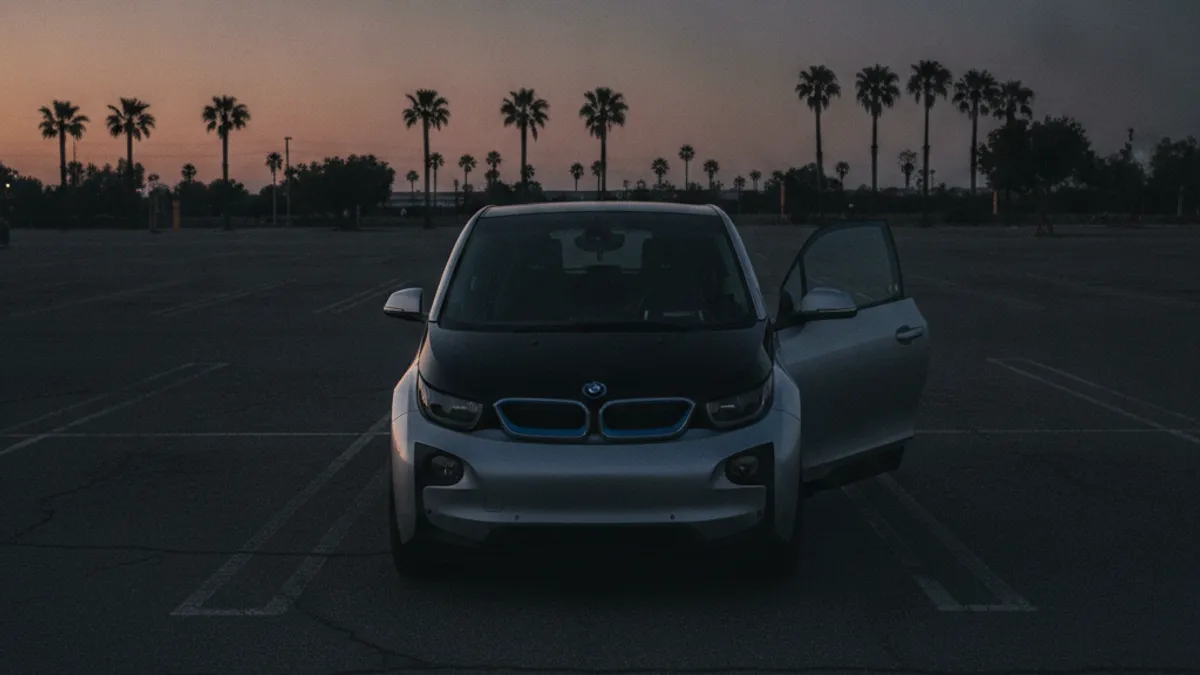
The i3 is one of the older EVs on San Diego roads today, and a lot of them are right in the window where 12V batteries start giving out. If yours went quiet in a driveway in North Park or a parking garage downtown, this guide walks through what’s happening and what to do about it.
Why a BMW i3 won’t start or wake up
The i3 has two power systems working together. A high-voltage traction pack moves the car, and a small 12V battery boots every low-voltage system, including the computers that let the high-voltage pack engage. If the 12V is dead, the car stays unresponsive no matter how much range is sitting in the main battery.
That failure shows up in two different ways. The first is a totally dark car. The fob does nothing, the screens stay black, and there’s no chime when you approach. The second is the notorious “Drivetrain malfunction: stop carefully, do not continue driving” warning, where the screens and radio may still power up but the car won’t shift out of park. Both of these very often trace back to the same weak link, the 12V system.
Owners assume the big battery failed. It almost never has. For the broader mechanics of why this happens across EV brands, read what happens when an EV 12V battery dies.
Why the i3 is prone to this right now
BMW sold roughly 45,000 i3s in the US between 2014 and 2021, then dropped it from the US lineup after the 2021 model year. That means the oldest i3s on the road are now 12 years old, and every US i3 is at least in its fifth year. A good number of them landed in California, and San Diego has plenty. That puts the i3 squarely in the age range where 12V batteries wear out.
Owners who dig into their no-start problems consistently land on the same short list of causes. An aging 12V AGM battery is the most common one. Loose or corroded 12V terminals are another, and they’re an easy thing to miss on a quick look. DC-DC converter trouble is a third, since that’s the part responsible for keeping the 12V topped up while the car runs, and if it’s failing, the 12V slowly starves even if the battery itself is fine. Repeated deep discharges finish off a weak battery faster than normal use ever would. In rare, worse cases the fault sits deeper in the drive electronics and needs a dealer to sort out.
Inland heat makes all of this worse. Cars sitting in El Cajon, Escondido, or Santee bake through the day, and lead-acid batteries age faster in that kind of heat, especially when they’re sitting at a low charge. If your i3 lives inland, we cover El Cajon and the rest of East County directly. Coastal cars aren’t off the hook either. Plenty of city-core i3s do short hop after short hop and never get a full recharge cycle on the 12V, which wears it down a different way.
It’s not just the i3 either. BMW’s newer EVs have their own documented 12V issues, which we cover in why BMW i4 and iX models get a dead 12V battery. If your i3’s 12V is original or unknown, a load test settles it fast, and our 12V battery replacement guide covers what that process looks like.
How to get into a locked i3 when the 12V is dead
A dead 12V can leave the fob unable to talk to the car, which locks you out the normal way. The fob hides a mechanical key blade for exactly this situation. Press the release button on the fob and slide the blade out.
Head to the driver’s door handle. There’s a small cover over the mechanical lock cylinder built into the handle. Use the key blade to pop that cover off, then insert the blade into the cylinder and turn it to unlock the door. That gets you into the cabin with zero power in the car.
Where the 12V is, how to jump it, and the frunk gotcha
The i3’s 12V battery sits in the front compartment, under the frunk insert. The insert tray has to come out before you can actually reach the battery. For jumping, use the dedicated jump points in the front compartment rather than the battery posts directly. The positive terminal sits under a red plastic cap. Ground the black clamp to a bare-metal stud or an unpainted chassis point, never to the battery’s own negative post.
Here’s the part that catches people off guard. With a completely dead 12V, the hood release sometimes won’t respond at all, since it’s an electrical release and there’s no power to trigger it. Some owners have gotten around this by unlocking the driver’s door with the key blade, lifting the rear cargo-floor carpet, unscrewing the access panel underneath, and feeding 12V power to the terminals exposed there. That wakes the car up enough to pop the hood open. Confirm this exact procedure against your model-year owner’s manual before you try it, since access details can vary by year. Honestly, this is exactly the kind of situation where calling mobile rescue is a lot easier than working through it in a parking lot.
There’s a slower fix a lot of i3 owners swear by too. Plugging the car into a Level 2 charger and just letting it sit can bring it back on its own. The i3 has an emergency circuit that slowly recharges the 12V straight from the charge port. It takes a while, sometimes a few hours, but it has revived plenty of “dead” i3s without a jump at all. For a full walk-through on jumping any EV safely, read how to jump start an EV safely.
After a jump or a fresh 12V, don’t be surprised if a warning like the drivetrain fault message sticks around on the dash. A lot of these clear on their own overnight once the system finishes rebooting. If one doesn’t, owners commonly clear stored codes with an OBD dongle and the BimmerLink app. If the same fault keeps coming back with a healthy, tested 12V in place, that points to something deeper and it’s worth a proper diagnosis rather than repeated jumps.
Running low on range too
Sometimes the i3 isn’t refusing to start, it’s just out of charge. The earliest 2014 to 2016 cars shipped with a small 60Ah pack rated around 81 miles when new, and a pack that age holds noticeably less today. Plenty of i3s around town simply run out before the driver expects it. Even the REx version, with its small gas range extender, still needs a healthy 12V to start at all, so a dead 12V and a low pack can look identical from the driver’s seat until you check both.
If you’re stuck on charge rather than power, our mobile EV charging service can bring enough juice to get you moving, and our out of charge recovery service is built for exactly this situation.
Common BMW i3 no-start scenarios
| What you see | Most likely cause | What to do |
|---|---|---|
| Fob does nothing, dash and screens dark, no chime | Dead 12V battery | Key-blade entry, then jump the 12V in the front compartment |
| Screens power up, “Drivetrain malfunction” warning, won’t shift out of park | Weak or dying 12V | Jump it, clear codes if the warning lingers |
| Hood release won’t respond at all | Completely dead 12V | Confirm the manual’s rear-access procedure or call for rescue |
| Starts after a jump, dies again within days | 12V near end of life or DC-DC converter fault | Load test the battery and have the converter checked |
| Car sat unplugged for weeks, now dead | Slow drain from short trips or age | Try a Level 2 charge session, then jump if needed |
| No donor car or charger nearby | No power source on hand | Call mobile rescue with a jump pack |
When to stop and call for rescue
If the key blade won’t turn, if the hood release won’t open no matter what you try, or if the car won’t wake up after a clean jump, stop there. Forcing a lock cylinder or feeding power into the wrong spot can turn a simple fix into an expensive one. The same goes for an i3 that’s dead in a tight parking structure or on the shoulder of I-15 or I-805, where working under the hood yourself isn’t safe.
That’s where we come in. Charge Pro SD runs mobile non-Tesla EV rescue across San Diego County, from city-core neighborhoods like North Park and Hillcrest to inland heat zones like El Cajon and Escondido where 12V batteries wear out fastest. We carry what it takes to get into a locked i3, jump the correct points, load test the 12V, and top up your charge if range is also low. Typical arrival is 25 to 60 minutes. For a wider look at what roadside help covers, see our EV roadside assistance guide.
Frequently asked questions
Why won’t my BMW i3 start or turn on?
The most common reason is a dead or weak 12V battery, not the high-voltage traction pack. The i3 needs the 12V to boot its computers before the main system can engage, so a dead 12V leaves the car unresponsive even with plenty of range in the pack. You’ll either get a totally dark car or a “Drivetrain malfunction” warning that won’t let you shift out of park. Jump or replace the 12V first, and if the car still won’t wake up, it likely needs a dealer diagnosis.
How do I get into a locked BMW i3 if the 12V is dead?
Use the mechanical key blade hidden inside the fob. Press the release button and slide the blade out. On the driver’s door handle, pop off the small cover over the mechanical lock cylinder with the blade, then insert it and turn to unlock the door. That works even with zero power in the car.
Where is the 12V battery on a BMW i3?
It’s in the front compartment, under the frunk insert. You have to pull the tray out to reach the battery itself. For jumping, use the dedicated jump points in the front compartment rather than the battery posts directly, with the positive terminal under a red plastic cap.
What if the hood won’t open because the 12V is completely dead?
That’s a known frunk gotcha on these cars. Some owners have restored enough power to pop the hood by unlocking the driver’s door with the key blade, lifting the rear cargo-floor carpet, and feeding 12V power to the terminals under the access panel back there. Confirm the exact steps in your model-year manual first, and if that feels like too much, this is a good moment to just call mobile rescue.
Can a BMW i3 recover on its own if I just plug it in?
Sometimes, yes. The i3 has an emergency circuit that slowly recharges the 12V through the charge port when it’s plugged into a Level 2 charger. It can take a few hours, but it has brought a lot of “dead” i3s back to life without a jump at all.
Does Charge Pro SD come out to a BMW i3?
Yes. We cover all non-Tesla EVs across San Diego County, including the i3. Our truck carries the gear to open a locked car, jump the correct 12V points, assess whether the battery needs replacing, and add a charge if you’re also low on range. Call us at (858) 400-4465 and we’ll walk you through it or head your way.
If your BMW i3 is sitting dark in a driveway in North Park, a parking structure downtown, or on the shoulder of I-15, we can help. Call Charge Pro SD at (858) 400-4465 and we’ll be on our way.