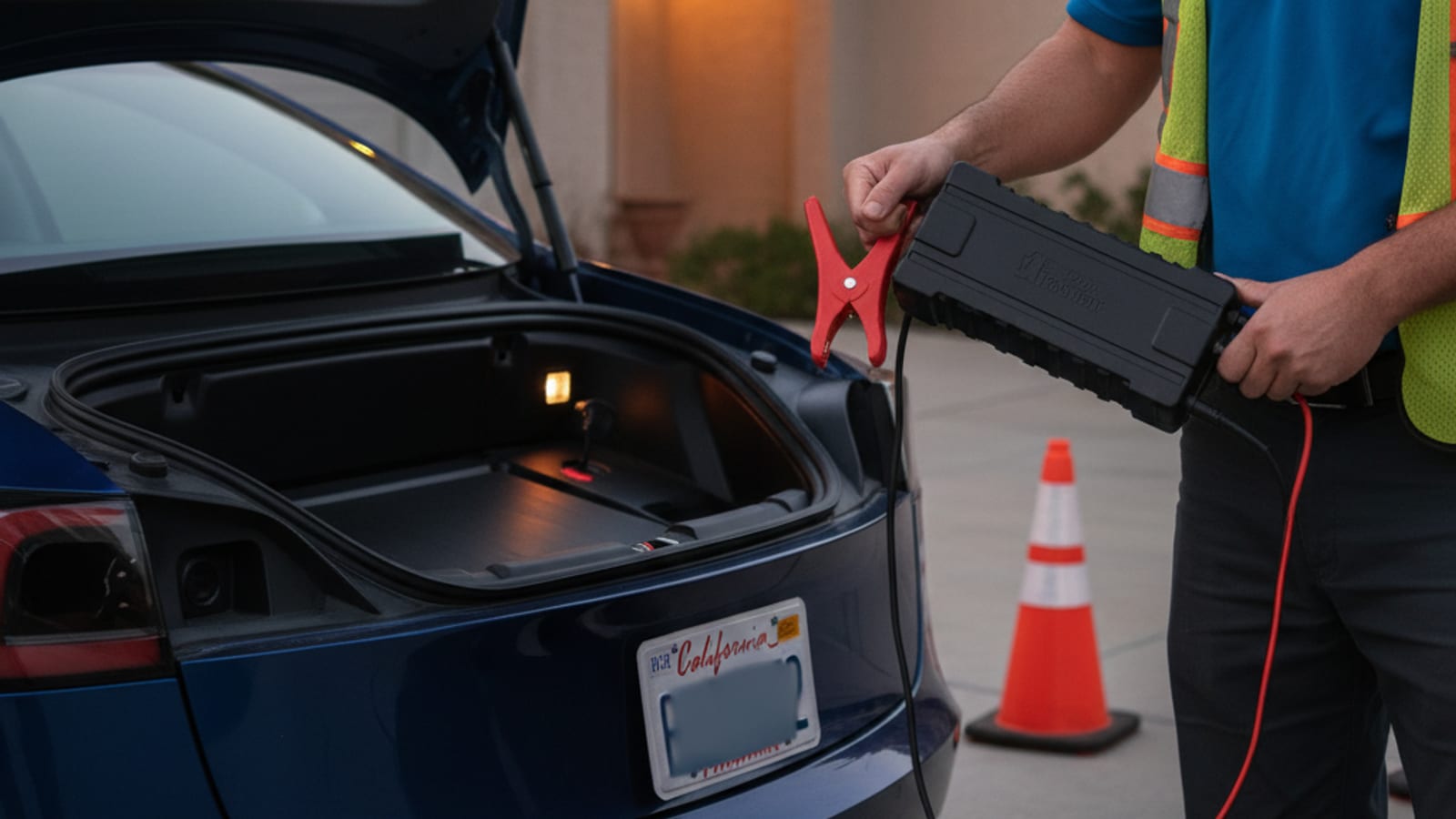
Every EV still has a 12V battery. It runs the screens, the locks, the contactors that connect the big traction pack. When the 12V dies, the car is a brick regardless of how full the traction pack is. The fix is a jump start — but the process differs from a gas car in ways that matter. Do it wrong and you can damage a four-figure DC-DC converter. Do it right and you’re back in business in five minutes.
Here’s how to jump an EV safely, what tool to use, and the specific access points for the EVs we see most in San Diego County.
Why jumping from another car is a bad idea
A running gas car puts out anywhere from 13.8 to 14.8 volts at its alternator, with the ability to surge much higher momentarily. Across a battery-to-battery cable transfer, the dead side sees voltage spikes and large current swings.
Gas 12V systems tolerate this. EV 12V systems are wired into sensitive DC-DC converters, body control modules, and battery management systems. A voltage spike or reverse polarity can fry any of those. The repair bills start at $800 and go past $3,000.
Tesla specifically warns against jumping from another vehicle. Rivian, Ford, and Hyundai service manuals all echo the warning. Every EV maker wants you to use a dedicated jump pack.
The right tool: a lithium jump pack
A lithium jump pack (also called a jump starter or jump box) is a portable battery with jumper leads built in. It puts out a controlled 12V at moderate amperage — enough to wake a dead 12V battery, not enough to spike a DC-DC converter.
Any of these work:
- NOCO Boost Plus GB40 (1,000A, ~$100). Gold standard. Big enough for trucks.
- NOCO Boost Sport GB20 (500A, ~$70). Plenty for any EV’s 12V.
- GOOLOO GP4000 (~$130). Larger reserve, good for multiple jumps.
Any pack rated 400+ peak amps with proper reverse-polarity protection is fine. Keep it in the frunk or trunk. Charge it every 3 months. It’s the single cheapest piece of insurance for EV ownership.
The safe jump procedure
Same process for any EV with any lithium jump pack.
- Check the pack is charged. Most have LED indicators. If the pack is below 50%, charge it first.
- Locate the 12V access points. Model-specific — see below.
- Connect positive first. Red lead to positive terminal or marked red post. A green “good connection” LED usually lights up.
- Connect negative. Black lead to the marked negative ground. Never to the negative battery post in a gas-car-style clamp. Use the designated ground if available.
- Wait 30 seconds. Let voltage equalize.
- Try to wake the car. Press a door handle, tap the app, open the driver’s door.
- Once the car wakes, leave the jump pack connected for 2 more minutes. This gives the main pack’s DC-DC converter time to kick in and take over.
- Disconnect negative first, then positive.

Brand-specific access points
Tesla Model 3 and Model Y
The tow-eye cover on the front bumper, driver’s side, pops off to reveal two pigtail leads — red positive and black ground. Connect the jump pack here.
Once the frunk releases (about 30 seconds after connection), you can open the frunk and access the real 12V battery for a full 2-minute charge before driving.
Tesla Model S and X (2021+)
Front door manual releases. Inside the car, pull the frunk release under the carpet. Open the frunk. Jump directly on the 12V terminals inside.
Tesla Model S and X (pre-2021)
Tow-eye access on the front fascia, same process as Model 3/Y.
Rivian R1T and R1S
Power frunk release on the fob. If the 12V is dead, the fob release won’t work. Use the manual release — a small pull cord behind the grille, accessible by removing a cover plate with a Phillips screwdriver. Once the frunk is open, the 12V sits under a panel on the passenger side. Jump on the positive post and a marked ground stud.
Ford F-150 Lightning
Power frunk release won’t work if the 12V is dead. Mechanical release is under the truck’s front bumper — a small pull loop. Once the frunk is open, the 12V is on the driver’s side. Standard post-style terminals.
Hyundai Ioniq 5, Kia EV6 and EV9
These EVs hide the 12V under the rear trunk floor (under the spare tire area). Because the 12V is in the back, they also provide jump terminals in the engine bay (front “frunk”) — a red positive post and a ground marked with a bolt and ground symbol. Jump from the front access points.
Chevrolet Bolt
12V is in the rear cargo area, under the load floor. Front-access jump terminals are in the engine compartment — a red positive under a cap, and a ground stud. Jump from the front.
Polestar 2
12V sits in the frunk. If the frunk won’t open, there’s a manual release cable behind the driver-side headlight housing. Standard post terminals inside.
Ford Mustang Mach-E
12V in the rear cargo area. Jump posts in the frunk, clearly labeled. Open the frunk from the app if it still works — if not, there’s a manual cable release behind a kickplate on the driver’s side floor.
Red to red, black to ground. A modern jump pack will refuse to deliver current if leads are reversed, but older packs and improvised cables won’t. Reverse polarity on an EV can destroy the DC-DC converter — a $1,500+ repair.
After the jump
Once the car is awake, drive it or plug it in. Either action gets the main pack’s DC-DC converter topping up the 12V properly. Fifteen minutes at a Level 2 charger or 20 minutes of driving should fully recondition the 12V.
If the 12V dies again within 24 hours, it needs replacement. A jump is a band-aid on a failing battery, not a fix.
Signs your 12V is failing (before it strands you)
- Dash warning “12V battery service needed.”
- Slower-than-normal waking from sleep.
- Random brief resets of the infotainment.
- App loses connection frequently when parked.
- Battery is over 4 years old (for AGM) or 8 years old (for lithium).
If you see these, replace the 12V before it dies in your garage. Replacement is a 30-minute job. In-shop cost is $100 to $200 for the part plus $50 to $150 labor. We do mobile 12V replacement too — same price range, we come to you.
When to call us
Call (858) 400-8901 if:
- You don’t have a jump pack and can’t get a ride to buy one.
- You jumped the 12V and it won’t hold — it’s going to need replacement.
- Your traction pack is also low and you need both a jump and a charge.
- You’ve locked yourself out of the frunk (common on Rivian and Lightning without the manual release).
Our trucks carry lithium jump packs, common 12V replacement stock for Tesla, Rivian, Ford, and Hyundai, and a 240V Level 2 outlet in the bed for topping off a main pack once the 12V is awake.
See EV roadside assistance, Tesla 12V battery jump, and non-Tesla EV rescue for full service details.
Dead 12V in San Diego County? Call (858) 400-8901. We arrive with the right pack, the right replacement, and the right cable — no guesswork, no second truck.