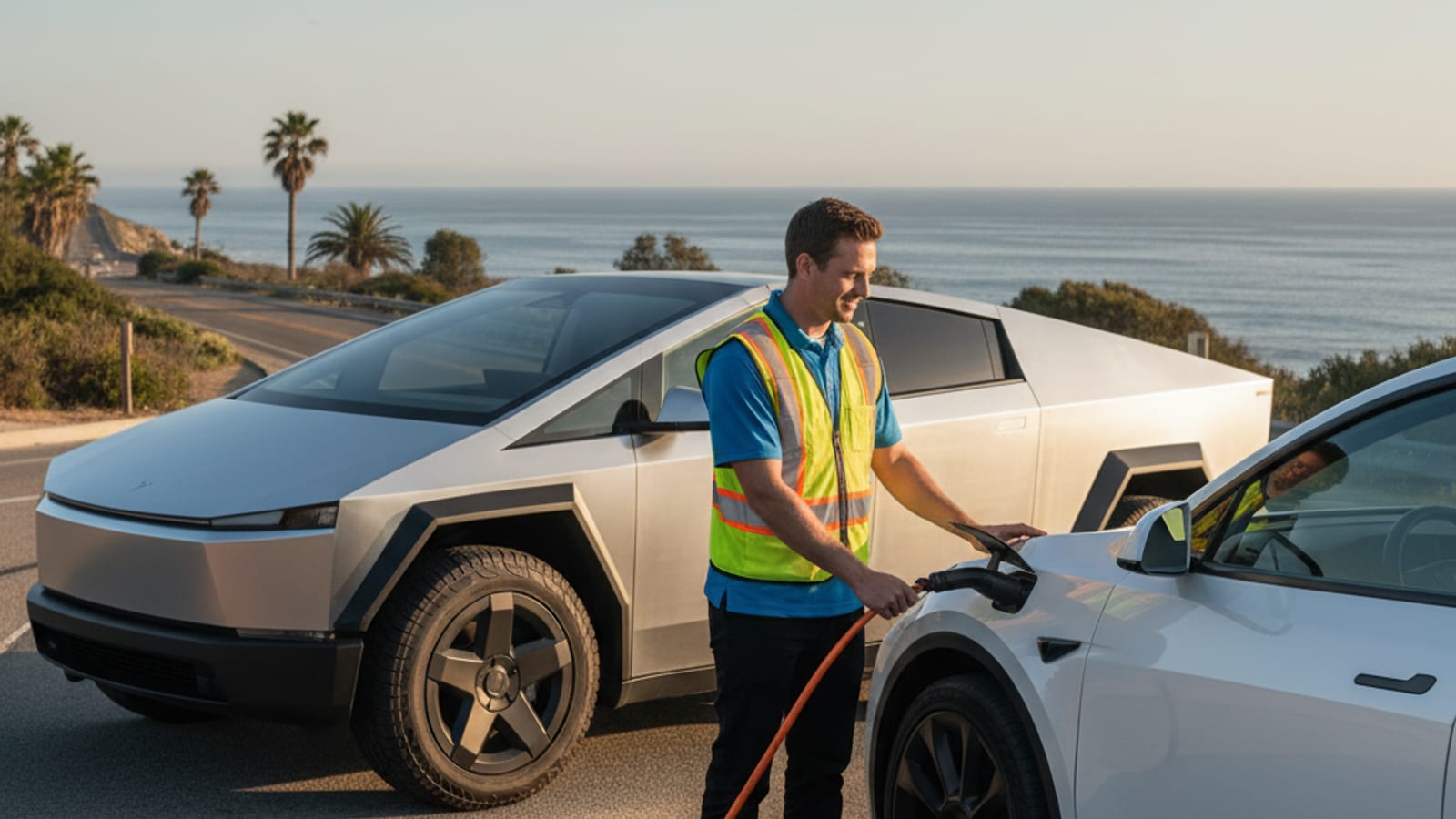
An EV breakdown is not a gasoline breakdown. Charge Pro SD is a referral for possible on-scene charging, not a specialized Charge Pro crew that covers every major EV brand. EV roadside assistance is the matching start. This page will not freeze a national adoption ranking.
Why EV roadside assistance is different
Traditional roadside services are built around internal combustion engine (ICE) vehicles. They focus on fuel delivery, jump-starting 12V batteries, or towing. EVs, though, have distinct needs. They don’t run on gasoline. Their “fuel” is electricity. Their batteries are complex. Towing an EV incorrectly can cause serious damage.
San Diego has coastal grades, inland heat, and uneven public stalls. Confirm live, vehicle-compatible stations. This page will not freeze Tesla density in La Jolla or Del Mar.
Common EV roadside scenarios in San Diego
EVs generally have fewer moving parts than ICE cars. This often means less maintenance. Still, specific issues can leave you stranded.
- Out of charge: This is the most common EV-specific roadside event. Long grades and inland heat change remaining range. Check live, vehicle-compatible stalls on I-5 north of Oceanside rather than assuming a charger on Camp Pendleton. This page will not freeze a 20-mile desert, a 1,500-foot I-8 climb, or a 10-20% heat cut.
- Flat tires: A flat can leave you stuck on I-5 or I-15. Many EVs ship without a spare. Charge Pro does not catalog tire jobs.
- The car will not wake: That is not proof of a 12V failure. Chemistry varies by model and year. See Tesla 12V battery dead diagnosis. Use that year’s Tesla book.
- Software glitches: A restart might clear it. Charge Pro does not diagnose software.
- Charge port issues: A stuck cable or a port that will not take a charge can happen at a public stall or at home. See EV charge port won’t release.
What EV roadside help can include
When you need help for an EV, a gasoline playbook may not fit. Charge Pro SD is a referral. An independent operator confirms tools they actually carry.
Mobile EV charging
A mobile charger, when an independent operator can work the pin, brings charging hardware to the car. That is not an invaluable Charge Pro rescue and not a promised hop to a fast charger or home. Confirm live stalls around Anza-Borrego or Julian rather than assuming sparse means none.
Charge Pro SD is a referral. We do not publish a 240V / 9.6 kW bed outlet, a NACS plug, or a CCS adapter as Charge Pro equipment. An independent operator confirms what they actually carry, whether they can work the pin, price, and timing. You pay them.
Flat tire service
Charge Pro SD does not catalog tire repairs. If the independent operator offers a tire job, they confirm that. Otherwise arrange a shop tow through that operator or on your own.
12V battery jump-start or replacement
Low-voltage chemistry varies. Charge Pro does not jump or replace 12V batteries as a Charge Pro crew. How to jump start an EV safely is a matching start. Use that year’s owner book. Do not treat a jump pack as universal.
EV-specific towing
Many makers specify a flatbed. Check that year’s owner book. Charge Pro SD does not focus on charging instead of towing as a Charge Pro crew. When a flatbed is the job, Quick Tow SD is a San Diego flatbed operator. Confirm their current practice on the call.
Choosing the right EV roadside assistance in San Diego
Public stall counts change. Confirm live, vehicle-compatible stations. East County and mountain roads often show fewer public options than the coast. This page will not freeze a 2,000-port inventory.
When selecting an EV roadside provider, consider these factors:
- Equipment: Charge Pro publishes no NACS or CCS kit as Charge Pro equipment. Ask the independent operator what they carry.
- Knowledge: Charge Pro does not employ EV technicians. The operator confirms whether they can work that car.
- Local questions: Can they work that pin, including East County and coastal freeways? Confirm live stalls rather than a remembered charger desert.
- Timing: The operator states their own window on I-805, SR-163, or SR-52. Charge Pro does not publish a Charge Pro arrival clock.
Charge Pro SD in San Diego
Charge Pro SD is a referral for EV roadside matching in San Diego County, not a Charge Pro rescue built for every I-15 or Mission Valley pin. Charge Pro owns no trucks. The operator confirms the job.
Charge Pro SD is a referral. We do not publish a 240V / 9.6 kW bed outlet, a NACS plug, or a CCS adapter as Charge Pro equipment. An independent operator confirms what they actually carry, whether they can work the pin, price, and timing. You pay them.
| Service Feature | Charge Pro SD referral | Traditional roadside |
|---|---|---|
| Out-of-charge | Possible on-site charge if the operator can work the pin | Often a tow to a charger or home |
| Low-voltage | Operator confirms. Charge Pro does not jump or replace 12V | Jump-start policies vary |
| Flat tire | Charge Pro does not catalog tire repair | Tire or tow policies vary |
| Connectors | Operator confirms what they carry. No Charge Pro NACS/CCS kit | Not a Charge Pro spec |
| Vehicle | Independent operator vehicle, not a Charge Pro truck | Tow truck or service van |
| Goal | Feasibility confirmed on the call | Move the vehicle |
| San Diego | Listed county matching | Provider’s own coverage |
Preventing EV strandings in San Diego
Preventing a breakdown is always better than reacting to one. Here are some tips for San Diego EV drivers:
- Plan your routes carefully: Use in-car navigation or a live map you trust. Check compatible stalls on I-5 north of Oceanside rather than assuming a charger on Camp Pendleton. For Anza-Borrego or Julian, map stops before you go. The California Energy Commission publishes charging infrastructure material: https://www.energy.ca.gov/.
- Monitor your range: Don’t push your range limits. Always aim for a comfortable buffer. Remember that hot inland temperatures (e.g., in El Cajon or Santee) can reduce your actual range.
- Charge at home on SDG&E’s live EV rates. Off-peak hours belong on SDG&E, not as frozen midnight-to-6 AM hours on this page.
- Check tire pressure regularly: Proper tire pressure improves efficiency and reduces the risk of flats. EVs are heavy, so tire condition is important.
- Understand your 12V battery: Know the signs of a failing 12V battery. Many EV owners overlook this small but critical component. Regular checks can prevent a no-start situation.
- Keep emergency contacts handy: Store Charge Pro SD’s number in your phone: (858) 400-4465.
What to do if your EV is stranded
If you find yourself stranded in San Diego, stay calm and follow these steps:
- Safety first: If you can, get out of the travel lane. Hazards on. If the car is in a traffic lane or another dangerous place, call 911. NHTSA publishes general roadside safety material: https://www.nhtsa.gov/.
- Note what you see: Flat tire, empty pack, or a car that will not wake. Charge Pro does not diagnose a 12V failure on the phone.
- Contact roadside assistance: Call Charge Pro SD at (858) 400-4465. Provide your exact location. Mention any landmarks, freeway exits, or cross streets. Be specific about your vehicle’s make and model. Describe the problem clearly.
- Stay out of the travel lane. If the car is in a traffic lane, call 911. Charge Pro does not send a Charge Pro crew. An independent operator confirms their own window.
- Conserve power: If your EV is out of charge, turn off non-essential accessories like climate control or infotainment to preserve any remaining power for safety systems.
For more detailed steps, refer to our blog post: Out of charge on freeway: what to do.
Charge Pro SD’s approach to EV roadside rescue
Charge Pro SD is a referral, not San Diego’s dedicated mobile EV rescue. There is no Charge Pro mission to provide fast solutions.
Charge Pro SD is a referral. We do not publish a 240V / 9.6 kW bed outlet, a NACS plug, or a CCS adapter as Charge Pro equipment. An independent operator confirms what they actually carry, whether they can work the pin, price, and timing. You pay them.
Charge Pro does not eliminate a tow in most out-of-charge jobs and does not get you to a nearby DC fast charger. Mobile EV charging and out-of-charge recovery are matching starts. The operator confirms feasibility.
Frequently asked questions
What happens if my EV runs out of battery in San Diego?
If the pack is empty, pull over if you can do it safely. If the car is in a traffic lane, call 911. Then call Charge Pro SD at (858) 400-4465 for a referral. Charge Pro does not bring mobile charging as a Charge Pro crew.
Can a regular tow truck tow an electric vehicle?
A regular tow truck can move an EV only if the operator uses the method that year’s owner book requires, often a flatbed. Charge Pro SD does not prioritize on-site charging to avoid towing altogether.
Does my EV’s manufacturer provide roadside assistance?
Most EV manufacturers, including Tesla, offer some form of roadside assistance, often included with the vehicle warranty. This coverage can vary in scope and duration. It’s wise to understand what your manufacturer’s plan covers and its limitations. For Tesla drivers, you can check their support page: https://www.tesla.com/support.
How long does it take to charge an EV with mobile assistance?
Charge Pro SD does not publish a 5-10 mile rescue, a 15-30 minute session, or an operator 9.6 kW charger as Charge Pro equipment. A rescue charge, if the operator can do it, is enough to move. That amount is confirmed on the call.
Are there specific areas in San Diego where EVs are more likely to get stranded due to lack of chargers?
Check live maps. East County towns such as Alpine, Ramona, and Julian often show sparser public stalls than the coast. Camp Pendleton access is a separate security question. This page will not call any corridor a charger desert.
Charge Pro SD is a referral when an EV is stuck in San Diego County. Charge Pro does not keep drivers moving as a Charge Pro crew and does not publish a peace-of-mind guarantee.
Call Charge Pro SD at (858) 400-4465 for a referral. EV roadside assistance is the matching start. Charge Pro does not run dedicated Charge Pro rescue anywhere in the county.