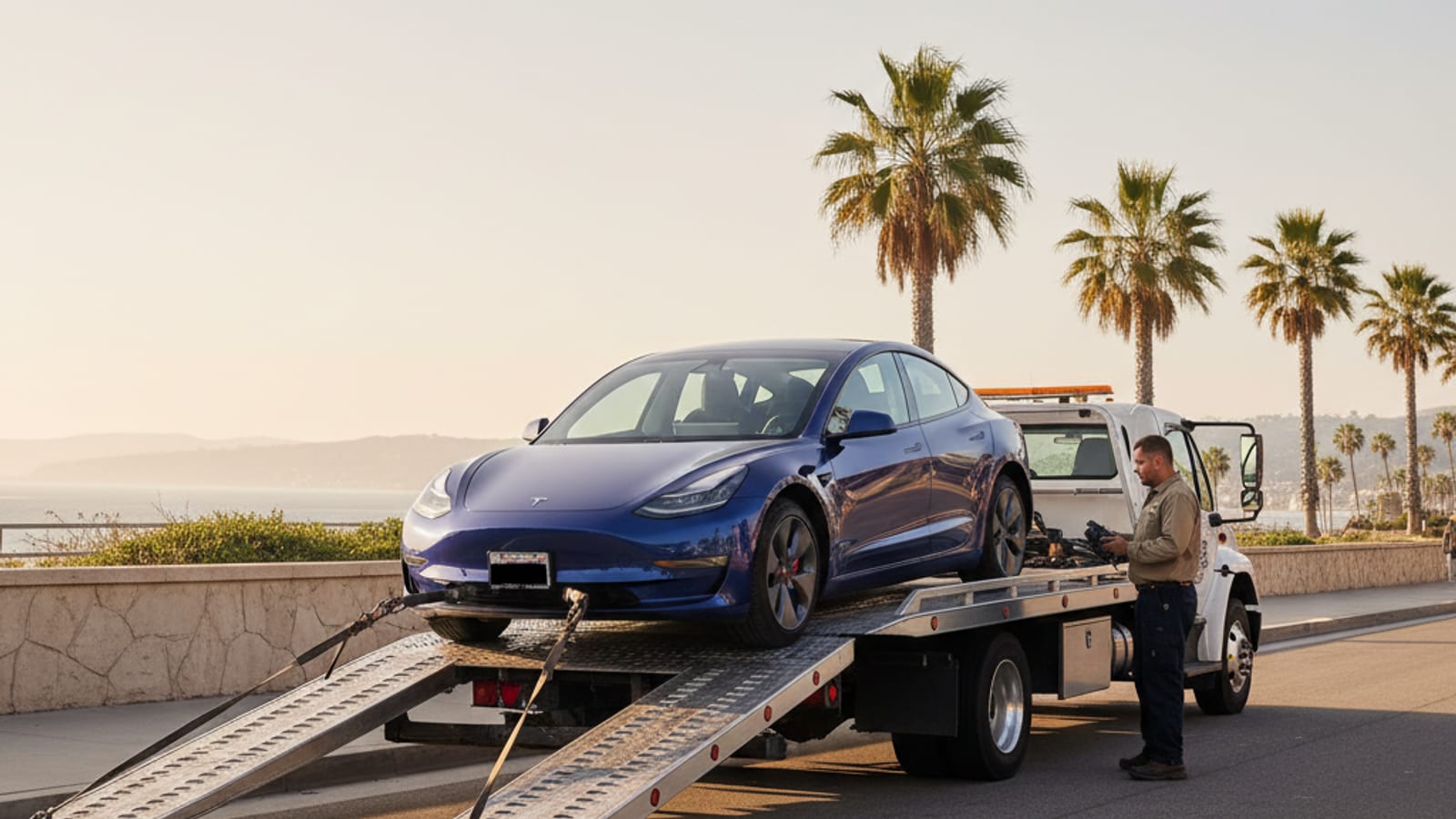
You’re on I-15 with a dead battery. You open two apps on your phone. One is for a tow. The other is for mobile charging. Which do you tap? The answer depends on why the car stopped, how far you are from infrastructure, and what you actually need to happen next. Here’s the honest framework for choosing — from a company that does one of them and not the other.
We dispatch mobile charging. If your situation needs a tow, we’ll tell you on the phone. Here’s the logic we use to decide.
The first question: can the car drive once charged?
This is the only question that really matters. Everything else is secondary.
If yes — the car is mechanically fine, no collision, no warning lights, just empty — mobile charging almost always wins. Cheaper, faster, simpler.
If no — there’s a fault that prevents driving even with a full charge — a tow is the only real option.
Faults that require a tow:
- Collision damage (front end, suspension, airbags deployed)
- High-voltage warning triangle on the dash
- Smoke, burning smells, fluid leaks
- Dead 12V and dead main pack simultaneously with no response to jumps
- Flat tire with no spare (tow to a shop)
- Transmission or motor fault codes that block driving
Everything else is a candidate for mobile charging.
The freeway scenario
You ran the pack to zero on I-5, I-15, I-805, or I-8. Car coasted to the shoulder. Hazards on. Nothing damaged, nothing leaking, no warning lights beyond “charge immediately.”
This is the classic mobile charging call. Numbers:
| Option | Time | Cost | Result |
|---|---|---|---|
| Mobile charge (us) | 25–60 min arrival + 20 min charge | $149 flat + miles after 15 min | 20 miles added, roll to Supercharger |
| Tesla roadside tow | 45–120 min arrival + 20–40 min to load + tow to Supercharger + wait for charge | Free in warranty | 1 to 3 hours door to Supercharger |
| Paid tow | 45–90 min arrival + load + tow | $250–$500 | Same as Tesla tow but on your dime |
For freeway strandings where the car will drive once charged, mobile charging is usually 30 to 90 minutes faster than any tow option.
The “dead in my garage” scenario
You plug in at night. Something misfires. Morning comes and the car has no charge, the 12V is dead, and the screen won’t wake. The car is safe, it’s in your garage, there’s no rush — but you need to get to work.
Mobile charging wins here for a different reason: it’s cheaper than a tow to a Supercharger followed by an Uber home. We roll, jump the 12V, top off the pack with 20 miles of range, diagnose whether your home charger is the problem, and leave. $149 covers the jump and the charge. Much simpler than the tow pathway.
The “dead at a charger that broke” scenario
You arrived at a fast charger with 4% left. The charger was broken, or your CCS connection handshake failed, or the next station was 50 miles away. You can’t leave, can’t charge, can’t cover the distance to the next station.
Mobile charging handles this cleanly. We roll to the broken charger’s location, plug into the car directly (bypassing the broken station), add enough range to reach a working station. Total time: under an hour for most stranding events in San Diego County.
A tow would haul you to the next working station. Longer, more expensive, and you’ve still lost the trip time.

The “I’m in the east county and the sun is setting” scenario
This one is where the calculus changes. If you’re out past Alpine, Julian, Ramona, or Pine Valley:
- Our arrival time is 75 to 90 minutes (east county / mountain response).
- The nearest tow might be further — rural flatbed coverage is thinner.
- Daylight and weather matter more.
For in-range east county calls (Ramona, Alpine, Lakeside area), mobile charging still often wins. For truly remote scenarios (deep back roads past Julian, Anza-Borrego), a tow with winch capability may be the only practical answer. Call us and we’ll be honest about whether we can reach you fast enough.
The “I don’t know what’s wrong” scenario
The car won’t move. You don’t know if it’s the 12V, the pack, a firmware thing, or something mechanical. Warning lights may or may not be on.
Call us first at (858) 400-8901. We do free phone triage. Tell us the symptoms and we’ll tell you whether mobile charging solves it or whether you need a tow.
If it turns out to be a mechanical fault we can’t fix on site, we don’t charge you for the diagnostic call. We’ll just say “this needs a tow to service” and give you a number.
Cost breakdown
Mobile charging (us) is priced to be the cheap answer for the scenarios it fits:
- $149 dispatch fee. Includes the roll and the first 15 minutes of charge (about 10 miles added).
- $1.80 per mile added after that. Most calls add 10 to 20 miles, so the total is usually $149 to $175.
- After hours (11 pm to 6 am) adds $50. For true overnight calls.
Compare to flatbed tow pricing in San Diego County:
- Flat rate: $150 to $250 for a hook.
- Per-mile: $4 to $10 after the included miles.
- Realistic out-of-warranty tow to a Supercharger: $250 to $500 round trip equivalent.
For a typical “empty pack, need 20 miles” situation, mobile charging saves $100 to $300 and 1 to 2 hours.
We’re not trying to tell you tows are bad. Tows exist because some situations need them. But 80% of stranded-EV calls in San Diego County are “I ran out of charge and I need to get to a real charger.” For that 80%, mobile charging is simply faster and cheaper.
San Diego corridor patterns
We’ve been doing this long enough to see patterns. The places we get the most calls:
- I-15 between Escondido and Temecula. Long gap between Superchargers, climbing terrain, range anxiety triggered.
- I-8 east of El Cajon. Similar — the climb to Pine Valley eats more charge than drivers expect.
- I-5 between downtown San Diego and Oceanside. High volume, dense stalls, but empty-pack arrivals happen when drivers leave home at 10%.
- Highway 67 north of Lakeside. Rural, limited charging, Ramona corridor.
- Julian tourist runs on weekends. Drivers cruise up for pie and apple tasting, then realize the Julian Supercharger doesn’t exist and panic.
If you’re planning a trip in any of these corridors, leave with more charge than feels necessary. 80% minimum for I-15 north past Escondido, 70% for I-8 east past La Mesa.
How to decide in the moment
Ask yourself three questions:
- Can the car drive if it had 20 miles of range? If yes → mobile charging. If no → tow.
- Is a Supercharger within 20 miles? If yes → mobile charging adds just enough range to reach it. If no → mobile charging to home or a Level 2 charger, or a tow.
- Is there damage, smoke, or a warning triangle? If yes → tow. No exceptions.
Three questions. Ninety seconds. You’ll know which to call.
When to call us
Call (858) 400-8901 if:
- Your pack is empty and the car is otherwise fine.
- You need a 12V jump and the pack could use topping up too.
- You’re stranded between chargers and need 20 miles to reach one.
- You’re at a broken public charger and can’t complete a session.
Browse our mobile EV charging, out-of-charge recovery, and EV roadside assistance pages for full coverage maps and service details.
Stuck in San Diego County right now? Call (858) 400-8901. We’ll triage on the phone and tell you honestly whether a charge or a tow is the better answer for your situation.