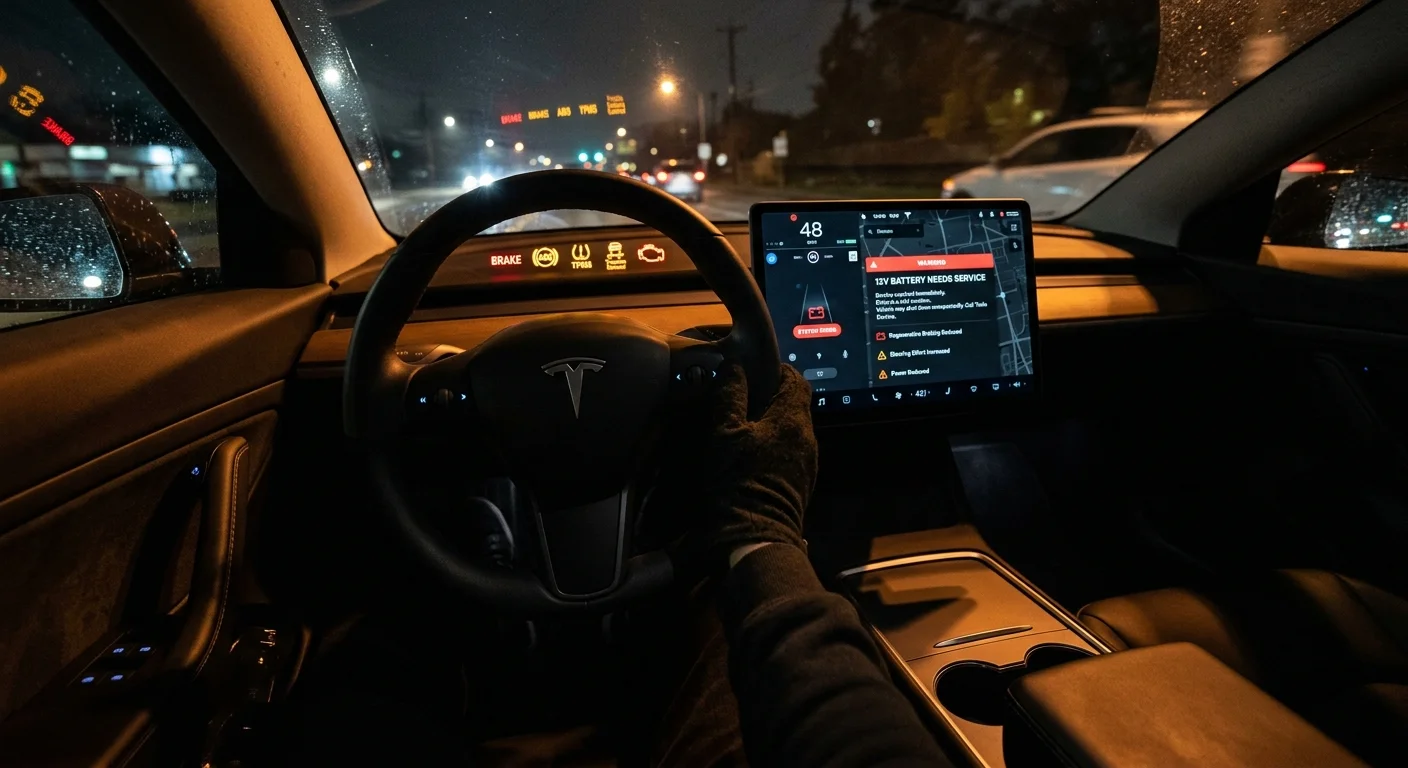
Imagine your EV, fully charged, ready for your commute across San Diego. You hop in, press the start button, and… nothing. No lights, no screen, just a silent, unresponsive vehicle. You might assume your main high-voltage battery is the culprit, but often, the real issue lies with a much smaller, less talked-about component: your car’s 12-volt battery.
Why your EV still needs a 12V battery
This is often the biggest surprise for new EV owners. “Doesn’t the big battery do everything?” they ask. The truth is, while your EV’s large, high-voltage battery powers the motor for propulsion, it doesn’t handle everything. Just like gasoline cars, electric vehicles rely on a separate, much smaller 12-volt battery to power all the low-voltage electronics and accessories. Think about it: your headlights, wipers, power windows, infotainment system, airbags, power steering, and crucially, the car’s main computer system, all run on 12 volts.
This 12V battery also plays a critical role in “starting” the car. Not in the combustion engine sense, but by powering the contactors – essentially big relays – that connect the main high-voltage battery to the rest of the vehicle’s electrical system. Without power from the 12V battery, these contactors can’t engage, meaning the colossal energy of your main battery remains locked away, unable to power anything. It’s the silent workhorse that enables your EV to wake up and function, ensuring everything from the door locks to the regenerative braking system has the immediate, consistent low-voltage power it needs. Failing to understand its importance can leave you stranded, even if your main battery shows a full charge.
The first symptoms: weird error messages and a car that won’t ‘turn on’
When your EV’s 12-volt battery starts to die, it rarely happens without warning, though the warnings can be subtle or confusing. Many owners report a cascade of unusual electronic glitches rather than a sudden, total shutdown. You might notice your infotainment screen flickering, navigation system acting erratically, or climate control behaving strangely. Dashboards often light up with various error messages that might seem unrelated, like “Service Required,” “Power Steering Assist Reduced,” or even warnings about regenerative braking. These warnings are your car’s way of telling you that critical systems aren’t receiving stable voltage.
The most definitive symptom, however, is when your EV simply won’t “turn on” or “start.” You’ll push the brake pedal and shift lever, expecting the familiar readiness chime, but nothing happens. The touchscreen might remain blank, or only show a low-power, flickering image. Door handles might not present, or the car might not respond to your key fob at all. This lack of response isn’t because your main drive battery is depleted; it’s because the 12V battery lacks the juice to initiate the startup sequence and engage the necessary high-voltage contactors. For many Tesla owners, this can manifest as a “Vehicle cannot be driven” message, often accompanied by warnings about the 12V system. For more in-depth information on what to look for, you can check out our post on Tesla 12V battery failure symptoms.
Can you get locked out? Yes, and here’s why
One of the most frustrating and often surprising consequences of a dead 12-volt battery in an EV is the potential to get locked out of your own car. Unlike gas cars, which typically have a physical key that can unlock the doors mechanically, many modern EVs, particularly models like Teslas, rely heavily on electronic systems for access. The door handles themselves are often electronically actuated, meaning they need power from the 12V battery to present or unlock. If this battery is completely flat, the electronic signals from your key fob or phone app won’t reach the car, or the car simply won’t have the power to respond to them.
Even if you manage to get inside using a mechanical key (if your specific model has one, often hidden), the car might not “wake up.” The electronic door latches, power windows, and even the ability to open the frunk (front trunk) to access the 12V battery itself, can be disabled. This situation can be particularly tricky in underground parking garages or remote areas where cell service is spotty, making it difficult to call for help. Understanding this vulnerability is key, as it highlights why maintaining your 12V battery health is important for basic accessibility, not just driving.
Is the main high-voltage battery affected? (Usually, no)
This is a common concern among EV owners facing a dead 12V battery. Many worry that their expensive main propulsion battery might be damaged or depleted, leading to a much larger problem. Fortunately, in most cases, a dead 12-volt battery does not directly affect the main high-voltage (HV) battery’s health or charge level. These are two distinct systems with different purposes. The HV battery is designed for propulsion and long-term energy storage, typically operating at hundreds of volts. The 12V battery is for immediate, low-voltage power to run the auxiliary systems mentioned earlier.
The main HV battery usually has its own sophisticated Battery Management System (BMS) that monitors its health and charge independently. When the 12V battery dies, it simply cuts off the “ignition” for the HV system, preventing the car from turning on or driving. Think of it like a safety switch. The HV battery remains charged and healthy, just inaccessible. Once the 12V system is restored, the car should power on and the HV battery will function normally. The only indirect effect might be a slight drain on the HV battery if the car attempted to charge the failing 12V battery before it completely gave out, but this is usually minimal and quickly recovered once the vehicle is operational again.
How to safely get your car powered back on
When your EV’s 12-volt battery dies, your primary goal is to provide enough temporary power to “wake up” the car’s computers and engage the high-voltage contactors. This is essentially a jump start, but it’s important to do it correctly and safely for an EV. Most EVs have clearly marked 12V jump points, often located in the frunk (front trunk) or under the hood, even if the actual 12V battery is elsewhere. You’ll typically need another 12V power source, such as a portable jump starter pack or another vehicle’s 12V battery.
Connect the positive (+) terminal of the jump starter to the positive (+) jump point on your EV, and the negative (-) terminal to a grounding point on the car’s chassis (not directly to the 12V battery if you can’t access it safely). Once connected, give it a minute or two for the car’s systems to power up. You should then be able to “start” your EV. After it powers on, the car’s internal DC-DC converter will begin charging the 12V battery from the main high-voltage battery. However, if the 12V battery is old or significantly degraded, this temporary jump might not hold, and you’ll need a Tesla 12V battery jump service or a full replacement. For detailed step-by-step instructions, our guide on how to jump start an EV safely offers helpful advice.
Why you shouldn’t try to jump it from a gas car
While the principle of a 12V jump start is similar, attempting to jump an EV from a gasoline-powered car comes with significant risks and is generally not recommended. The main reason lies in the sensitive electronics and differing charging systems of EVs. Traditional gas cars have alternators that can produce voltage spikes during a jump, especially if cables are connected or disconnected improperly. These voltage spikes can potentially damage the delicate control modules and computers in an EV, leading to far more expensive repairs than a simple 12V battery replacement.
Modern EVs, particularly high-performance models, are complex machines. Their onboard diagnostic systems and power electronics are designed for precise voltage regulation. Introducing an unregulated or unstable power source from a gasoline car can introduce electrical noise or overcurrents that could fry components. A portable jump starter specifically designed for vehicles, or a professional roadside service that uses specialized equipment, is always the safest approach. These devices provide a more controlled and stable power delivery, protecting your EV’s sensitive systems. Don’t risk permanent damage to save a few dollars; rely on the right tools and expertise.
When to call us
Dealing with a dead 12-volt EV battery can be stressful and complex, especially if you’re unsure how to access the jump points or if your car’s electronics aren’t responding as expected. If you’re stranded in San Diego County and need fast, reliable assistance, our team specializes in EV roadside rescue. We have the right equipment and expertise to safely get your electric vehicle powered back on. Call us at (858) 925-5546 for a same-day estimate.