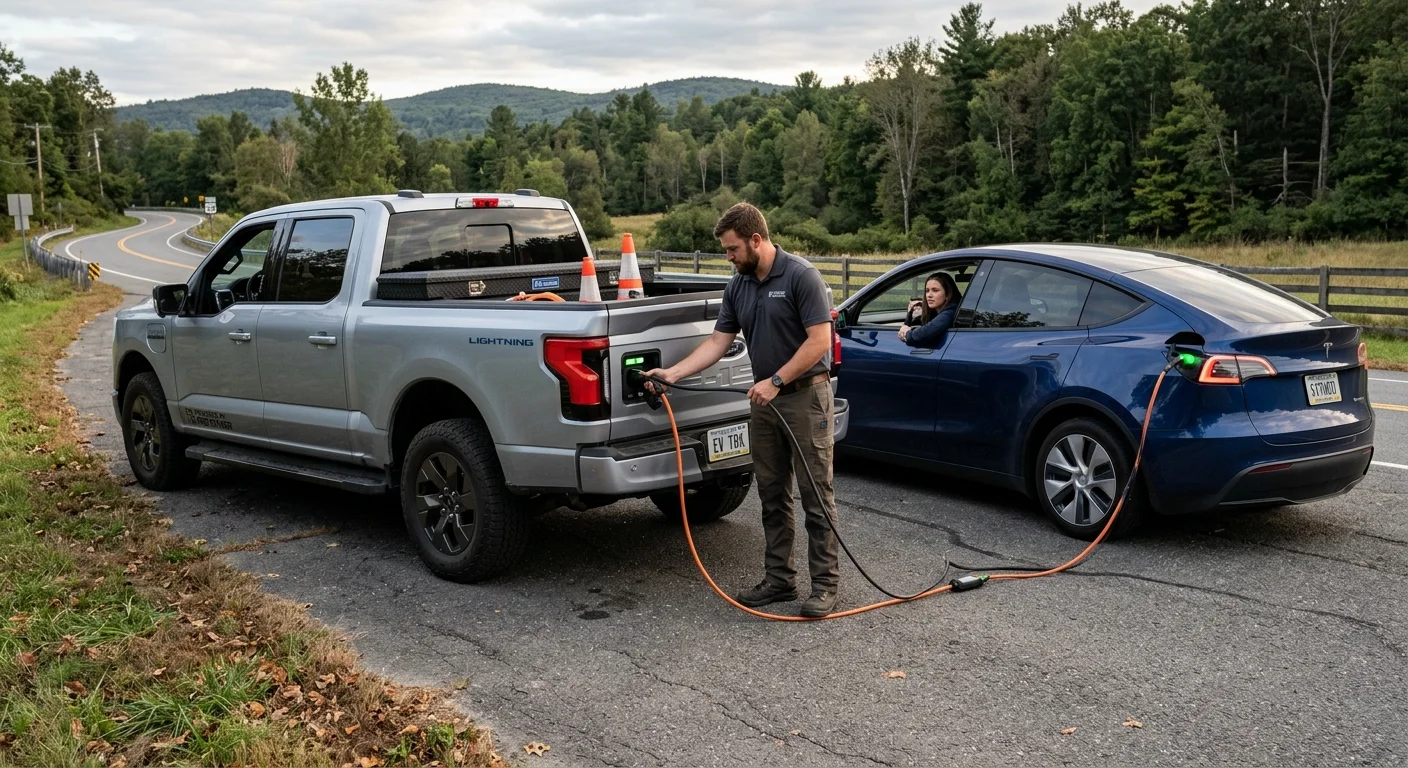
Picture this: you’re cruising through San Diego County in your Ford F-150 Lightning, when you spot a fellow EV owner stranded on the side of the road with a dead battery. Your truck has a massive battery itself and power outlets. Can you actually help them out? The short answer is yes, the F-150 Lightning can charge another EV, but there are some important details to understand about how it works, how fast it charges, and when it’s genuinely practical.

A Ford F-150 Lightning parked next to a stranded Tesla Model Y, with a charging

Understanding Ford’s Pro Power Onboard feature

The Ford F-150 Lightning stands out for its Pro Power Onboard system. This innovative feature turns the electric truck into a mobile power station. Depending on the trim level, the Lightning offers different levels of power output. The standard setup provides 2.4 kilowatts (kW) of power, while higher trims can deliver 7.2 kW or even a robust 9.6 kW. This power is accessible through various 120V and 240V outlets located in the truck’s bed and cabin.

Originally designed to power job site tools, camping equipment, or even an entire home during a power outage, Pro Power Onboard has a surprisingly versatile application: charging other electric vehicles. Essentially, it allows the Lightning to act like a Level 2 EV charging station. It’s a remarkable piece of engineering that showcases the potential of vehicle-to-load (V2L) technology. This capability extends beyond just tools, offering a lifeline to other EVs in a pinch. It doesn’t use the Lightning’s DC fast charging port, but rather the AC outlets intended for typical household or workshop appliances. This distinction is key to understanding the charging speed.

What you need: the right adapters for Tesla and non-Tesla EVs

To charge another EV using your F-150 Lightning, you won’t just plug a regular extension cord into the truck. You’ll need specific equipment. First, you need an EVSE (Electric Vehicle Supply Equipment) that can plug into the Lightning’s 240V outlet. This is typically a portable Level 2 charger that comes with a NEMA 14-50 plug, matching the high-power outlet found in the Lightning’s bed.

Once you have the right EVSE, you also need the correct adapter for the receiving vehicle. Most non-Tesla EVs in North America use the J1772 charging standard. So, if you’re helping a Chevy Bolt, a Hyundai Ioniq 5, or a Volkswagen ID.4, your portable EVSE will connect directly via its J1772 connector. However, if the stranded vehicle is a Tesla, you’ll need an additional NACS (North American Charging Standard) to J1772 adapter. This small, crucial piece converts the J1772 plug from your EVSE into the NACS connector that Teslas use.

It’s similar to the general concept of charging an EV from another EV, but specifically tailored to the Lightning’s onboard power. Always make sure your adapters and EVSE are in good condition and rated for the power output to ensure a safe connection. These accessories are essential for converting your Lightning from a mobile generator into a mobile EV charger. Without them, you’re just a good Samaritan with a powerful truck and no way to share the electrons.

How fast can the Lightning actually charge another car?

This is where expectations need to be managed. While the F-150 Lightning can charge another EV, it’s not a fast process. The Pro Power Onboard system, even the 9.6 kW version, delivers power at a rate equivalent to a Level 2 charging station.

Here’s a breakdown:

  • 2.4 kW system: This delivers about 8-10 miles of range per hour to a typical EV. It’s roughly equivalent to a slow Level 1 charger.
  • 7.2 kW system: This is the more common setup in many Lightning trims. It provides approximately 20-25 miles of range per hour.
  • 9.6 kW system: The most powerful option, offering around 30-35 miles of range per hour.

Compare this to what a stranded EV owner might need in an emergency. A dedicated mobile EV charging service like Charge Pro SD uses commercial-grade equipment capable of delivering significantly higher power, often nearing Level 3 (DC fast charging) speeds. While a 9.6 kW charge can provide enough juice to get to the nearest charging station, it requires a considerable amount of time. If someone is truly out of charge on a busy freeway in San Diego County, waiting an hour for 30 miles of range might not be practical or safe. It’s a “trickle charge” compared to the quick boost needed for genuine roadside emergencies.

Infographic comparing F-150 Lightning EV charging speed to standard Level 2 and Charge Pro SD's mobile charging service for emergency EV roadside assistance.

When it’s a great idea (and when it’s not)

Using your F-150 Lightning to charge another EV is a fantastic capability, but it has specific scenarios where it shines brightest.

It’s a great idea for:

  • Minor top-offs in remote areas: If you’re camping or off-roading far from charging infrastructure and a friend needs a small boost to make it home, the Lightning is perfect.
  • Non-emergency situations: Perhaps a neighbor’s EV battery dipped lower than expected overnight, and they just need a few miles to reach their workplace charger. Your Lightning can provide that without a rush.
  • Community goodwill: It’s an excellent way to help out a fellow EV driver when time isn’t critical, showcasing the versatility of your truck.

However, it’s not a great idea for:

  • True roadside emergencies: If an EV is completely dead on a busy San Diego freeway, waiting an hour or more for a minimal charge isn’t safe or efficient. The stranded driver needs a quick, substantial charge to get moving.
  • Regular charging: The Lightning’s battery isn’t designed for repeated vehicle-to-vehicle charging, nor is it the most energy-efficient way to charge another car compared to a dedicated charging station.
  • Situations requiring speed: If you need to add significant range (e.g., 50+ miles) quickly, the Lightning’s Level 2 output simply isn’t sufficient. You’d be draining your own battery considerably for a relatively slow return for the other driver.

Think of it as a helpful gesture or a last resort, not a primary solution for urgent needs.

Why calling for a dedicated mobile charge is still faster for emergencies

While the F-150 Lightning’s capability is impressive, it’s important to differentiate it from a professional, high-speed solution for roadside emergencies. When an EV runs completely out of charge on a busy street or highway in San Diego, time is of the essence. You don’t want to wait an hour for 20-30 miles of range.

Charge Pro SD specializes in rapid, on-demand mobile EV charging. Our service trucks are equipped with powerful, commercial-grade chargers that deliver power significantly faster than even the highest output of the F-150 Lightning’s Pro Power Onboard. We can get a substantial amount of range into a stranded EV in a fraction of the time, allowing the driver to quickly and safely reach the nearest charging station or their destination. Our professional team understands the intricacies of EV charging and safety protocols, ensuring a smooth and reliable rescue. The Lightning is an innovative tool, but for a true emergency, a dedicated service is built for speed and efficiency.

When to call us

If you or another EV driver finds themselves truly stranded with a dead battery in San Diego County, your F-150 Lightning can offer a helpful hand, but a professional mobile EV charging service like Charge Pro SD is your fastest, most reliable option. We’re equipped for rapid response and high-speed charging to get you back on the road quickly and safely. Call us at (858) 925-5546 for a same-day estimate.