A dead EV mid-shift means a mobile charge can have you earning again in under an hour, while a tow usually ends your whole night.
You’re three rides into a Friday shift when the dash flashes zero and the car rolls to a stop on a side street off Convoy or a curb near the airport terminal. The app is still pinging with ride requests you can’t accept. Every minute you spend waiting for help is a minute you’re not earning, and for a rideshare or delivery driver, that’s the whole problem with a dead EV. It’s not just an inconvenience. It’s lost income stacked on top of a stressful moment.
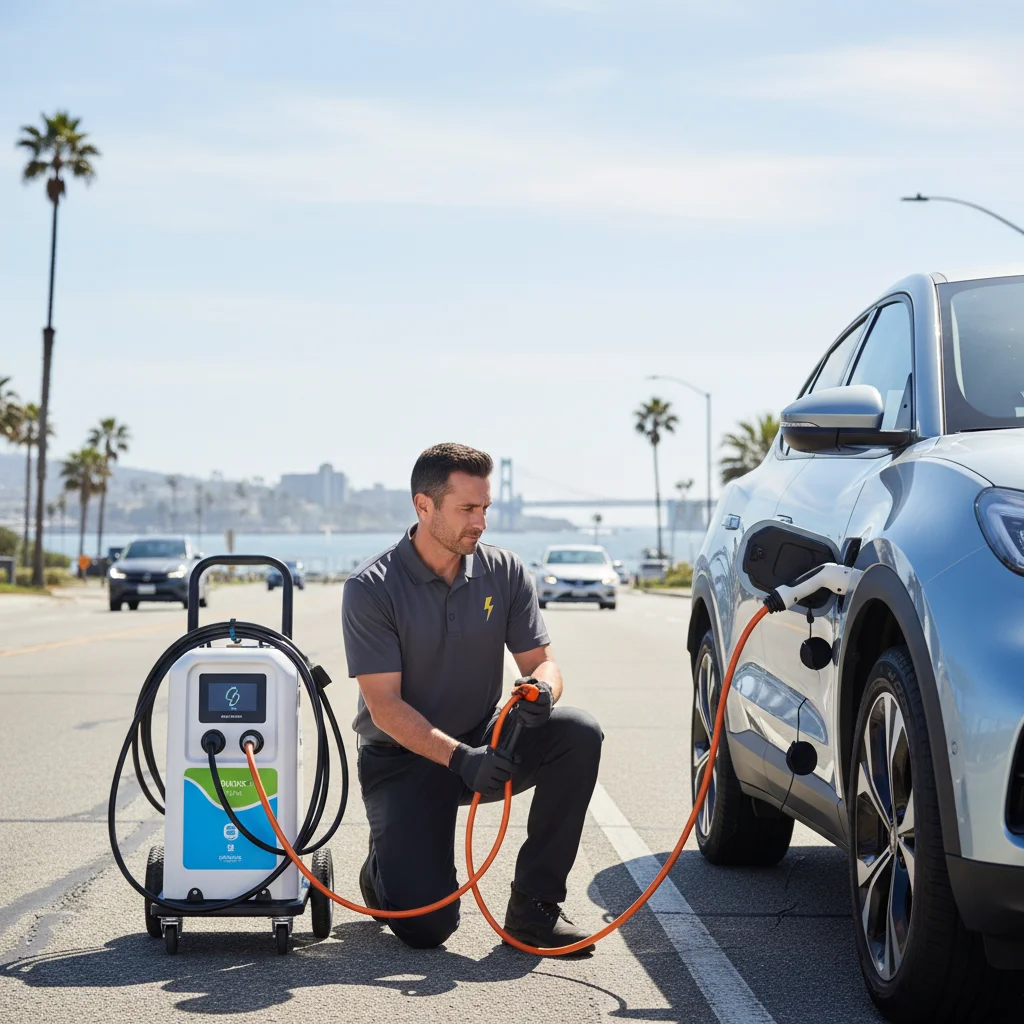
Every minute offline costs you a fare
Gas drivers who run out of fuel can grab a gallon from a gas station and be moving in ten minutes. EV drivers who run the pack to zero, or whose 12V battery quits on them mid-shift, don’t have that option. A flatbed tow means your car leaves on a truck and you’re standing on a sidewalk trying to figure out how to get home, let alone how to get back to work. For a driver paying off a car note on rideshare income, a lost shift is real money, not an abstraction.
That’s the entire reason Charge Pro SD exists as a separate option from towing. We don’t haul your car away. We drive a truck to you, add 10 to 20 miles of range or jump a dead 12V battery on the spot, and you’re back on the app within the hour in most San Diego County calls.
Why a tow is the wrong call for most mid-shift deaths
Most mid-shift EV failures fall into one of two buckets: the high-voltage pack ran to empty, or the small 12V battery that runs the car’s computers and door locks died. Neither one requires a shop visit. Both are things we fix in your parking spot.
A tow makes sense when there’s collision damage, a serious warning light, or a mechanical fault that keeps the car from driving even with a full charge. Outside of that, towing an EV that just needs range or a jump is slower and more expensive than it needs to be, and it takes you out of service for hours instead of minutes. Our mobile EV charging service exists specifically for the “just needs power” scenario that eats most rideshare drivers’ bad nights.
What actually happens when we roll up
You call or text us your location and vehicle. We dispatch the nearest truck, and in most of San Diego proper you’re looking at a 25 to 60 minute arrival window. When we get there, our tech figures out fast whether this is a 12V issue, an empty pack, or something else. If it’s a jump or a charge, we handle it right there in the rideshare queue, the delivery lot, or wherever you’re parked. You don’t move the car. You don’t sign anything with a tow operator. You go back to driving.
If the diagnosis points to a real mechanical problem, we tell you honestly on the spot instead of charging you for a charge that won’t fix it. That’s rare, but it happens, and we’d rather lose the job than waste your time.
More EV drivers on the road means more of this
This is becoming a bigger issue across San Diego because more rideshare drivers are switching to EVs every month. California’s Public Utilities Commission approved a new incentive program in July 2026, part of the state’s Clean Miles Standard, that will offer eligible Uber and Lyft drivers up to roughly $20,300 toward a new zero-emission vehicle or $14,200 toward a used one, plus help with charging costs, once the program opens later this year. The goal is to push more rideshare miles onto electric vehicles statewide.
That’s good news for drivers’ bottom line long term, but it also means more EVs logging the long, back-to-back shift hours that put the most stress on a 12V battery and the most pressure on drivers to keep the pack topped off between rides. A dead EV mid-shift is only going to become a more common call, not a less common one.
What to tell dispatch while you wait
Pull over somewhere safe and legal, hazards on. Note your cross streets or drop a pin. Tell us your EV make and model and whether the screen powers on at all. A screen that’s completely dark, with no chime and no response to the key fob, usually points to the 12V battery. A screen that’s on but the car refuses to shift or charge usually means the main pack is empty. Either way, we bring the right fix in the same truck.
Frequently asked questions
Will Uber or Lyft pay for a tow if my EV dies mid-shift?
Sometimes, through Uber’s in-app roadside partner or your own insurance roadside plan, but tow programs are built around gas cars and often route you to a shop rather than back to work fast. For a full breakdown of what Uber’s roadside actually covers for EVs, see our post on Uber roadside versus mobile charging.
How fast can Charge Pro SD get to me during a shift?
Most calls in the city core, from downtown to Kearny Mesa to the airport corridor, see a 25 to 60 minute arrival. Rural and far East County calls take longer. Call (858) 400-4465 and we’ll give you a real estimate before you decide anything.
Can you charge me while I’m parked in a rideshare queue or delivery lot?
Yes. We come to wherever you’re legally parked, including airport rideshare lots, curb space, and delivery staging areas. You don’t need to move the car or find a charger yourself.
What if it’s the 12V battery, not the main pack?
We carry jump equipment for 12V failures on every truck. A 12V jump takes a few minutes and gets your screen, locks, and drive system back online, separate from any range charging you might also need.
Does this work for both Uber and Lyft drivers, or just one platform?
Both. We don’t work with a specific rideshare company. Any EV driver stranded in San Diego County, rideshare, delivery, or personal, can call us directly.
A dead EV during a shift doesn’t have to mean the shift is over. Compare your options in more detail in mobile EV charging versus tow, or see what a tow really costs you beyond the tow bill in the hidden costs of towing a dead EV.
Call Charge Pro SD at (858) 400-4465 and we’ll be on our way.