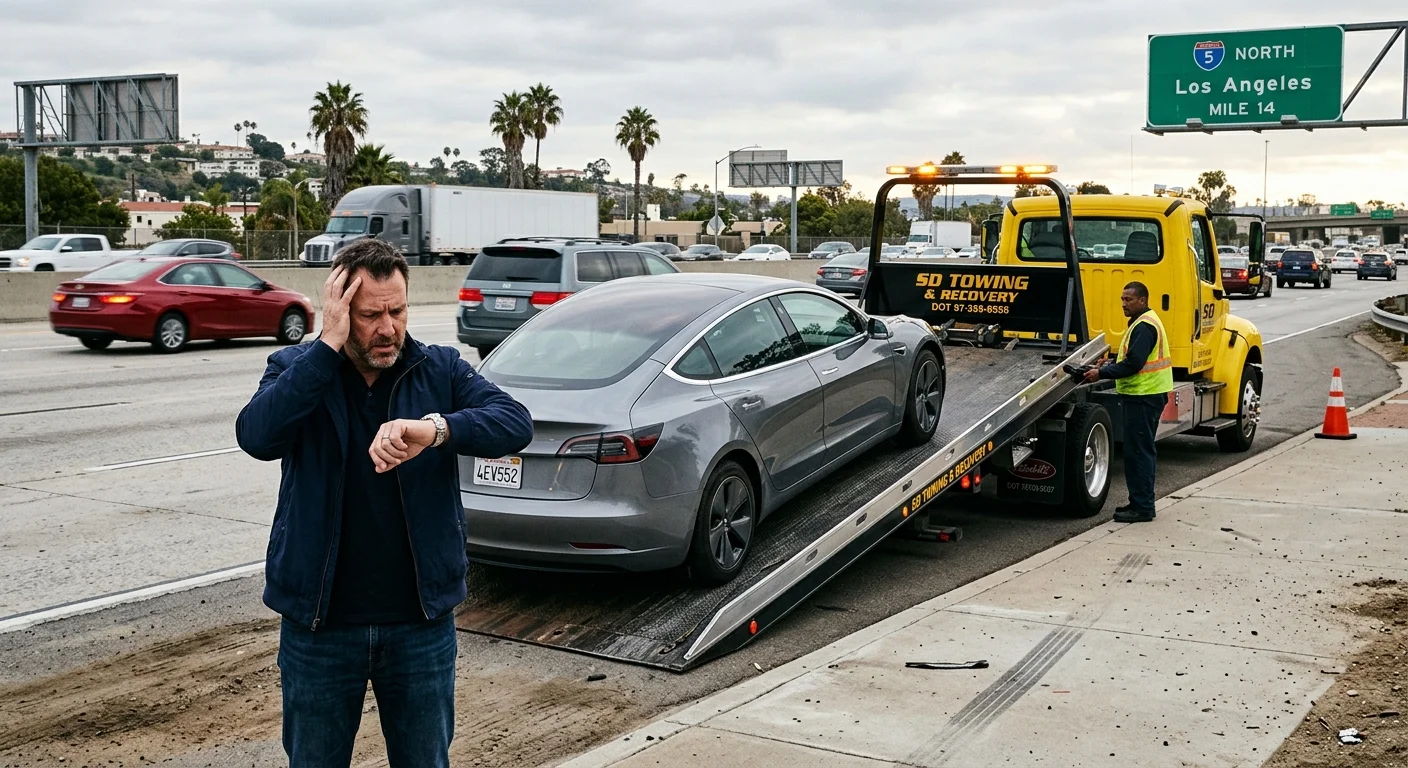
Running out of charge in your EV in San Diego can quickly turn a good day into a frustrating ordeal. Your first thought might be to call a tow truck. But what seems like a straightforward solution often hides a web of unexpected expenses, time drains, and potential risks that extend far beyond the initial hook-up fee. It’s more complicated than just getting your car from point A to point B.

An EV being loaded onto a flatbed tow truck on the side of a busy San Diego freeway, with the driver looking stressed and checking their watch.

Beyond the hook-up fee: what a tow really costs you

When your EV dies, calling for a tow feels like the only option. However, the price tag often includes much more than just the basic service. Standard towing services typically start with a hook-up fee, but then they add charges for mileage, after-hours calls, and any special equipment needed. In San Diego, these costs can quickly climb. Factor in freeway tolls, navigating congested areas like downtown or beach communities, and the variable distance to the nearest suitable charging station, and you’re looking at a significant expense.

Many people assume a tow is the cheapest way to get power, but that’s rarely the complete picture. A standard tow truck might take your vehicle to the nearest garage, which isn’t always an EV-friendly location with charging capabilities. Or, they might take you to a public charging station that could be broken, occupied, or incompatible with your specific EV. This immediately sets you up for further delays and additional costs, as you might need another tow or a long wait. When you start comparing the total cost, not just the initial quote, a service like mobile EV charging vs. a tow truck often shows mobile charging as the more economical solution. We often see drivers underestimate how much extra time and money a traditional tow can truly demand.

The risk of damage: why flatbeds are necessary (and expensive)

Towing an electric vehicle isn’t the same as towing a gas-powered car. EVs have complex battery systems and drivetrains that are highly sensitive to improper towing methods. Standard wheel-lift tow trucks, which lift only two wheels off the ground, can cause significant damage to an EV’s electric motors, regenerative braking systems, or even the battery pack if not properly disengaged. For most EVs, especially when completely out of power, a flatbed tow truck is the only safe option to ensure all four wheels are off the ground.

Flatbeds prevent wear and tear on the drivetrain, protect the battery from impact or vibration damage, and avoid issues related to the vehicle’s locked transmission or parking brake when power is lost. However, flatbed towing is a specialized service, and it often comes with a higher price tag. Not all tow companies have flatbeds readily available, which can mean longer wait times, especially if you’re stranded in a less accessible area of San Diego County. Furthermore, not all tow truck operators are properly trained in the specific procedures required for various EV models. Incorrect towing methods, like dolly towing for all four wheels, can severely damage an EV’s sensitive drivetrain or battery pack. This is especially critical for vehicles like Teslas, which have specific towing requirements when they’re out of power. Choosing an experienced, EV-aware roadside rescue service can mitigate these risks and save you from potentially costly repairs down the line.

Time is money: calculating the cost of waiting for a tow and a charge

Beyond the monetary costs and the risk of damage, the most significant hidden expense of towing a dead EV is often your time. Being stranded on the side of a San Diego freeway or a busy street means lost productivity, missed appointments, and a substantial amount of stress. Let’s break down the typical timeline:

First, you’ll wait for the tow truck. Depending on traffic, time of day, and your location in San Diego, this could be anywhere from 30 minutes to several hours. Then, the actual tow itself. Navigating San Diego’s freeways like the I-5 or I-805, or surface streets during rush hour, adds considerable travel time to the nearest charging station. Once you arrive, you might face another wait. Public charging stations aren’t always immediately available; they could be occupied, out of order, or require a specific app or payment method you don’t have. Finally, there’s the charging time itself. Depending on the charger speed and how much range you need, this can take another 30 minutes to a few hours.

Infographic comparing the typical time and steps involved in towing an EV to a charging station versus receiving mobile EV charging on-site.

Adding these segments together – the initial wait, the tow, the wait for a charger, and the charging process – can easily consume half a day, if not more. For many, that’s hours of lost work, canceled plans, or precious family time gone. Think about the hourly value of your own time. When you factor that in, the “cheaper” tow starts to look very expensive.

The ‘second tow’ problem: what if the charging station is broken?

Imagine this scenario: your EV dies, you call a tow truck, and after an hour or two of waiting and driving, you finally arrive at a public charging station. You plug in, hopeful, only to find the charger is broken. Or it’s occupied by another vehicle, and you’re next in a long queue. Or, even worse, the specific charger type isn’t compatible with your EV, or you don’t have the correct app or membership to activate it. This isn’t just an inconvenience; it’s the “second tow” problem.

At this point, you’re still stranded, still without power, and now you’re faced with the prospect of calling another tow truck to take you to a different charging station. This doubles your initial tow cost, doubles your waiting time, and exponentially increases your frustration and stress. This is a common issue in San Diego, where public charging infrastructure is growing but not always reliably available or universally compatible. The time spent dealing with a broken or inaccessible charger, only to repeat the entire process, truly highlights the inefficiencies and hidden pitfalls of relying solely on traditional towing for an out-of-charge EV. It’s a risk you simply don’t have to take.

Comparing the true cost: a tow vs. on-site mobile charging

When you tally up all the potential hidden costs associated with towing a dead EV – the direct tow fees, the specialized flatbed requirement, the risk of expensive drivetrain or battery damage, the significant investment of your time and mental energy, and the dreaded “second tow” problem – the traditional solution often becomes surprisingly expensive. It’s not just about the dollar amount on the tow truck invoice; it’s about the end-to-end impact on your day, your wallet, and your peace of mind.

This is where a service like mobile EV charging truly shines. Instead of moving your vehicle to the power source, we bring the power source directly to your vehicle, wherever you are in San Diego County. Our specialized mobile charging units can deliver a crucial boost to your EV battery right on the spot. This means:

  • No Tow Fees: You eliminate the entire cost of the tow, including any surcharges or specialized equipment fees.
  • Reduced Damage Risk: Your EV stays put, eliminating any risk of damage from improper towing techniques.
  • Significant Time Savings: You avoid the multiple stages of waiting and transit. Our technicians arrive, charge your vehicle enough to get you to the nearest reliable charger or even home, and you’re on your way much faster.
  • Eliminate the ‘Second Tow’ Problem: We verify the charging compatibility on-site and ensure you get the power you need, removing the uncertainty of finding a functional public charger.
  • Less Stress: The convenience of roadside charging means less anxiety, less disruption to your schedule, and a much smoother recovery from an out-of-charge situation.

Charge Pro SD provides a transparent, efficient, and safer alternative, turning a potentially disastrous situation into a manageable inconvenience. We focus on getting you back on the road quickly and confidently, without the hidden expenses and headaches of traditional towing.

When to call us

If your EV battery is dead, or you’re dangerously low on charge in San Diego, don’t let the hidden costs of towing add to your stress. Our mobile EV charging service is the efficient, safe, and often more economical solution to get you moving again. Call us at (858) 925-5546 for a same-day estimate.