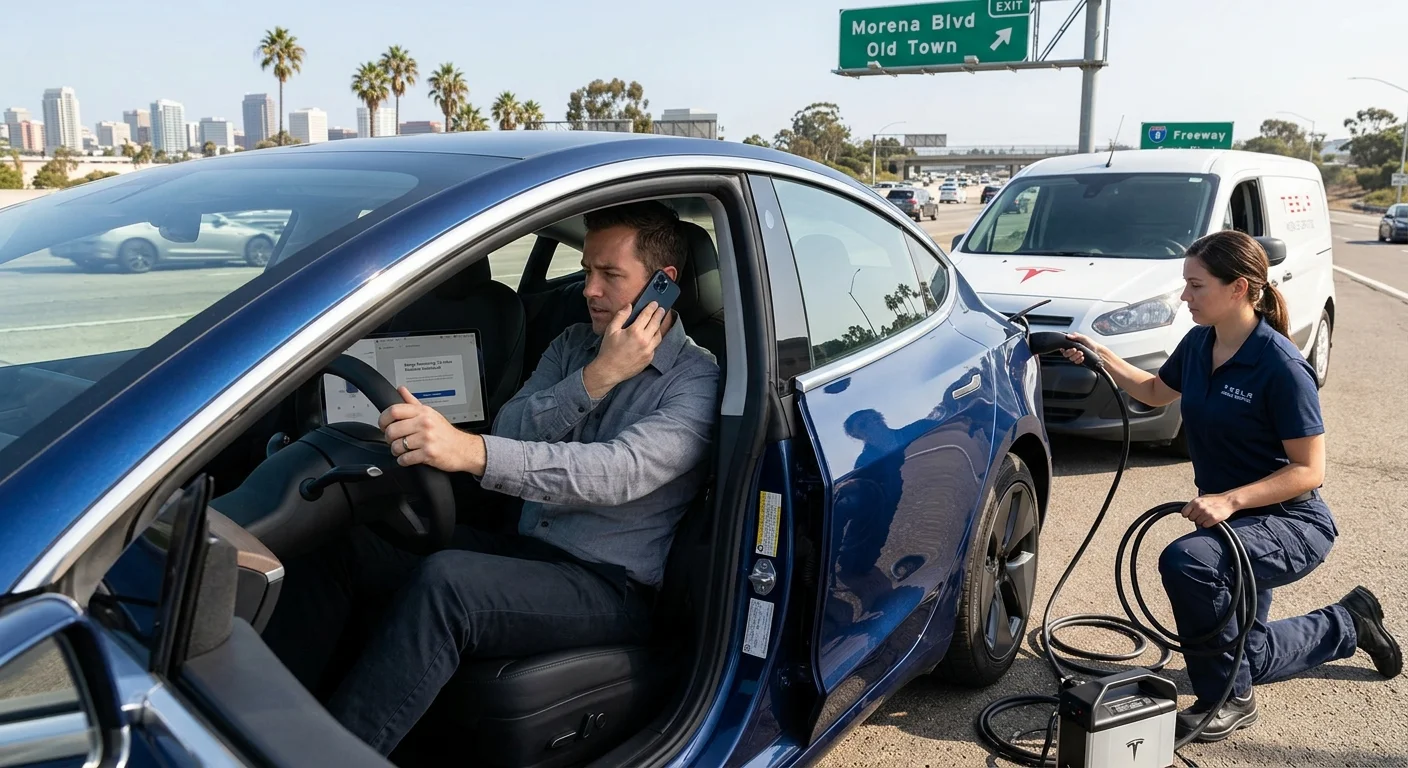
Roadside assistance for a Tesla Model 3 starts with one decision. Does the car need mobile charging, low-voltage help, or transport? Charge Pro SD connects stranded San Diego drivers with licensed, independent local operators who can assess that situation.
That distinction matters when the battery reads 0%, the screen stays dark, or the car remains stuck at a charging stall. It also matters when someone searches for a mobile Tesla mechanic but actually needs roadside recovery.
Match the symptom to the right kind of help
Start with what happened immediately before the Model 3 stopped moving. Don’t diagnose the car from one warning, a dark screen, or a disconnected phone app. Give the operator the full sequence instead.
A displayed 0% battery reading points toward an out-of-charge assessment. Tell the operator whether the percentage declined while driving or the car stopped after sitting. Mention any words or symbols still visible on the screen. Our out-of-charge recovery service is the relevant starting point when usable driving charge appears depleted.
A dark display creates a different decision. Report whether the doors respond, interior lights work, or the charge port opens. These observations can help an operator evaluate a possible low-voltage problem. They don’t confirm which battery or component failed. Our guide to traction-battery and low-voltage symptoms explains why the distinction deserves care.
A Model 3 sitting at a Walmart Supercharger stall may still need roadside help. Tell the operator whether the connector is attached and what the car displays. Don’t assume the charging station caused the failure.
Collision damage, a wheel problem, blocked controls, or an unknown warning may change the plan. In those cases, ask whether transport is more suitable than charging. Charge Pro SD’s Tesla roadside rescue referral service can connect you with a local operator for that assessment.
Check Tesla’s current Model 3 roadside terms
Tesla’s current Model 3 roadside coverage, exclusions, prices, and service limits couldn’t be confirmed from the approved claims ledger for this page. Check the official Tesla terms associated with your vehicle before assuming a service is covered.
Model year and vehicle configuration may affect the instructions you receive. Use the owner information supplied by Tesla for your exact car. Don’t rely on a procedure copied from another Model 3 without confirming that it applies.
Before authorizing roadside work, ask several direct questions:
- Does the requested service fall within your current Tesla roadside terms?
- Will Tesla arrange charging, transport, or another form of help?
- Is there a cost, and who receives payment?
- If transport is required, who selects the destination?
- Are there limits based on the vehicle’s condition or location?
Charge Pro SD doesn’t set Tesla’s policies or roadside prices. It also doesn’t perform the physical work. The driver contracts with and pays the matched independent operator directly.
Keep screenshots of any messages, terms, or quoted charges you receive. Confirm the final service and destination before work begins. If Tesla’s available option doesn’t fit the situation, an independent EV rescue operator may offer another path. Coverage and payment should still be confirmed with the party providing that service.
Tell a low-voltage failure from an empty battery
A Model 3 has different possible reasons for appearing completely dead. Roadside assistance should begin with observed symptoms, not a confident battery diagnosis.
If the display showed 0% before the car stopped, report that exact reading. Also describe whether the vehicle was driving, parked, or connected to a charger. This gives the operator a clearer basis for considering mobile energy delivery or transport.
If the car had indicated usable driving charge but now has a dark screen, unresponsive controls, or access trouble, report those details separately. They may point toward a low-voltage assessment, but they don’t prove the cause. Avoid telling the operator that the main battery is healthy unless it has been checked.
The correct access and low-voltage procedures couldn’t be confirmed from approved Tesla documentation for this page. Consult Tesla’s current instructions for your Model 3 and model year. Don’t apply generic jump-start steps to unfamiliar terminals or components.
Our Tesla low-voltage service page describes how to request an operator familiar with this type of call. Drivers comparing older and newer configurations can also read the Model 3 and Model Y lithium low-voltage guide. Confirm every physical step against the instructions for your exact vehicle.
The most useful report is simple: state the last battery percentage seen, visible messages, which controls respond, and what changed first. That’s more reliable than describing every powerless Model 3 as having a dead main battery.
Decide whether the car needs charging or transport
Mobile charging makes sense to evaluate when the Model 3 appears out of usable driving charge and an operator can safely access it. Transport may be the better request when charging isn’t suitable, the vehicle has damage, or its condition remains unclear.
Don’t request a mobile charge as a cure for every no-power event. Delivered energy won’t answer an unidentified low-voltage, charging-port, collision, tire, or mechanical problem. Likewise, don’t request a jump solely because the display is dark. Give the operator the symptoms and let that professional assess the service needed.
A completely dead Model 3 at Cross Border Xpress in Otay creates different access questions than one beside I-15. A car inside a San Diego parking structure may have height, gate, aisle, or turning restrictions. A vehicle near I-5 or SR-52 may require a precise exit, direction, and safe meeting point.
Transport also requires vehicle-specific planning. The approved materials for this page don’t confirm the correct Model 3 tow-mode, battery-access, or loading procedure. The operator should consult Tesla’s current instructions for the exact car. Don’t guess at settings or force a control that isn’t responding.
Before transport begins, confirm where the car will go and who chose that destination. Share any access problem before the operator arrives. Our guide to transporting a Tesla without power lists details worth discussing without assuming one procedure fits every Model 3.
Prepare the location details an operator will need
A clear location description helps the operator understand the job before reaching you. A dropped map pin is useful, but it shouldn’t be the only detail you provide.
On I-5, I-15, or SR-52, state the travel direction and nearest confirmed exit. Describe whether the Model 3 is on a shoulder, at an off-ramp, or in a nearby lot. Don’t cross moving lanes to improve access. If you’re exposed to immediate danger, contact emergency services.
At Cross Border Xpress in Otay, name the parking area, level, row, and nearest entrance. Mention gates, tickets, or access controls. If someone else must admit the operator, share that arrangement during the call.
Inside a downtown or Mission Valley parking structure, provide the posted clearance. Include the level, stall, aisle, and entrance street. Say whether the car can roll, steer, unlock, or enter a transport setting. Don’t attempt to move it if the correct procedure remains uncertain.
At a Walmart Supercharger stall, report the store location as shown on your map. Include the stall identifier if one is posted. Tell the operator whether the cable is connected, the charge port responds, and the display shows any message.
Have the Model 3 model year available if you know it. Share the last visible charge percentage and the order of symptoms. Mention collision damage, unusual smells, smoke, heat, water exposure, or blocked wheels immediately. Those details help the operator decide whether the request involves charging, low-voltage support, or transport.
When to call us
Call when your Model 3 is stranded and you need a mobile EV rescue operator to assess charging, low-voltage support, or transport. Charge Pro SD connects drivers with licensed, independent local operators and doesn’t perform the roadside work itself.
Call us at (858) 400-4465 and we’ll connect you with a local EV rescue operator.