Your EV is sitting on a San Diego shoulder, a Mission Valley ramp, or a Chula Vista side street, and the range number is no help. You searched for nearby EV roadside help because you need a local operator who can talk through charging, a low-voltage jump, or a move. Charge Pro SD is a referral service. We match you with licensed, independent EV rescue operators across San Diego County. We do not own trucks, set prices, or do the work.
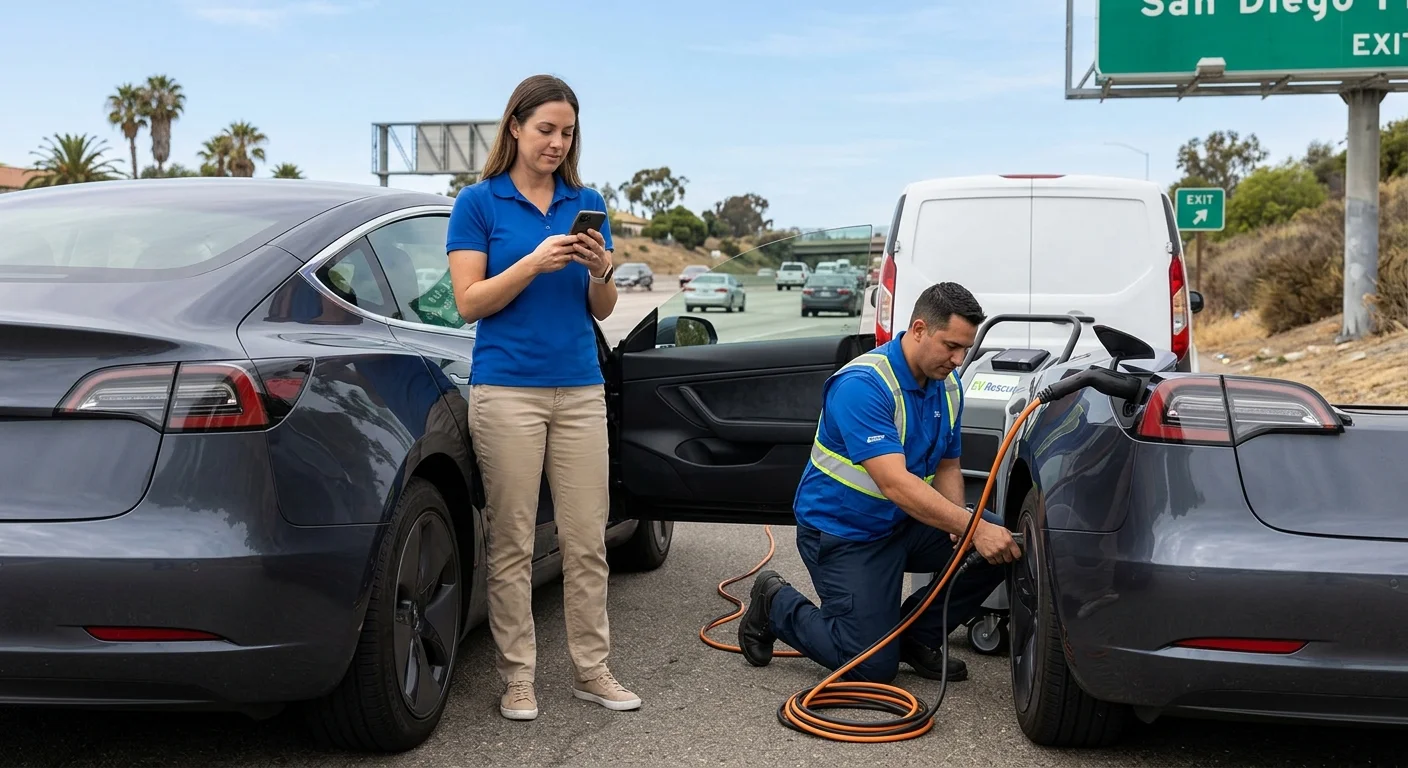
Confirm you need nearby EV roadside help
This search is for help that can reach the car you cannot keep driving. It is not a public charger list. If you still have enough indicated range to roll to a station, that is a different job. Our page on mobile EV charging near me in San Diego is for a charger that comes to a parked car. This page is roadside triage: empty pack, a car that will not wake, or a vehicle that has to leave the lane.
San Diego County is not one grid. I-5 along the coast, I-805 through the South Bay, I-15 inland, and I-8 into East County strand people in different ways. Coastal north county (Oceanside, Encinitas, La Jolla) has dense traffic and tight shoulders. Inland north county (Escondido, San Marcos, Poway) stretches farther between safe pull-offs. East County (El Cajon, Santee, Lakeside) sits hotter and more open. South Bay (National City, Chula Vista, San Ysidro) mixes freight, border traffic, and neighborhood streets. A useful near-me request names which of those you are in.
If the car is in a traffic lane or a dangerous spot, California Highway Patrol says to call 911. In metro areas, other roadside requests can go through 511. You say “Roadside Assistance.” CHP’s Freeway Service Patrol works designated routes and hours. If the car will not restart, FSP may move it to an approved drop, not a shop or house you pick. FSP materials do not describe mobile EV pack charging.
OEM programs are another lane. Tesla asks owners to request help in the Tesla app. Tesla says out-of-range help may exist but is not financially covered, and availability can be limited for safety or rules. Rivian says roadside is included for the New Vehicle Limited Warranty period, through the Rivian app and the center display. Rivian’s legal terms (updated July 16, 2026) put most services on the owner except complimentary towing Rivian offers for warranty issues, and only in supported regions. Lucid’s warranty page says roadside is a separate Lucid Roadside Assistance Program, not part of the New Vehicle Limited Warranty, and lists +1 (888) 995-8243. Confirm live coverage in the app or policy. None of those programs make Charge Pro SD the operator.
Insurance roadside is often a jump, a tire, a lockout, and a tow. GEICO’s Emergency Roadside Service page lists those categories. It does not list on-site EV pack charging. Uber’s Urgent.ly help for Gold, Platinum, or Diamond driver rewards is similar: tire, jump, fuel, lockout, winch, and towing up to 25 miles, up to three times on a rolling 365-day window from first use. Confirm eligibility in the app. If you need the traction pack charged on the shoulder, say that out loud. A generic “battery” ticket often gets a 12-volt jump truck.
Charge Pro SD serves San Diego County’s 67 cities. We connect you. The independent operator you hire confirms the job.
Tell empty charge from low-voltage failure
Empty traction pack and a dead 12-volt (or low-voltage) system are not the same rescue. Mix them up and you send the wrong truck.
An empty drive battery is a range problem. The car may have been losing miles, showing a low-charge warning, or already sitting at a reported zero. You cannot add driving range without energy into that pack. The U.S. Department of Energy’s Alternative Fuels Data Center notes that charging time depends on state of charge, battery capacity and type, the vehicle’s onboard charging capacity, equipment output, and electrical service. A mobile operator who brings AC Level 2 gear is working in a 240-volt residential-style or 208-volt commercial-style range, with equipment that can span 2.9 to 19.2 kW. That is not a public DC fast station. Nobody here should promise a full pack on the shoulder, a set percentage, or a timed fill.
A low-voltage failure is a wake-up problem. The high-voltage pack can still hold charge while the car will not ready, shift, or respond the way it did an hour ago. Tesla’s current Model Y manual describes a lithium-ion low-voltage battery and jump posts after the hood is open. Tesla also says Model Y cannot jump another vehicle. The wires behind a Tesla Model Y tow-eye cover only release the hood latches. Tesla says they cannot charge the low-voltage battery and must be disconnected as soon as the hood unlatches. Other brands put jump points in different places. Ford’s Mach-E how-to says a charge may be needed to open the door and hood before cables, and to use the Owner’s Manual. Rivian’s R1T guide for model years 2025-2027 puts a 12-volt jump harness at the trailer-hitch area for those years. Do not copy that onto an older year without that year’s guide. Do not improvise with household cords or guess at clamp points.
Tell the operator the make, model, year, what the dash showed before it went dark, and whether the charge port still opens. J1772 and J3400 (NACS) are the common AC Level 2 connectors. A CCS inlet uses the J1772 portion for AC and adds two lower pins for DC. Connector shape does not prove a mobile unit can feed your car. Ask the operator to confirm the port, any approved adapter, and the proposed service before anyone rolls.
If you are not sure which failure you have, say so. Guessing “just charge it” when the 12-volt is dead wastes a trip. Guessing “just jump it” when the pack is at zero leaves you in the same spot. Charge Pro SD does not diagnose the car the way a shop would. We pass what you report to an independent operator so that person can decide if they can take the job.
Share a San Diego location an operator can use
Pin the car, not the restaurant you meant to reach.
Operators need a place a service vehicle can legally stop. On I-5, I-8, I-15, or I-805, that usually means a shoulder, an off-ramp, or the first surface street after you exit. A live lane is a 911 call, not a charging call. If CHP or FSP already tagged the car, say so.
Give the freeway, direction, and the last exit you passed. “Northbound I-15 past Ted Williams Parkway” is usable. “Somewhere near Rancho Bernardo” is not. Downtown and Mission Valley have parking structures and HOV ramps that confuse GPS. Coastal jobs in Pacific Beach, Ocean Beach, and Point Loma often need a cross street plus which side of the curb. East County jobs on SR-67 or I-8 can sit in cell-shadow canyons. SR-52, SR-78, SR-94, and SR-125 strand people on connectors that apps label poorly. Stay with the car if it is safe. If you have to walk for signal, note a landmark the operator can see from the road.
Do not send a list of public charger addresses you found in an app and expect the operator to meet you there unless you can still drive. If you cannot move, the job is at the car. If you can limp a short distance to a lot, say the remaining indicated miles and the lot name. The operator still confirms access, height clearance, and whether they can work there. We do not publish charger addresses here because a stall that was open this morning may be blocked, gated, or out of service when you arrive.
Charge Pro SD does not dispatch a branded fleet. The independent operator you are matched with has to agree the pin is reachable with the equipment they actually have. Ask about price and timing on that call. We do not quote either.
Choose charging, a jump, or transport
Three common paths. None is automatic.
Mobile charging is an operator bringing charging equipment to the car so you can add enough energy to reach a station or home. That is mobile EV charging, not a Supercharger on wheels. Output, connector, and how much energy they can add are operator questions. The U.S. Department of Energy EV overview is a useful primer on levels and connectors. We do not promise a delivered charge, a percentage, or that any given operator has a unit free.
A low-voltage jump is the path when the car will not wake. A jump of the 12-volt system may restore computers so you can drive or open the charge port. Manufacturer manuals differ. Some brands want a portable pack in a stated voltage window. Some warn you not to use the EV to jump another car. If the operator cannot jump your model, they should say that before they take the job. We do not walk DIY clamp maps on this page.
Transport is the path when the car cannot take a charge, cannot be jumped, is in a no-stop zone, or you need it at a shop. We do not publish a required tow method here. Ask the operator what equipment they will use for your make and year, and where they can legally take the car. FSP drops are approved locations, not a dealer you name. Manufacturer roadside may cover a tow under warranty terms, or it may bill you. Rivian, Tesla, and Lucid each describe those lines differently. Read the app and the warranty page for your VIN.
A fourth path is wait and call the brand. That can be right when the car is in a safe lot and the OEM program will take it. It is a poor fit when you are on a freeway shoulder after dark. Emergency EV charging in San Diego walks the charge-on-site case. Emergency EV roadside assistance is the service page when you want a match for the whole roadside decision, not only a charger.
Tires, lockouts, and winching are still classic roadside items. An EV still gets flats on I-8 grade or a nail in Otay Ranch. Confirm whether the operator in front of you does those jobs or only energy and transport. Roadside assistance for an EV is a menu, not one truck that does every job.
How Charge Pro SD connects you with a local operator
You call. You describe the car, the symptom, and a pin an operator can use. We match you with a licensed, independent local EV charging or rescue professional. You contract and pay that professional directly. Charge Pro SD performs no work, employs no roadside crews, owns no trucks, holds no trade license for the job, and gives no warranty on the operator’s work.
Before anyone accepts, ask the operator to confirm make, model, year, charge port, approved adapter, symptoms, location, proposed service, price, and timing. If they cannot do the job, say so and we can try another match. Availability is not a promise. Equipment on a given truck is not a promise. Arrival is not a timed product.
We serve San Diego County. That includes the coast, inland north county, the central city, East County, and the South Bay. Electric car roadside assistance here has to respect those corridors. I-5, I-8, I-15, and I-805 are the routes people actually stall on. Your pin is the local fact that matters.
If you still have range and you only need a public plug, use your charging app and keep driving. The California Energy Commission tracks statewide charging policy. It will not send a truck. If you are stopped and you need a person, that is this search: EV roadside assistance near me, answered with a real San Diego location and a clear failure type.
When to call us
Call when the EV is stopped in San Diego County and you need a local operator to talk through a charge, a low-voltage jump, or a move. Call us at (858) 400-4465 and we’ll connect you with a local EV rescue operator.