The Tesla app can still take a roadside request after factory coverage looks closed. That tap is not a price quote. Tesla says out-of-range assistance may be available, but it is not financially covered. Before anyone hooks a line on I-5, I-15, or I-8, confirm eligibility and get the charge in writing.
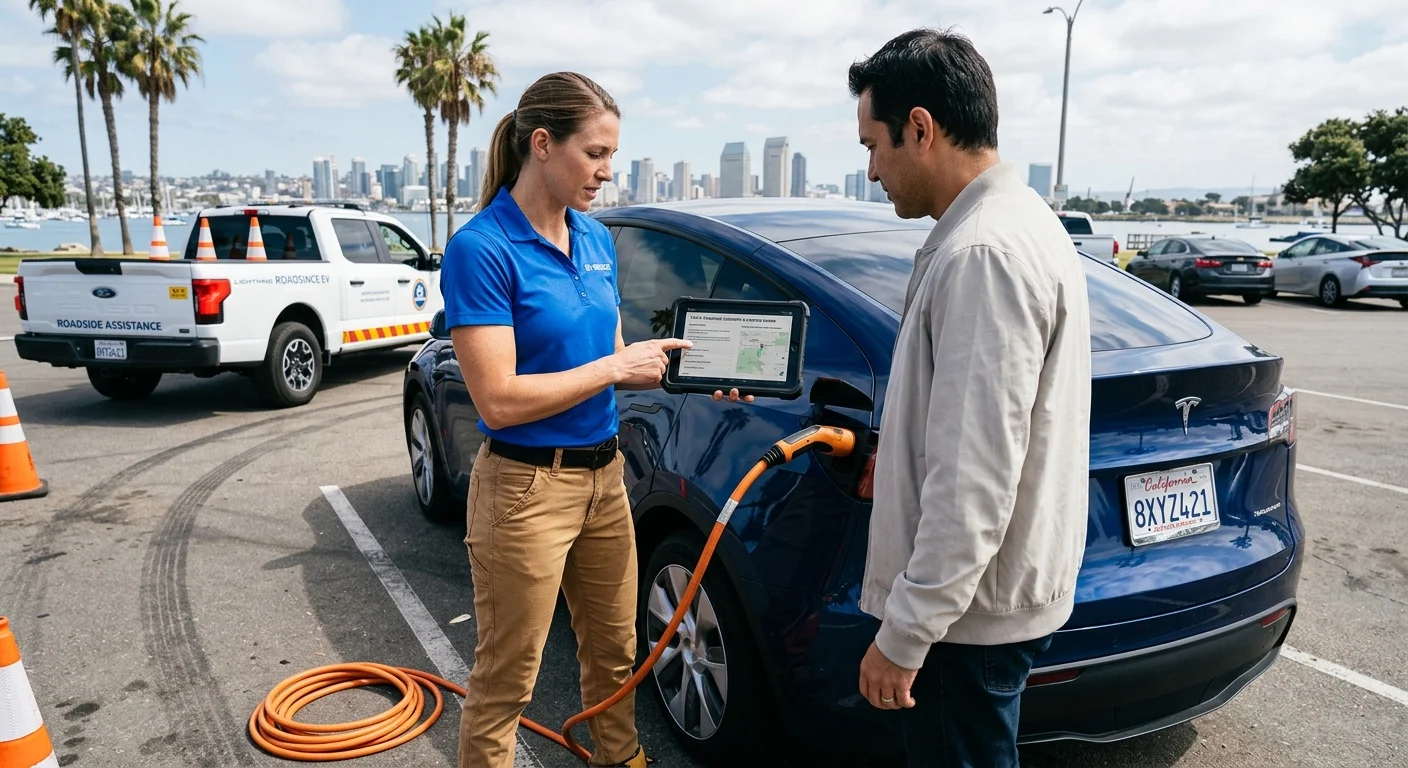
Confirm the vehicle’s current eligibility
Open the Tesla app and read Specs and Warranty for this VIN. Do not guess from the model year, the Carfax, or a forum post. Tesla’s New Vehicle Limited Warranty for Model S, Model 3, Model X, and Model Y sold by Tesla is VIN-specific. The app still controls, even if a PDF you found online looks close.
What Charge Pro SD can confirm from Tesla’s New Vehicle Limited Warranty (North America, effective 2025/06/05) is the Battery and Drive Unit Limited Warranty for those four models. Model S and Model X: 8 years or 150,000 miles, whichever comes first, with a minimum 70% battery capacity retention. Model 3 and Model Y Standard or Standard Range Plus: 8 years or 100,000 miles. Model 3 and Model Y Long Range or Performance: 8 years or 120,000 miles. That PDF does not cover Cybertruck. If you drive a Cybertruck, stop here and read the warranty screen in the app.
Those battery numbers are repair coverage for the pack and drive unit. They are not a roadside price list. Tesla directs owners to request roadside assistance through the Tesla app. Tesla also says roadside availability can be restricted case by case for safety or regulatory reasons. A request on a closed I-5 shoulder at rush hour is not the same as a request in a Mission Valley garage.
Owners in San Diego often treat “out of warranty” as one switch. It is not. A 2021 Model Y Long Range can still sit inside the 8-year / 120,000-mile battery window while other coverage has already ended. A Standard Range Model 3 hits its battery mileage cap sooner. Used cars sold in Kearny Mesa, El Cajon, or Oceanside still follow the original VIN terms. Check the app before you assume Tesla will or will not bill you.
If the car is already in a travel lane, skip the paperwork fight. California Highway Patrol says to call 911 when a disabled vehicle is in a dangerous location or a traffic lane. In metropolitan areas, other roadside requests can go through 511 by saying “Roadside Assistance.” That path is safety, not Tesla billing.
Separate roadside terms from repair coverage
A warrantable battery defect is a service-center problem. A car that hit 0% on I-805 is an energy problem. Tesla’s roadside page treats those as different things. Tesla says out-of-range assistance may be available, but it is not financially covered. That sentence is the after-warranty cost question in plain words: running out of range is not a free Tesla tow, and it is not a free pack repair.
Roadside is a dispatch request. Repair is a warranty claim. Mixing them is how people get a bill they did not expect. A pack that will not hold charge under what Tesla’s battery warranty covers can still be a warranty conversation after the basic coverage window people talk about has closed. A car that sat empty overnight in a Pacific Beach garage is usually not that conversation.
Tesla roadside assistance coverage is the place to map included versus excluded help while a plan is still active. This page is the later decision. Once Tesla is no longer financially covering the call, you are shopping a service: tow, lockout, low-voltage jump, or a charge to the nearest working stall.
Do not treat an Extended Service Agreement as a known dollar figure. Charge Pro SD could not confirm a current Tesla ESA price, term, or roadside add-on from the approved claims ledger. If Tesla still offers an agreement for your VIN, the app is where that purchase lives. A blog that quotes a 2023 range is not your contract.
Insurance roadside is a third bucket. GEICO’s emergency roadside page lists towing to the nearest qualified repair facility (mileage limits apply), battery jump starts, tire changes with a working spare, lockout help with a dollar cap for covered causes, winching near a publicly maintained roadway, and fuel delivery with the fuel cost excluded. Coverage varies by state. The policy contract is the mileage number. That page does not list on-site EV pack charging. If your insurer is GEICO, do not expect a mobile charger from that benefit. Confirm live coverage with the carrier before you waive a Tesla charge or hire a local operator.
Verify any charge before accepting service
Charge Pro SD could not confirm a public Tesla dollar amount for roadside after warranty. Tesla has not published a figure in the sources this site is allowed to treat as fact. Anyone quoting a flat fee, a per-mile rate, or a “usually free” line is guessing. Guessing is how a Kearny Mesa owner pays for a tow they thought Tesla owned.
Ask for the charge in writing before you accept the truck. Get the service type, the destination, and whether Tesla is billing you or a contractor is. If the destination is a Tesla Service Center, confirm that is still the destination once you are paying. If you want the car at home in Rancho Bernardo or at a shop in National City, say so before the hook is on. A change of destination after the truck is rolling is a second negotiation.
Tesla’s roadside assistance page is the official request path. Use it. Then treat every number they or a contractor speak as provisional until it is written. Our Tesla roadside assistance cost breakdown walks the same discipline while coverage is still in play. After coverage, the discipline matters more, because there is no “it should be included” cushion.
CHP’s Freeway Service Patrol works designated routes and operating periods. If the vehicle cannot be restarted, an approved drop location may be used. That is not a chosen private shop and not your driveway in La Mesa. FSP materials do not state that mobile EV charging is available. A patrol stop can get you off I-8 or I-15. It does not replace a written Tesla quote or a local operator who can actually charge the pack.
Refuse to authorize work on a verbal “we’ll figure it out.” Independent operators in this county should state the proposed service, the price, and the timing before they start. Charge Pro SD does not set those prices. The operator you contract with does. You pay that operator directly.
Identify the problem before requesting help
Name the failure before you name the vendor. A dark screen with range still showing is not the same as a 0% pack. A flat on SR-52 is not the same as a car that will not unlatch. The wrong request is how you wait for a tow when you needed a low-voltage jump, or pay for a long haul when a charge to the next stall would have moved you.
Tesla’s current Model Y manual describes a lithium-ion low-voltage battery and identifies positive and negative jump posts after the hood is open. Model Y cannot be used to jump-start another vehicle. The wires behind the tow-eye cover only release the hood latches. Tesla says those wires cannot charge the low-voltage battery and must be disconnected as soon as the hood unlatches. If jump starting Model Y using another vehicle, Tesla says to follow that other vehicle’s instructions. Do not copy a Model Y map onto a Model 3, Model S, Model X, or Cybertruck. Ask the operator to confirm the year and the manual for the car in front of them.
If the high-voltage pack is empty, you need energy, not a 12-volt pack. The U.S. Department of Energy notes that charging time depends on state of charge, battery capacity, the vehicle’s onboard charger, equipment output, and electrical service. A mobile charge on I-5 through the South Bay is a different job from a roll-back to a service center in the central city. Say which outcome you want.
Tesla could not be confirmed, from the sources this site uses, on a specific rule for leaving a car unplugged for two weeks. If the car sat in an Oceanside driveway or a downtown garage, read the alerts in the app and describe those alerts to whoever you call. Do not diagnose a pack from a parked-time story.
If you are in a lane, call 911 first. If you are on a designated Freeway Service Patrol route, 511 can request roadside help. Then decide whether Tesla, your insurer, or a matched local operator is the paying party. Safety first. Billing second.
Consider a matched local operator
Once Tesla is not financially covering the call, you are hiring a local job. Charge Pro SD is a referral service. It matches you with licensed, independent EV rescue operators in San Diego County. It does not own trucks, does not send a crew, and does not set the price. The operator confirms the make, model, year, port, symptoms, location, proposed service, price, and timing before the job is accepted.
That confirmation matters on a Tesla. Towing a car with no power is not a generic hook. Low-voltage jumps follow Tesla’s posts, not a gas-car clamp map. A charge to the next Supercharger or destination charger is a pack-energy job. Ask the operator which of those they can actually do at your pin: a closed lane on I-805, a coastal lot in La Jolla, or a shoulder on SR-67.
Tesla roadside rescue is the Tesla-specific path. Emergency EV roadside assistance covers the wider county dispatch when the car is simply disabled. Use the one that matches the car and the failure. If Tesla already quoted a tow you do not want, a local operator can still be the second bid. Get both numbers in writing and pick.
Do not wait for a “complimentary” label that Tesla has not put on out-of-range help. Do not assume an insurer will charge the pack. Do not assume Freeway Service Patrol will take you home. In this county the working sequence is: get out of the lane, identify the failure, read the Tesla warranty screen, demand a written charge, then hire the operator who can finish the job.
When to call us
Call when Tesla has said the help is not financially covered, when the app request is restricted, or when you need a local operator to confirm a Tesla-specific tow, low-voltage jump, or mobile charge in San Diego County. Call us at (858) 400-4465 and we’ll connect you with a local EV rescue operator.