Tesla roadside is requested in the Tesla app. Tesla says out-of-range assistance may be available but is not financially covered, and roadside availability can be restricted case by case for safety or regulatory reasons. Confirm current coverage on Tesla’s support pages. This page will not inventory Tesla menu items. Many makers specify a flatbed. Check that year’s book.
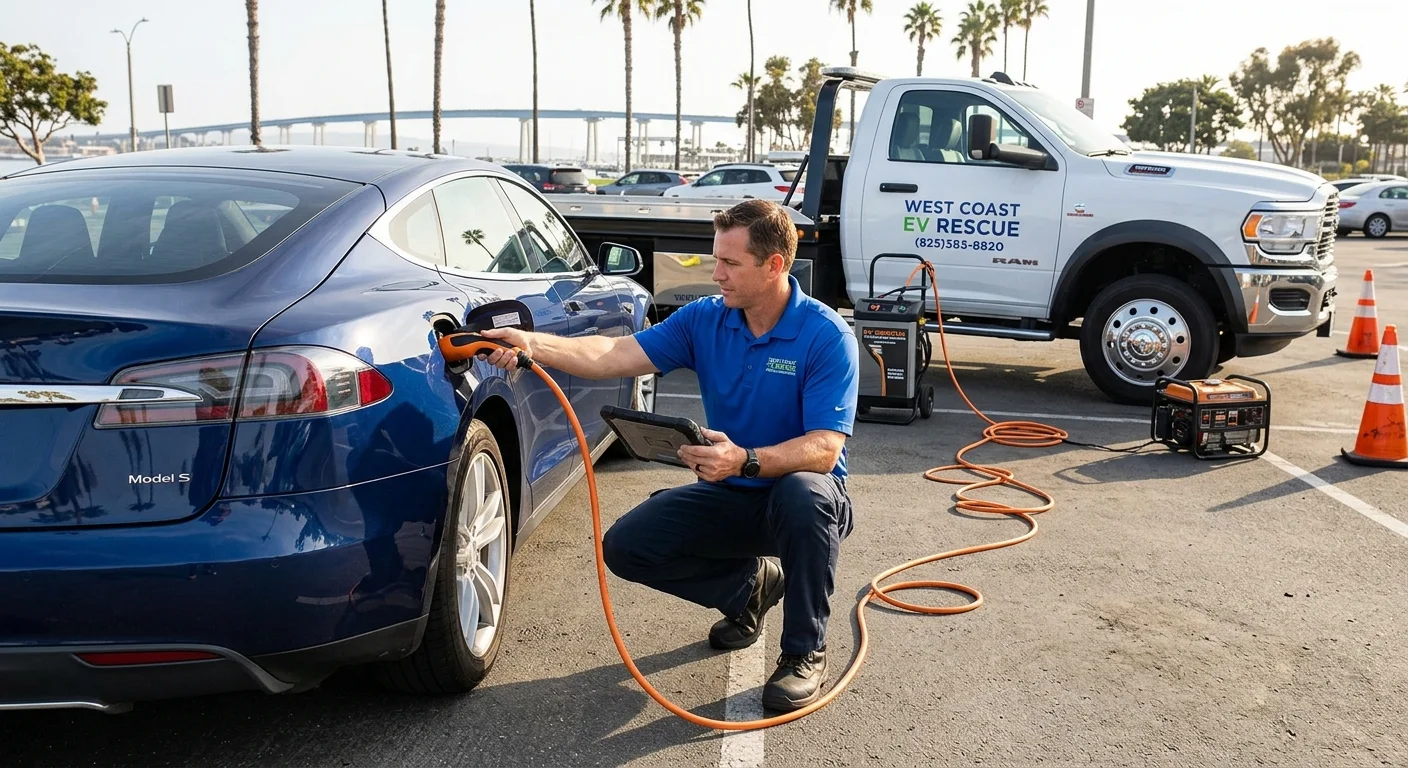
Decide whether the Tesla needs charging or transport
A Tesla that won’t move doesn’t automatically need towing. Start by describing exactly what happened before requesting a Tesla tow truck.
Tell the operator what appears on the display or phone app. Mention whether the car reached zero charge, stopped accepting a charge, or shows another warning. Also say whether it was involved in a collision or has a tire, wheel, steering, or access problem.
These details help separate two different requests. One is getting enough energy to continue toward a suitable charger. The other is transporting a car that shouldn’t or can’t continue under its own power.
Mobile charging may be the better question when the car simply ran out of energy. Ask whether an operator offering out-of-charge EV recovery can assist at your location. Don’t assume every roadside provider offers that option.
Transport may make more sense when charging won’t address the immediate problem. It may also be the only option an available operator offers. Ask the operator to explain why the proposed service matches the symptoms you reported.
Location changes the conversation. A Tesla stopped near Kearny Mesa presents different access questions than one inside a Downtown parking structure. A vehicle along I-5, I-805, or I-15 also needs a different pickup discussion than one parked at home.
Our guide to mobile EV charging versus a tow can help you frame that first decision. Give the operator facts, not a diagnosis. Let the operator determine what help can be provided safely.
Ask how the operator handles a powerless vehicle
“Powerless” can mean several things to a driver. The screen may be dark, the doors may not respond, or the vehicle may refuse to enter the requested setting. Explain what you can observe without guessing at the cause.
Before booking a Tesla towing service, ask the operator how they’ll approach the car in its present condition. Useful questions include:
- Have you handled this Tesla model in a similar condition?
- What information do you need before coming to the vehicle?
- How will you access the car if normal controls don’t respond?
- What loading method do you plan to use?
- Will you consult current Tesla instructions for this model?
- What should I avoid doing while I wait?
Listen for a specific answer tied to your vehicle. “We tow Teslas” isn’t the same as explaining how the operator will verify the current procedure.
Don’t try an improvised workaround based on an old video or another model’s instructions. Tesla procedures can depend on the model, configuration, and condition. Confirm the current steps in the owner documentation available through Tesla’s official channels.
Access matters across San Diego. Tell the operator if the vehicle is underground, behind a gate, in a narrow garage aisle, or parked against a wall. Share the posted height clearance when one exists. Don’t estimate it.
A garage pickup also needs a clear meeting plan. Tell the operator which entrance reaches the vehicle, where payment gates sit, and whether building staff control access. Our emergency EV roadside assistance page explains how we connect drivers with independent local help.
Confirm model-specific loading requirements
Don’t book based only on the word “Tesla.” Give the operator the exact model and any details shown in your app or vehicle information.
Model-specific confirmation should happen before the vehicle moves. Ask the operator to identify the Tesla guidance they plan to follow. If their answer sounds general, request a clearer explanation or check the current owner documentation yourself.
A useful confirmation message includes:
- The Tesla model
- The vehicle’s present condition
- Whether normal controls respond
- Whether every wheel can be reached
- The position of the vehicle
- Any visible damage or warning message
- The garage or roadway access limits
- The intended destination
Photos can clarify the pickup space. Send views of the vehicle, nearby walls, the driving aisle, and the entrance when the operator accepts them. A dropped map pin can also reduce confusion around large parking areas.
Don’t direct the operator through loading steps from memory. Instead, ask them to confirm the procedure against current Tesla guidance. That keeps responsibility with the professional handling the vehicle.
The same approach applies when normal vehicle power isn’t available. Our guide about how to tow a Tesla with no power focuses on the information drivers should gather before transport. It doesn’t replace Tesla’s current instructions or the operator’s assessment.
For model-focused help, review our Tesla roadside rescue page. Charge Pro SD is a referral service. We connect drivers with licensed, independent local operators, and the customer hires and pays the matched operator directly.
Choose a safe destination before the vehicle moves
Decide where the Tesla should go before confirming transport. “The nearest charger” may not answer the operator’s questions, especially when charging isn’t the identified need.
Your destination might be a location selected through Tesla’s official support channels, another repair facility, or a secure private address. Confirm that the destination accepts the vehicle before it leaves. Ask where the operator should enter and where the car may be placed.
Get the destination name and address from a current source. Don’t rely on an old search result or a saved map listing. Also confirm any entry instructions directly with the destination.
San Diego geography can complicate a vague plan. A pickup in the South Bay followed by a destination in North County is different from a short move within Kearny Mesa. Downtown access can involve garages, loading areas, and controlled entrances. Mission Valley properties may have several driveways serving one address.
Share the exact route constraints you already know. If a gate, parking attendant, or property manager controls access, contact that person before transport. Don’t promise the operator that access will be available unless it has been confirmed.
Ask what happens if the destination can’t receive the vehicle. The operator should explain the available choices before movement begins. Confirm who may authorize any destination change.
Pricing isn’t listed in the approved Charge Pro SD claims ledger. Ask the independent operator for their current terms before agreeing to service. Request an explanation of charges connected to pickup conditions, access, waiting, distance, destination changes, or storage. Our guide to the hidden costs of towing a dead EV provides more questions to ask without assuming any particular price.
How Charge Pro SD connects drivers with local help
Charge Pro SD helps stranded drivers find independent local EV operators. We don’t tow vehicles, provide mobile charging, employ roadside crews, own recovery equipment, set operator prices, or warranty their work.
When you contact us, describe the situation in plain terms. Start with the Tesla model and your San Diego County location. Then explain what the vehicle is doing, where it sits, and whether you’re deciding between charging and transport.
Include details that affect access. A vehicle inside a Kearny Mesa garage needs different pickup information than one in an open lot. A freeway shoulder requires a precise location and direction of travel. A gated residential property needs an entry plan.
You should be ready to share:
- Your Tesla model
- The warning or condition you can observe
- The pickup address or map pin
- The floor and clearance information for a garage
- Any gate, wall, curb, or parking constraint
- Your preferred destination
- Whether that destination has confirmed acceptance
We use those details to connect you with a local operator suited to the request. You’ll confirm service terms, pricing, loading plans, destination, and any warranty directly with that operator.
If you’re still unsure whether the car needs energy or transport, say that first. The operator can review the reported condition and explain what they can provide. Our out-of-charge recovery service is the most relevant starting point when the traction battery appears depleted.
Don’t describe Charge Pro SD as the towing company arriving at your vehicle. We’re the connection point. The independent operator you hire performs the roadside or transport work.
When to call us
Call when your Tesla won’t continue and you need help choosing between mobile charging and transport. Have the model, visible warning, exact location, access details, and preferred destination ready.
Call (858) 400-4465. Charge Pro does not send a Charge Pro crew.