The dash just showed a weak power source line, and the car is not acting like itself. Charge Pro SD could not confirm that exact Tesla phrase in the owner manuals on our verified list, so we treat it as a message to copy. Photograph the screen, write down the model and year, then sort Tesla service, a low-voltage jump, or a local rescue operator.
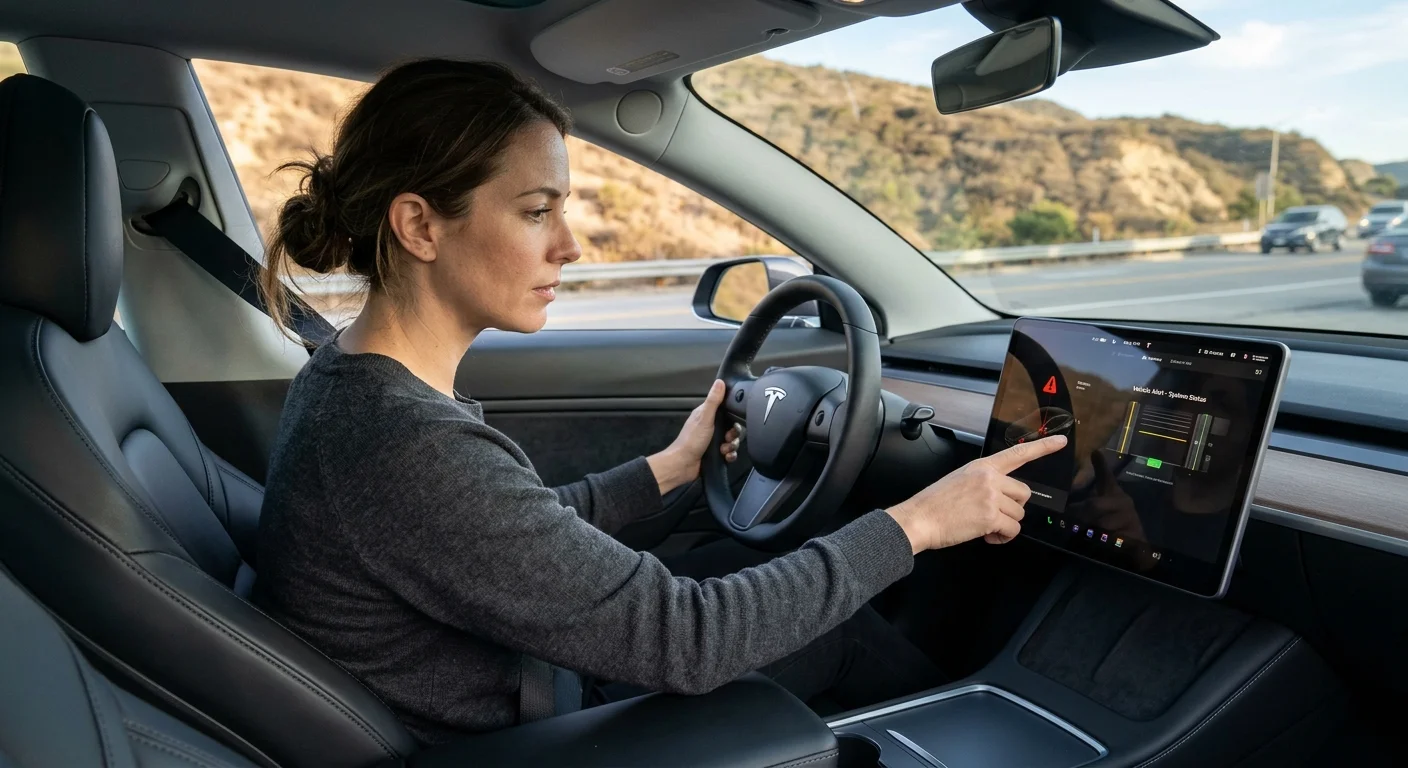
Read the exact warning on the Tesla display
Park somewhere safe and stay with the car if you can. On a San Diego freeway shoulder, that means hazards on, cabin occupied only if it is safer than getting out, and 911 if you are in a traffic lane. California Highway Patrol says to call 911 when a disabled vehicle is in a dangerous location or a travel lane. In metro areas, other roadside requests can go through 511 by saying “Roadside Assistance.”
Then treat the screen as evidence. Write the full string, including any second line. Photograph it in daylight or with the cabin light so a later operator can read it. Note the model, model year, and the software version if the car still shows it. Tesla changes alert language across years, so a 2021 Model 3 and a current Model Y can put different words on the same kind of problem.
If the display also shows a Tesla low voltage warning, copy that string too. Owners also search “voltage supply too low,” “unable to drive voltage too low,” and “low voltage battery warning.” Those may be related lines, or they may be different alerts. Charge Pro SD does not have a Tesla document that maps “weak power source” to a voltage number, a battery chemistry, or a single failed part. A matched operator and Tesla service still need the words you actually saw.
Leave the car in Park. Do not keep cycling Drive hoping the banner clears. Each wake-up draws on the low-voltage system Tesla describes in the current Model Y jump-start pages, and that system is what keeps the computers, locks, and screens talking. If the screen is already dim, get the photo first.
San Diego adds a location note to that photo. A stall in a Mission Valley garage, a coastal Encinitas driveway, or an East County shoulder on SR-67 are three different call-outs. Write the city, the road, and whether you can stay with the car. That is the file Tesla roadside and a local operator both need.
Separate weak power from an empty traction battery
A Tesla has more than one power store. The traction battery is the pack that moves the car and shows as range or percent on the display. The low-voltage system is the smaller battery Tesla’s current Model Y manual describes as lithium-ion, with jump posts under the hood. “Weak power source” is a dashboard line. An empty traction battery is a range problem. They can strand you in the same parking stall and still need different help.
Look at the indicated range if the display still wakes. Miles remaining, a 0% pack, or a “charge now” style banner points at the traction battery. That is the path toward a charger, Tesla Supercharging if the car will take it, or Tesla roadside rescue if you cannot move. The U.S. Department of Energy explains that charging time depends on state of charge, battery capacity, the vehicle’s onboard charging capacity, equipment output, and electrical service. A 240-volt home circuit is Level 2 in typical residential use. That fact answers a charging question. It does not decode this alert.
If the display still shows usable range and the car will not ready, stay with the weak-power file you already started. Do not drive across Kearny Mesa or down I-5 hunting a Supercharger on a guess. An empty pack on I-15 at 0 miles is one job. A car in a Chula Vista lot at 40% with a weak power source banner is another. Tell whoever you call which one you have.
Related Tesla 12V battery failure symptoms can look adjacent: slow screens, locks that hesitate, a car that will not wake after sitting. Those patterns still do not prove what “weak power source” means on your year. Tesla has not given Charge Pro SD a published definition of that phrase. Record the traction percent anyway. It keeps Tesla service and a matched operator from sending the wrong truck.
A car that sat unplugged for days in a hot Clairemont driveway can wake with a low pack, a low-voltage complaint, or both. Copy every banner. Then let Tesla’s current service path and the operator’s own check separate the systems.
Check Tesla’s current service path
Open the Tesla app while the phone still has signal. Tesla tells owners to request roadside assistance there. Tesla also says out-of-range help may be available, with the owner paying, and that roadside can be restricted case by case for safety or regulatory reasons. That is Tesla’s rule, not a Charge Pro SD promise.
Start that request before you shop other options if the car is under Tesla’s process and you can wait for their channel. Save the request number. If the app will not connect, note that too. Downtown garages, canyons off SR-52, and the far edge of Ramona all eat cell coverage in different ways.
Tesla’s New Vehicle Limited Warranty for Model S, 3, X, and Y sold by Tesla (North America PDF effective 2025/06/05) covers the high-voltage battery and drive unit for 8 years, with mileage caps that depend on the model and range pack, and a minimum 70% capacity retention on S and X. VIN-specific terms in the Tesla app still control. That PDF does not name a “weak power source” repair, and it does not cover Cybertruck. Do not treat this banner as a confirmed warranty event. Ask Tesla how they classify the ticket.
If the car sits in a live lane on I-5, I-805, or I-15, call 911 first. CHP and Freeway Service Patrol work designated routes and hours. If the car cannot restart, they may move it to an approved drop, not the shop you pick. That is a safety move. It is separate from Tesla service and from a later Tesla 12V battery jump.
Charge Pro SD is a San Diego County referral service. We match you with a licensed, independent local operator. We do not hold a trade license, own trucks, or perform the work. Tesla’s app remains the factory channel. A local operator is the backup when Tesla is unavailable, the car is off their coverage, or you need someone who can confirm a jump or a transport on this exact vehicle.
Know when a low-voltage jump may fit
A low-voltage jump is a possible next step when the car will not wake, the hood can be opened, and Tesla’s procedure for that model year says to use the jump posts. It is a maybe until the operator sees the car.
For the current Model Y, Tesla’s owner’s manual describes a lithium-ion low-voltage battery and identifies positive and negative jump posts after the hood is open. Tesla’s jump page assumes an external low-voltage supply such as a portable jump starter. If someone uses another vehicle, Tesla says to follow that other manufacturer’s instructions. Model Y cannot be used to jump-start another vehicle.
If the Model Y has no power to open the hood, Tesla’s “Opening the Hood with No Power” page says the wires behind the tow-eye cover only release the hood latches. Those leads cannot charge the low-voltage battery. Tesla says to disconnect them as soon as the hood unlatches. That is a latch trick, not a jump.
Those pages are Model Y documents. Do not copy them onto a Model 3, S, X, or Cybertruck. Ask Tesla, or the independent operator, for that year’s manual before anyone clamps a pack. Charge Pro SD does not jump batteries. The operator we connect you with confirms the make, model, year, posts, and whether a jump is even on the table.
A jump that wakes the screens is a temporary charge of the low-voltage system. Tesla still wants the 12-volt or low-voltage status reviewed. If the banner returns in a Santee driveway the next morning, you need Tesla service, not another roadside cycle. If the traction pack is empty, a low-voltage jump will not put miles on the display. Say so up front so the operator brings the right gear.
Skip DIY if you cannot follow Tesla’s page for your year, cannot open the hood, or are on a live shoulder. Stay with 911 and Tesla’s app in that case, then a matched operator once the car is somewhere they can work.
What to share with a matched local operator
Give the operator a file, not a guess. Start with the exact dash text and a photo. Add the model, model year, color, and VIN if you have it. Name the last place the car charged, the indicated range, and whether the charge port still opens. Say whether doors, windows, and the hood still work. If you already opened a Tesla roadside ticket, give them the number.
Pin the location the way a driver would say it: “northbound I-5 shoulder, Oceanside,” “parking structure near Petco Park, level 3,” “street parking in North Park.” San Diego County is 67 cities in our service map. Coastal north county, inland north county, the central city, East County, and the South Bay have different shoulders, different cell coverage, and different tow rules. The operator needs the city, not “San Diego” as a blur.
Describe what you already tried: Tesla app, 911, 511, a portable jump pack, another vehicle. Say whether anyone touched the tow-eye cover. For a Model Y, that matters because those wires are only for the hood latches.
Then let the operator confirm the job. Before a referral is accepted, they should confirm the exact vehicle, the proposed service, the price, and the timing with you. Charge Pro SD does not set those. We also do not promise an arrival window. If the right help is a low-voltage jump, they say so. If the car needs transport to Tesla or a charge for an empty pack, they say that instead.
Keep people out of live lanes while you wait. If the car is already on a quiet street in La Mesa or a lot in Carlsbad, stay with it if that is safe. The more complete the notes, the less time the operator spends diagnosing the banner you already photographed.
When to call us
Call when the Tesla is stuck in San Diego County, the dash shows a weak power source line or a related voltage banner, and you need a licensed independent operator for a possible low-voltage jump or a roadside rescue. Call us at (858) 400-4465 and we’ll connect you with a local EV rescue operator.