A Subaru Solterra that won’t start almost always has a dead 12V auxiliary battery, not a depleted traction pack. When that small battery fails, the READY light never appears, the dash stays dark, and the doors may not unlock from the fob. Restoring power to the right terminals brings the car back in minutes, though a battery near the end of its life will need replacing soon after.

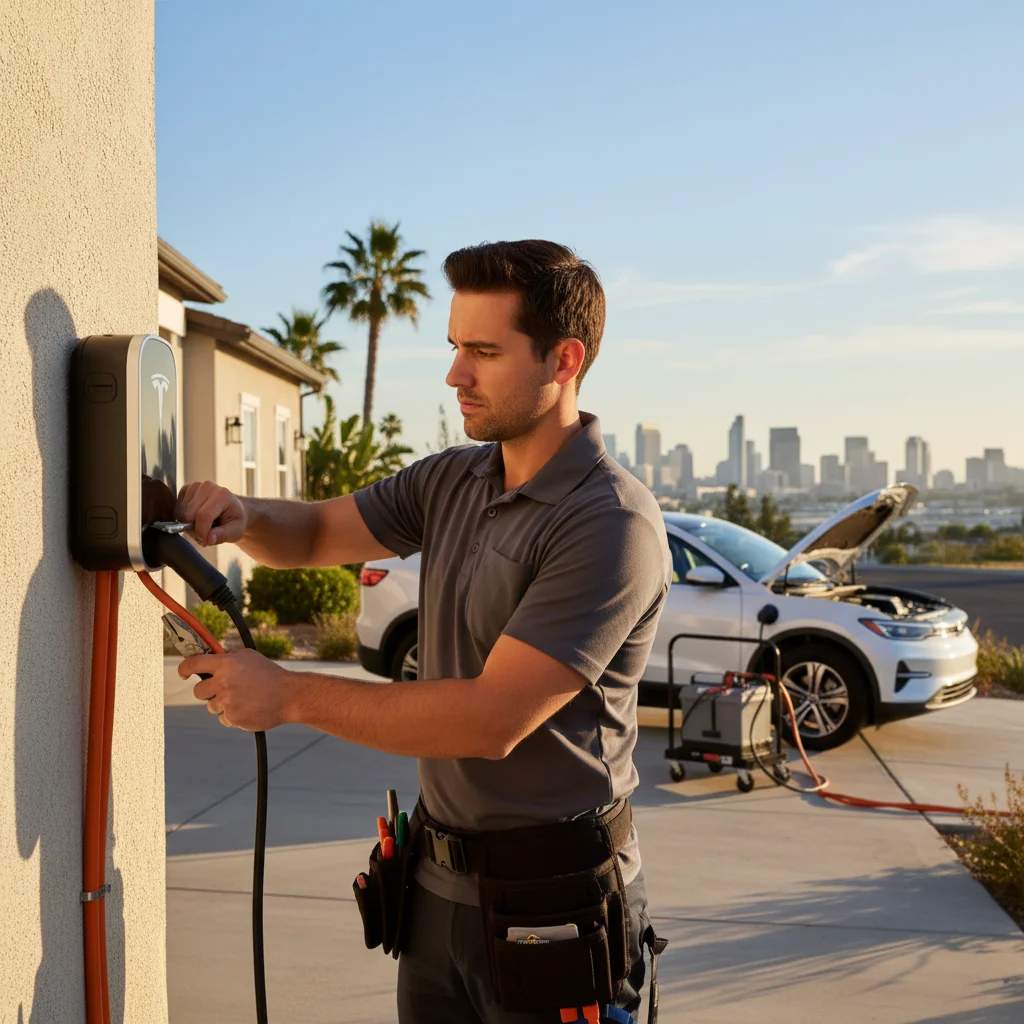
A stranded Subaru Solterra parked at a San Diego trailhead with a mobile EV rescue vehicle pulling up to assist.

The Solterra is the twin of the Toyota bZ4X. Both ride on Subaru and Toyota’s shared e-TNGA platform, so they’re mechanically identical down to the 12V system. If you want the same walkthrough framed for the Toyota, our Toyota bZ4X won’t start guide covers the exact same hardware.

Why the Solterra goes completely dead

The Solterra runs on two separate batteries. A high-voltage traction pack moves the car, and a conventional 12V lead-acid battery powers every low-voltage system, including the computers that wake the high-voltage system up. That order matters. If the 12V is dead, the traction pack stays locked out no matter how full it is.

So a Solterra showing 70 percent range can still refuse to start. The dash never lights, the screens stay black, and there’s no chime when you press the power button. People assume they’re out of charge. They’re not. The 12V just can’t boot the car.

The Solterra’s 12V is a standard lead-acid unit, not a lithium pack, so it sulfates and fails the same way a gas car’s battery does. EVs rarely run the engine to top it back up, so a weak 12V tends to die quietly. San Diego heat speeds that up, and the Solterra has owner reports of early 12V failure at fairly low mileage.

For the full picture on why this hits every EV brand, read what happens when an EV 12V battery dies.

The symptoms that point to the 12V

A few signs separate a dead 12V from a real high-voltage problem:

  • Dash, ambient lighting, and infotainment all stay dark when you press Power
  • Key fob unlock does nothing, and the physical key is your only way in
  • Hazard lights won’t turn on
  • No chime or “clunk” from the door locks as you walk up
  • The car was fine yesterday, then completely dead this morning

That last one is the tell. A 12V usually fails overnight after it’s been quietly weakening for weeks. If the dash lights up, throws a high-voltage system warning, then shuts down, that’s a different fault and belongs at a dealership. For the plain “nothing happens” case, start with the 12V.

Where the Solterra’s 12V battery and jump points are

Because the Solterra shares the bZ4X layout, the 12V battery sits under a plastic cover on the driver’s side of the front compartment. You can reach the terminals there, but Subaru also provides dedicated jump posts on the same side so you don’t have to pull the cover off completely.

Jump point locations:

  • Positive (+): Red terminal post under a hinged red plastic cover, driver’s side front of the engine bay, marked with a ”+” symbol.
  • Negative (-): Don’t clamp the battery’s negative terminal. Use an unpainted metal bracket or bolt on the bay structure, away from the battery, so any spark stays clear of off-gassing.

Step by step:

  1. Confirm the donor vehicle or portable jump pack is off before you connect anything.
  2. Clamp positive to the Solterra’s red jump post, then positive to the donor’s positive.
  3. Clamp negative to the donor’s negative, then the last negative to bare metal on the Solterra, not the battery.
  4. Power the jump pack on, or start the donor car, and wait two to three minutes.
  5. Press the Solterra’s power button. The dash should light and the READY light should appear.
  6. Remove the clamps in reverse order once it’s awake.

Years and trims vary, so check the owner’s manual for your exact year before you connect anything. If you’re not sure, our team does this on Solterras regularly. Our guide on how to jump start an EV safely walks through the same steps with more detail on what not to touch.

When it’s the traction pack instead

Sometimes the 12V is fine and the real problem is range. If your dash actually lights up, you get a READY light, but the car shows zero or near-zero miles and won’t drive, the traction pack is depleted, not the 12V. That’s an out-of-charge situation, and a jump won’t fix it.

The Solterra uses a CCS charge port, so it can take a DC top-off in the field. We carry a CCS adapter and can add real range right where you’re parked, enough to reach the nearest fast charger or get you home. That’s our out-of-charge EV recovery service, separate from a 12V jump.

San Diego context: where we get these calls

Subaru runs deep in San Diego. The Solterra is a common sight at East County trailheads and weekend trips out toward Julian, Alpine, and Anza-Borrego. That’s also where the 12V tends to strand people, because the car sits parked for hours at a trailhead in the heat, then won’t wake up when it’s time to head home.

We cover all 67 cities in the county. Metro response runs 25 to 60 minutes. East County and the backcountry, the Julian and Anza-Borrego runs included, are 75 to 90 minutes given the drive. Dispatch is 24/7, so a cold Solterra at a dark trailhead is a normal call for us, not an unusual one.

How our rescue works

We roll a Tesla Cybertruck with a 240V, 9.6 kW bed outlet and a CCS adapter for non-Tesla EVs like the Solterra. For a dead 12V, we jump the correct posts and get your READY light back, then check whether the battery will hold or needs replacing. On-site 12V replacement runs $220 to $380 if it’s done.

If the issue is range instead, we add charge through the CCS port, usually 30 to 60 miles depending on conditions, enough to reach a fast charger or home. Dispatch is $149 and includes the roll plus the first 15 minutes, then $1.80 per added mile. Most rescues land between $149 and $225. After-hours, 11pm to 6am, adds $50.

Stranded right now? Call (858) 400-4465. We’ll confirm whether it’s the 12V or the pack before we leave, so we show up with the right fix. More on the service on our non-Tesla EV rescue page.

Frequently asked questions

Why won’t my Subaru Solterra start even though it has charge?

Because the Solterra needs its 12V battery to boot the car before the traction pack can do anything. If the 12V is dead, the dash stays dark and nothing responds, no matter how much range you have. It’s the most common cause of a Solterra that won’t start. A jump to the right terminals usually brings it back in minutes.

Is the Solterra’s 12V battery the same as the Toyota bZ4X?

Yes. The Solterra and bZ4X share Subaru and Toyota’s e-TNGA platform and are mechanically identical, including the 12V system, its location, and the jump points. Any 12V guidance for one applies to the other. The only differences are badging and a few tuning choices, none of which affect how you jump the 12V.

Can I jump start my Solterra myself?

You can, carefully. Use the red positive jump post under the hinged cover on the driver’s side, and ground the negative to bare metal, not the battery terminal. Confirm your exact year in the owner’s manual first. If you’re unsure or the car still won’t wake after a few minutes, call us and we’ll handle it.

How long does range last after you charge my Solterra?

For a non-Tesla like the Solterra, we typically add 30 to 60 miles through the CCS port in the field. That’s meant to get you to the nearest fast charger or home, not to fully recharge on the spot. Once you reach a DC fast charger, you can top off to full at normal charging speeds.

Do you cover East County trailheads like Julian and Anza-Borrego?

Yes. We dispatch 24/7 across all 67 San Diego County cities, including the backcountry. Metro response runs 25 to 60 minutes. East County and backcountry trips out toward Julian and Anza-Borrego run 75 to 90 minutes because of the drive distance. Call ahead so we can confirm your exact location and the right fix before we roll.