Progressive’s roadside assistance covers a jump start and a tow for a dead EV battery, but it doesn’t charge your car on the spot.
If you’re a Progressive policyholder in San Diego and your EV’s battery dies, you’re probably assuming your insurance has you covered. It does, to a point. Progressive will send help and get your car moving again. What it won’t do is hand you range while you’re sitting on the shoulder. That gap matters more for an EV than it ever did for a gas car.
What Progressive’s roadside plan actually does for an EV
Progressive sells roadside assistance as an add-on to a policy, and it’s built around the same benefits whether you drive a gas car or an EV: flat tire changes, lockout help, fuel or fluid delivery, and towing when the car won’t move under its own power. For a 12V battery that’s died (the small battery that runs the computers and locks, separate from the big traction battery), Progressive will dispatch someone to attempt a jump start at the scene. If that doesn’t bring the car back, or if the high-voltage battery itself is the problem, the next step is a tow.
Progressive’s own materials say that if your EV runs out of charge, they’ll arrange a tow, and if there isn’t a charging station within their standard towing radius, they’ll take you to the nearest one. You’re responsible for the actual cost of the electricity once you get there. That’s the whole benefit: a ride to a plug, not a charge in your driveway or on the freeway shoulder.
The distance limit you need to check yourself
Every roadside plan, including Progressive’s, sets a cap on how far they’ll tow you for free. That cap varies by policy tier and can change year to year, so we’re not going to quote you a number here and have it be wrong for your specific plan. Pull up your policy declarations page or call your agent and ask two questions directly: what’s my towing distance limit, and does it apply the same way to a tow-to-charger as it does to a tow-to-repair-shop. Some reps will tell you the mileage cap without hesitation. Others will need to look it up. Either way, know the number before you need it, not while you’re stranded.
In San Diego County, that distance cap matters because chargers aren’t evenly spread out. Coastal cities like La Jolla and Carlsbad have plenty of options. East County and the mountain corridors toward Julian and Alpine have a lot fewer. If your tow radius doesn’t reach a working charger, you could end up short, or you pay the difference out of pocket.
Why a tow to a charger still costs you hours
Even when the tow itself goes fine, the sequence is slow. You call, you wait for the truck, you’re loaded and driven to a station, and then you sit while the car actually charges. If the nearest option is a Level 2 charger instead of a fast charger, that last step alone can eat an hour or more. Add up the wait for dispatch, the drive, and the charging session, and a dead battery that should’ve cost you 30 minutes can turn into half your afternoon. We broke down what that full sequence really costs in hidden costs of towing a dead EV, and it’s not just the receipt from the tow company.
What a mobile charge does instead
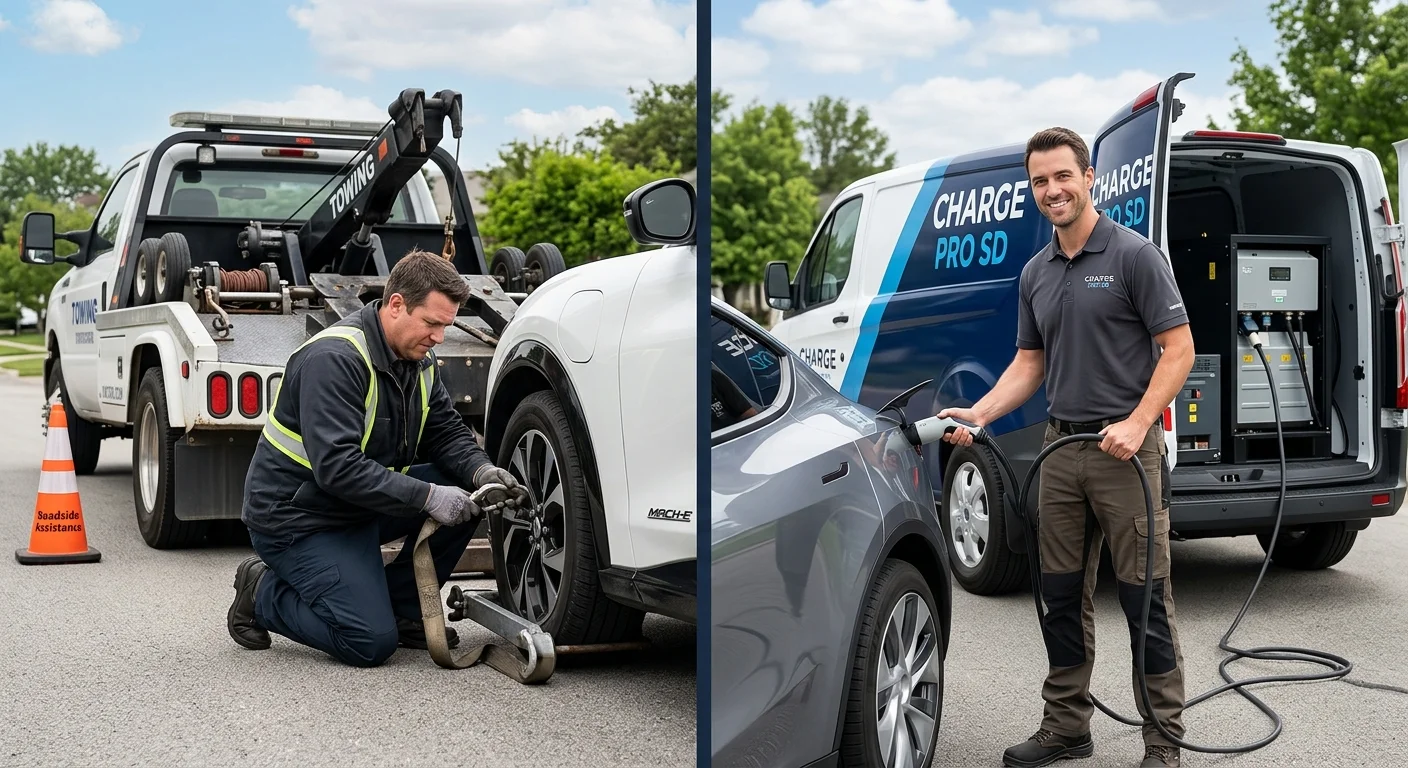
A mobile EV rescue skips the tow entirely. We drive to wherever you’re stopped, freeway shoulder, parking structure, driveway, and deliver charge directly into your car. You’re not riding along with a tow truck or waiting at a public station that might be occupied or broken. You get enough range to reach a charger on your own terms, or sometimes enough to just get home. It’s the difference between someone bringing you gas and someone hauling your car to a gas station.
This isn’t a knock on Progressive. Their roadside plan does what it’s built to do, get a broken-down car to help. It just wasn’t designed around the specific problem of an EV that’s simply out of charge but otherwise fine to drive. For a closer look at how insurance roadside stacks up against a dedicated mobile charge, read our comparison of Geico’s roadside process for EVs and AAA vs. mobile EV charging. The pattern holds across carriers.
Can you use Progressive and a mobile charging service together
Yes, and a lot of EV owners in San Diego do exactly that. Keep Progressive’s roadside coverage for the stuff it’s genuinely good at, flats, lockouts, a mechanical issue that actually needs a repair shop. Call a mobile charging service specifically when the problem is charge, not damage. They’re not competing services. One moves a broken car. The other solves a battery that’s simply empty.
Frequently asked questions
Will Progressive jump-start my EV’s 12V battery?
Yes. A dead 12V battery is a common failure point on EVs and it’s treated like any other jump-start call under Progressive’s roadside benefit. If the jump doesn’t hold or the car won’t stay running, the next step is usually a tow.
Does Progressive tow EVs on a flatbed?
Most EVs need to be flatbed towed rather than pulled with the drive wheels on the ground, since dragging the wheels can damage the motor or regenerative braking system. Confirm with the dispatcher that a flatbed is what’s coming, especially if you’re stranded somewhere the tow company might default to whatever truck is closest.
Does Progressive pay for the electricity once I’m towed to a charger?
No. The tow itself may be covered under your policy’s towing benefit, but charging costs at the station are on you, the same way gas would be if they towed a gas car to a station.
What should I do if Progressive’s tow radius won’t reach a working charger?
Ask the dispatcher directly before the truck arrives. If the nearest charger is outside your covered radius, you may be charged the difference, or you can call a mobile charging service instead and skip the tow question altogether.
Is a mobile charge cheaper than a Progressive tow for a dead EV?
It depends on your plan and how far you are from a charger. What’s consistent is the time. A mobile charge gets you moving in well under the two to six hours a tow-and-charge sequence usually takes.
If your EV is sitting dead somewhere in San Diego County and you’d rather get charged than towed, call Charge Pro SD at (858) 400-4465 and we’ll be on our way.