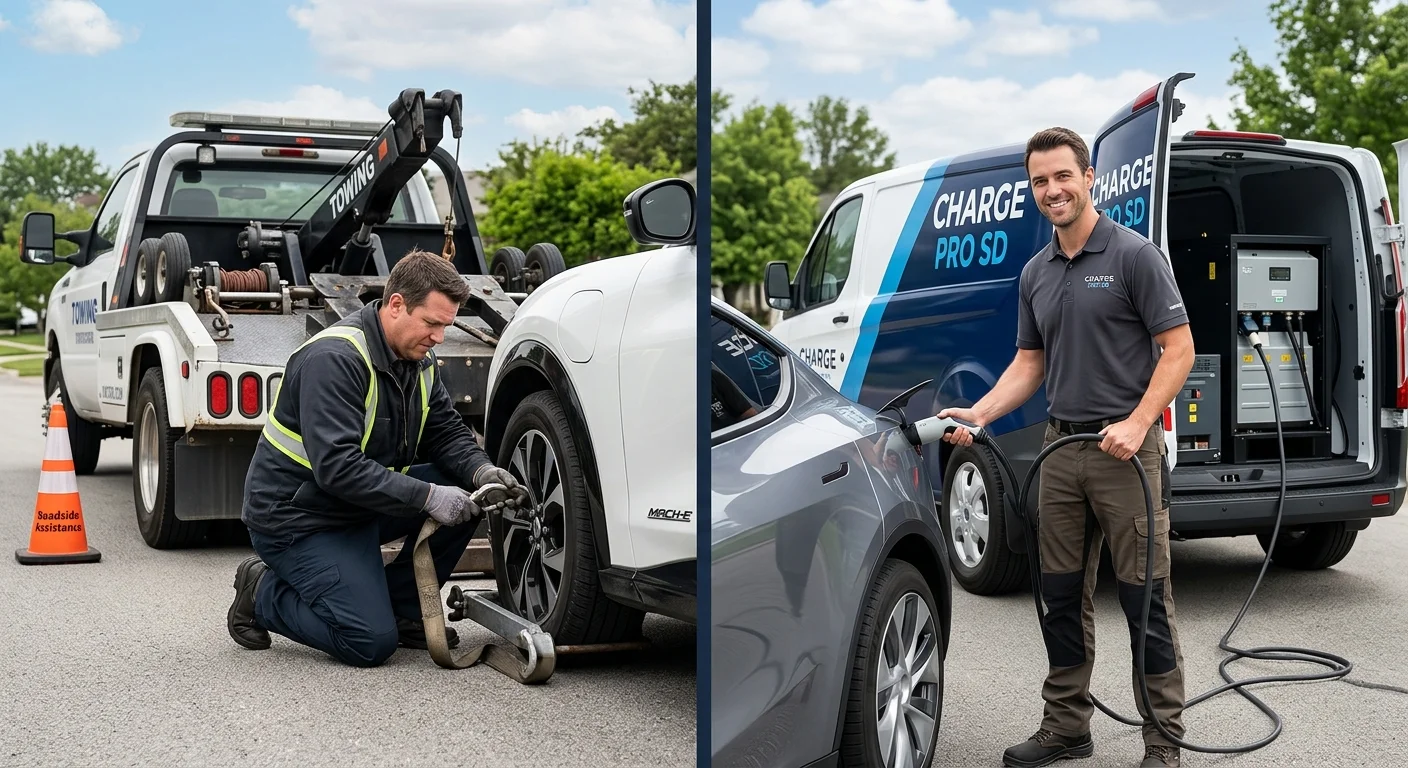
Driving an EV in San Diego is great, but what happens if your battery runs critically low or completely out? Many EV owners instinctively reach for their insurance provider’s roadside assistance. If you’re a Geico policyholder, you might wonder what to expect when you call for help with your electric vehicle. The reality of using traditional roadside services for an EV can be very different from what you anticipate.
What Geico’s roadside assistance actually covers for EVs
Geico’s roadside assistance is designed to offer a safety net for many common vehicle issues. For EVs, their coverage generally aligns with what they provide for gasoline-powered cars. This means you can typically expect help with flat tires, dead 12V batteries, lockouts, and towing services. When your EV runs out of charge, Geico usually offers to tow your vehicle to the nearest charging station or a repair facility. They don’t typically provide on-the-spot mobile charging as a standard benefit.
It’s important to understand the specifics of your policy. While the goal is to get you moving again, the method might not be tailored to the unique needs of an electric vehicle. For instance, a traditional tow truck might be dispatched, which can be a concern for some EV owners who prefer flatbed towing to protect their vehicle’s drivetrain. Always confirm the type of tow service available when you call. Geico aims to provide efficient assistance, but the network of providers they use might not always have EV-specific equipment or expertise readily available, especially in less populated parts of San Diego County. This general approach can sometimes lead to unexpected delays or solutions that aren’t ideal for a discharged EV.
The problem: they dispatch a traditional tow truck
One of the main challenges EV owners face with conventional roadside assistance, like Geico’s, is the dispatch of a standard tow truck. Most insurance companies contract with a broad network of towing providers. Many of these providers are equipped for traditional internal combustion engine (ICE) vehicles. While they can certainly tow an EV, they might not always have a flatbed truck immediately available. Towing an EV with its drive wheels on the ground can risk damage to the electric motors, transmission, or regenerative braking system. Modern EVs are often designed to be flatbed towed to prevent such issues.
When you’re stranded on a busy San Diego freeway, perhaps near the I-5 or I-15 corridors, waiting for the right type of tow truck can add significant stress and time to your situation. The dispatch process often focuses on the fastest available tow, not necessarily the most EV-appropriate one. This means you could end up waiting longer or needing to specifically request a flatbed, which might not be guaranteed or might involve a longer wait. This situation highlights a key difference between general insurance coverage and specialized emergency EV roadside assistance designed exclusively for electric vehicles.
Will they tow you to a charger? What are the limits?
Yes, if your EV is out of charge, Geico will typically tow it to the nearest public charging station or a repair shop. However, there are often limits to how far they’ll tow you. Many policies have a maximum towing distance, for example, 15 or 20 miles. In a sprawling area like San Diego County, the “nearest” charger might not be the most convenient, the fastest, or even fully operational. What happens if the closest charger is a Level 2 station and you need a quick DC fast charge to get back on the road efficiently? Or what if the charger is occupied, out of order, or requires a different adapter than what you have?
These limitations can turn a simple tow into a multi-step ordeal. You’re towed to a location, then you have to wait for your car to charge. This process involves waiting for the tow, the tow itself, and then potentially a long charging session. It’s a significant time investment when you just want to get your EV powered up and continue your journey. This extended downtime and the potential for a less-than-ideal charging situation are critical considerations when comparing Geico’s service to a mobile charging solution. Think about the hidden costs of towing a dead EV beyond just the tow itself.
Comparing wait times and outcomes: Geico vs. a dedicated EV rescue service
When your EV is stranded, time is often of the essence. Comparing the typical wait times and outcomes between Geico’s roadside assistance and a specialized EV rescue service like Charge Pro SD reveals significant differences. With Geico, the process generally involves:
- Calling Geico’s general roadside assistance line.
- Waiting for a standard tow truck dispatch. This can vary widely depending on location and availability of a suitable tow.
- The tow truck arrives and transports your vehicle to the nearest charging station or repair shop, adhering to policy limits.
- You then wait for your EV to charge, which could take hours, especially if it’s a Level 2 charger.
This multi-stage process can lead to extended periods of being stranded. In contrast, a dedicated mobile EV charging service streamlines the entire experience. When you call Charge Pro SD, you’re connecting with specialists who understand EVs inside and out. We dispatch a dedicated mobile charging unit directly to your location in San Diego County. Our units are equipped with the right charging technology to give your EV enough power to reach the nearest suitable charger or even get you home. This means:
- Calling a specialized EV rescue line.
- A mobile charging unit is dispatched directly. Our fleet is equipped specifically for EV needs.
- The unit arrives, provides an immediate charge on the spot, getting you enough range to continue.
This direct-to-location charging eliminates the need for a tow and the subsequent waiting at a public charging station. It’s a faster, more convenient, and often less stressful outcome for EV owners facing an out-of-charge scenario. For a deeper dive into how specialized services compare, you might want to read our article on AAA vs mobile EV charging San Diego.
Why a mobile charge is often faster and cheaper than your ‘free’ insurance tow
Many Geico policyholders view their roadside assistance as “free” because it’s included in their insurance package. However, when it comes to a dead EV, this “free” tow often comes with hidden costs and inconveniences that can make a dedicated mobile charge a more appealing option. Consider the following:
- Time is Money: The multi-step process of waiting for a tow, being towed, and then waiting for a full charge at a public station can easily consume several hours of your day. For someone on a schedule, this lost time can be more costly than the fee for an immediate mobile charge.
- Actual Cost of the Tow: While the tow might be covered, exceeding the mileage limit of your policy could result in out-of-pocket expenses. Additionally, if the first available tow isn’t a flatbed and you insist on one for your EV’s safety, you might face additional charges or a significantly longer wait.
- Charging Costs: Once towed to a public charger, you’ll still need to pay for the electricity to recharge your vehicle. These costs vary by station and can add up.
- Convenience and Stress: Being stranded is stressful enough. The uncertainty of tow truck availability, the potential for damage from improper towing, and the prolonged waiting can elevate that stress. A mobile charge delivers power directly to you, resolving the immediate problem without additional travel or waiting.
- Vehicle Preservation: Knowing your EV is being handled by professionals with the right equipment and knowledge specifically for electric vehicles provides peace of mind. This protects your investment and avoids potential costly repairs down the line due to improper towing.
In essence, while Geico’s roadside assistance is a valuable general service, for the specific and critical problem of an out-of-charge EV, a specialized mobile charging solution often proves to be a faster, more direct, and ultimately more efficient and less expensive option in terms of your overall time and convenience. The California Energy Commission supports the development of charging infrastructure, but getting to it when stranded is key.
When to call us
If your EV is out of charge in San Diego County and you need a swift, safe, and specialized rescue, don’t hesitate. You need an EV charging professional who can get you back on the road quickly without the complications of traditional towing. We’re equipped with the right gear and expertise to handle your electric vehicle with care. Call us at (858) 925-5546 for a same-day estimate.