When a Lucid Air won’t start, the cause is almost always a dead 12V auxiliary battery, not the big traction pack. The screens go dark, the door handles don’t present, and the car won’t wake even though the high-voltage pack still holds plenty of charge. The 12V system runs every wake-up signal in the car, and when it’s flat, nothing responds. Jump the 12V, give it a couple of minutes to recover, and the Air boots normally. Stranded in San Diego? Call Charge Pro SD at (858) 400-4465.

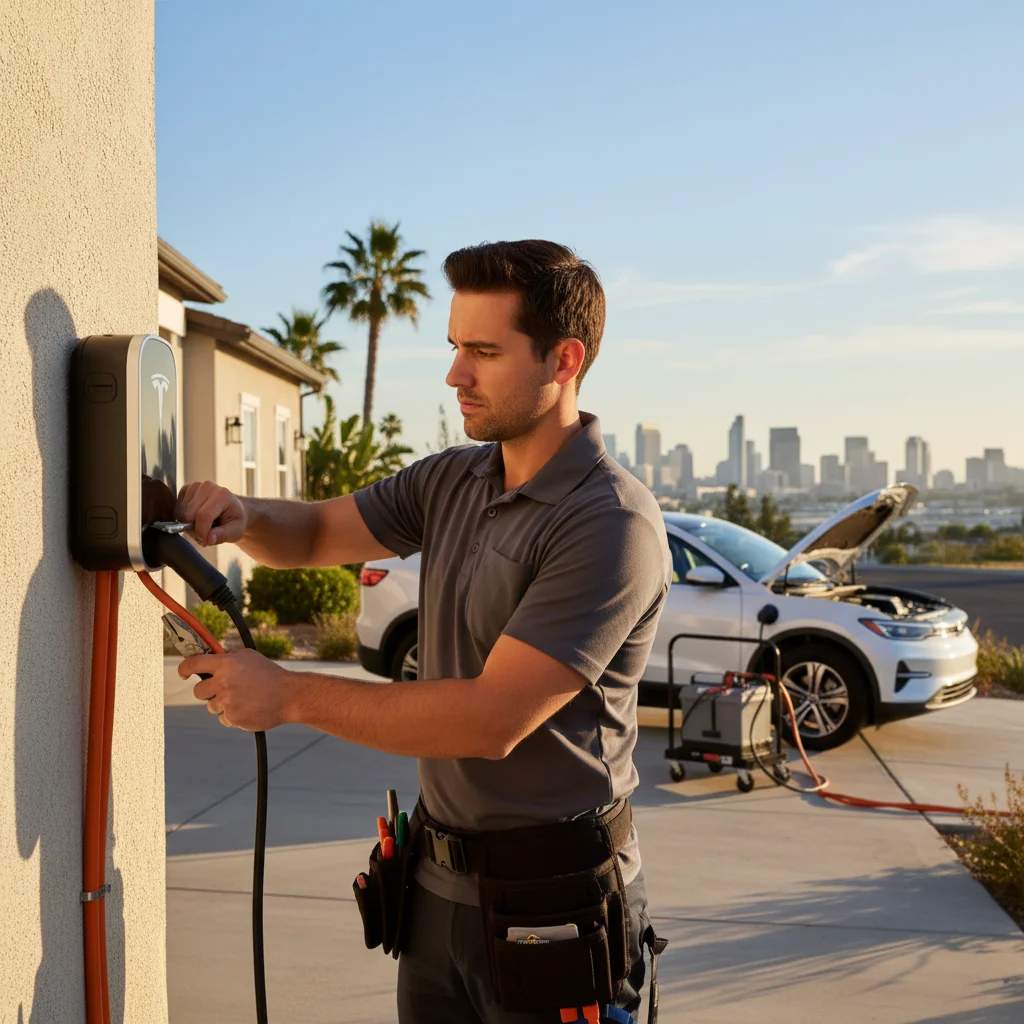
A Lucid Air luxury electric sedan parked in a San Diego driveway with a mobile EV rescue truck pulled up alongside it.

The Lucid Air is a luxury sedan, and like every modern EV it depends on a small 12V system to power its electronics and bring the rest of the car online. This guide covers why that 12V battery dies, how to spot it, how to get into the frunk and reach the jump points, when it’s actually the traction pack instead, and what to do when you’re stuck in San Diego.

Why the Lucid Air 12V battery fails

The Air’s 12V auxiliary battery feeds the entire low-voltage network: the flush door handles that motor out to meet you, the curved glass cockpit display, the central pilot screen, the power closures, the comfort electronics, and the control modules that connect the high-voltage pack to the drive system. None of that runs off the traction pack directly. It all runs off 12V.

The most common failure is simple parasitic draw. A luxury sedan like the Air has a long list of always-on modules: connectivity, sensors, the keyless entry system constantly listening for the fob. Park the car for two or three weeks without driving, and those modules can pull the 12V battery down below the voltage the car needs to wake up. The high-voltage pack normally tops the 12V back up through a DC-DC converter, but that only happens when the car is awake or charging. A car sitting idle in a garage isn’t replenishing anything.

San Diego’s mild coastal weather looks easy on a battery, but it cuts both ways. Warm parking in places like Del Mar or La Jolla keeps standby electronics cycling, and a 12V battery that’s three or more years old and never load-tested is the first thing to give out. Add a long airport trip or a second home where the car sits for weeks, and a flat 12V is a question of when, not if.

The failure signature usually looks like one of these:

  • Complete silence: no lights, handles don’t present, the fob won’t unlock the car
  • Screens flash on, show a 12V or system warning, then go dark before the car is ready to drive
  • The car partly wakes, then stalls and won’t enter drive-ready mode

All three point at the same thing. The 12V can’t deliver enough voltage to finish the startup handshake.

How to access and jump the 12V on a Lucid Air

The Air keeps its 12V battery and jump access under the front trunk. If the 12V is dead and the handles won’t present, start with getting inside and getting the frunk open.

  1. Use the physical key card or the mechanical key blade inside your fob to unlock the driver’s door manually. The flush handles need 12V power to present, so a dead battery means you open the door the old-fashioned way.
  2. Open the frunk. With no 12V power, the normal button release won’t work, so you’ll use the manual frunk release. On the Air this is a pull mechanism reached from inside the frunk area or via a release cable. The exact location and access vary by model year, so check the owner’s manual for your exact year before you start pulling.
  3. With the frunk open, locate the jump points. Lucid provides a dedicated positive (+) post under a protective cap for exactly this situation, paired with a chassis ground point for the negative (-).
  4. Connect a jump pack or donor source in the standard order: positive to the Air’s jump post, positive to the donor, negative to the donor, then negative to the Air’s chassis ground. Wait two full minutes.

After the 12V recovers, the screens should boot, the handles present, and the car should enter drive-ready mode normally. If a 12V fault warning sticks around and won’t clear, the battery is failing internally and needs replacement, which is a workshop job, not a roadside fix.

A few cautions worth repeating. Don’t guess at terminal locations, the Air’s layout differs from a Tesla or a German EV. We don’t do home or garage charger work, so if your real problem is that the car isn’t maintaining 12V because it never gets plugged in, that’s a conversation for a licensed electrician about a Level 2 install.

When it’s the traction pack, not the 12V

Most “won’t start” calls are 12V. But not all. If the Air woke up fine, showed you a low state of charge, and then quietly ran out of usable range, that’s the traction pack, not the auxiliary battery. The tell is whether the car ever powered up at all. A flat 12V is dark and dead from the first touch. An empty traction pack still lights up the screens and shows you a range or charge warning before it stops moving.

If you genuinely ran the high-voltage pack to empty, a jump won’t help. What you need is range delivered on the spot, which is what our out-of-charge EV recovery service is built for. We add enough miles to reach the nearest fast charger or get you home.

San Diego scenarios: where this happens

Lucid Air density in San Diego County clusters in the luxury pockets: Rancho Santa Fe, La Jolla, Del Mar, and Carmel Valley. Those are also the areas where the car sits for long stretches, second homes, airport trips, weeks between drives. That combination, an expensive sedan with heavy standby draw plus long idle time, is exactly what flattens a 12V.

A typical Charge Pro SD call: an Air parked at a Rancho Santa Fe estate for a couple of weeks, owner comes back to a dark car that won’t even unlock. Another: a La Jolla driveway with no Level 2 charger, so the 12V never gets maintained, and the battery quietly dies overnight. We see the same pattern near the I-5 and SR-56 corridor when someone heads from Del Mar toward downtown and the car won’t restart after a stop.

We cover all 67 cities in San Diego County. Response runs 25 to 60 minutes in the metro, longer for East County and the Backcountry. No tow needed for a 12V failure, and no tow needed for an empty pack either when range delivery can get you moving.

How our rescue works

We roll in a Tesla Cybertruck with a 240V, 9.6 kW bed outlet, a native NACS plug, and a CCS adapter for non-Tesla EVs like the Air. For a dead 12V, we carry the gear to jump the Air’s dedicated jump post safely, then let it recover and confirm the car boots and drives. For an empty traction pack, we deliver 30 to 60 miles depending on the car, enough to reach a charger or home.

Dispatch is $149 and includes the roll plus the first 15 minutes of work, then $1.80 per added mile. Most rescues land between $149 and $225. A 12V jump starts at $149, and if the battery is shot, on-site 12V replacement runs $220 to $380 where we can do it. After-hours calls between 11pm and 6am add $50. We dispatch 24/7.

Our non-Tesla EV rescue service covers the Lucid Air along with Rivian, Ford Lightning, Mach-E, Ioniq, EV6, and most North American EVs. If you want the step-by-step on the jump itself, read how to jump start an EV safely. And to understand why a tiny 12V battery can strand a car with a huge main pack, see what happens when an EV 12V battery dies.

Frequently asked questions

Why won’t my Lucid Air start even though the battery shows charge?

The charge you see on the dash is the high-voltage traction pack, but the car wakes up off the separate 12V auxiliary battery. When the 12V is flat, the screens, door handles, and control modules can’t power on, so the car won’t start no matter how full the main pack is. Jumping the 12V brings everything back online.

How do I open the frunk on a Lucid Air with a dead battery?

With no 12V power, the normal frunk button won’t work. The Air has a manual frunk release for exactly this situation, but its location and access vary by model year. Check the owner’s manual for your specific year before pulling anything. Once the frunk is open, the 12V jump post is accessible there.

Can Charge Pro SD jump a Lucid Air in San Diego?

Yes. We cover all of San Diego County for non-Tesla EV rescue, including the Lucid Air. We carry the equipment to jump the Air’s dedicated 12V post safely and confirm the car boots before we leave. Typical dispatch is 25 to 60 minutes. Call (858) 400-4465 with your location.

Is it the 12V battery or did my Lucid Air run out of charge?

Check whether the car powered up at all. A dead 12V is completely dark from the first touch, no lights, no handles, no unlock. An empty traction pack still lights the screens and warns you about low range before it stops. If it never lit up, it’s the 12V. If it warned you first, it’s the pack, and you need range delivered, not a jump.

How long does a Lucid Air 12V battery last?

Most owners get 3 to 5 years before the 12V auxiliary battery needs replacing, sometimes less on a car that sits for long stretches without driving. San Diego’s warm coastal climate adds standby stress year-round. Get the 12V load-tested at your service interval, especially after year three, and don’t ignore early warning messages.


Stranded with a Lucid Air that won’t start anywhere in San Diego County? Call Charge Pro SD at (858) 400-4465. We dispatch to Rancho Santa Fe, La Jolla, Del Mar, Carmel Valley, and every other part of the county, no tow needed for a 12V failure.