A Kia Niro EV that won’t start almost always traces back to the 12V auxiliary battery, not the main traction pack. When the 12V dies, the car’s electronics go dark: no dashboard, no response to the start button, no charging communication. The good news is that you can jump-start the Niro EV’s 12V battery at the under-hood jump posts in about ten minutes, and if you’re stranded anywhere in San Diego County, a mobile rescue can reach you without a tow.

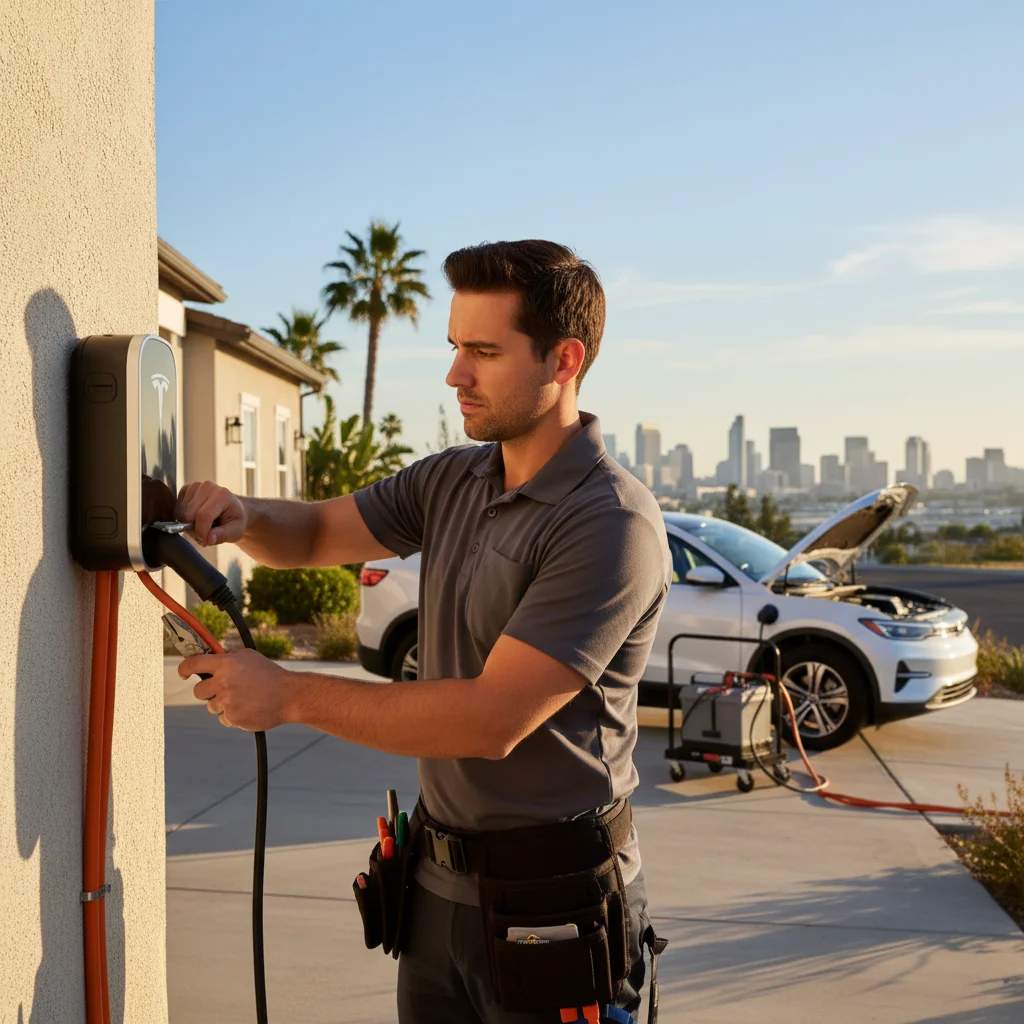
Mobile EV rescue vehicle alongside a stranded Kia Niro EV on a San Diego roadway

Why the Kia Niro EV won’t start

The Niro EV, sold as the 2019 to 2022 Niro EV and the redesigned 2023 to 2025 Niro EV, uses the same split-battery architecture as every other modern EV. A large lithium-ion traction pack moves the car; a small 12V lead-acid (or AGM) battery powers the control modules, door locks, alarm system, and the relay that wakes the main pack. If the 12V drains or fails, the car behaves like it’s completely dead even if the traction battery is at 80 percent.

Common no-start causes for the Kia Niro EV, roughly in order of frequency:

CauseSymptomsDIY fix?
Dead or low 12V auxiliary batteryBlank dash, no response to start button, no door-lock beepYes, jump-start at under-hood posts
Corrupted sleep mode (parasitic drain)Car stayed off for 2+ weeks, screens won’t wakeYes, 12V jump restores normal operation
Faulty 12V Battery Saver relayRepeated 12V drains over daysNo, dealer diagnosis needed
High-voltage interlock fault”Ready” mode never engages after 12V is fineNo, scan tool + dealer
Corroded or loose 12V terminalIntermittent starts, warning lightsYes, clean and retighten terminals
Key fob battery deadCar doesn’t recognize fob, won’t let you inYes, replace CR2032, or use physical key

San Diego’s marine layer climate is gentler on batteries than Phoenix heat, but coastal humidity accelerates terminal corrosion. If your Niro EV lives near the coast (La Jolla, Coronado, Pacific Beach, Oceanside) and starts acting up after a couple of years, corroded terminals are worth checking before you assume the 12V is dead.

Where the 12V battery is and how to jump-start it

On the Kia Niro EV, the 12V auxiliary battery is under the hood, on the driver’s side near the firewall. It’s tucked under a plastic cover but fully accessible without removing major components. The 2023+ redesigned model keeps the same general location.

You don’t jump directly from the 12V battery terminals. Kia provides dedicated jump-start posts just inside the engine bay, marked with a red positive cover (+) and a chassis ground point (–). These are the only safe jump points.

Step-by-step:

  1. Park the donor vehicle or position a portable jump starter so cables reach the Niro EV’s engine bay.
  2. Open the red positive cover on the Niro EV’s jump post. Connect the red cable to this post.
  3. Connect the other red cable to the donor’s positive terminal (or jump-starter positive).
  4. Connect the black cable to the donor’s negative terminal (or jump-starter negative).
  5. Connect the other black cable to an unpainted metal ground on the Niro EV (not the negative battery terminal directly, this reduces spark risk near the battery).
  6. Wait 2 to 3 minutes. Then press the Niro EV’s start button.
  7. If the dash lights up and the car enters Ready mode, remove cables in reverse order (negative first, then positive).
  8. Drive for at least 20 to 30 minutes to let the DC-DC converter recharge the 12V. Avoid turning the car off until you reach your destination.

Do not use a high-amperage diesel-truck jump starter on the Niro EV. A standard 12V jump starter rated 400 to 600 peak amps is plenty. The Niro EV’s 12V is a smaller battery than what you’d find in a full-size pickup.

For a broader look at safe jump-start technique on any EV, see our guide on how to jump-start an EV safely.

The Niro EV’s 12V Battery Save feature

The 2023 to 2025 Kia Niro EV includes a 12V Battery Save function in the vehicle settings menu. When enabled, it tells the DC-DC converter to keep the 12V topped up more aggressively while the main pack is being charged or while the car is parked plugged in.

If your Niro EV repeatedly loses its 12V charge, check this setting first:

  • Go to Settings → Vehicle → 12V Battery Save → toggle On.

This won’t fix a failing 12V battery, but it can extend the life of a borderline one and prevent the no-start symptom if you tend to leave the car parked for more than a week without plugging in. Kia added this feature specifically because early Niro EV owners reported repeated 12V drain events.

If you’ve enabled Battery Save and the 12V still keeps dying within days, the battery itself needs replacement, or there’s a parasitic draw from a faulty module. That’s a dealer-level diagnosis.

Dead-dash symptoms vs. main pack symptoms

A dead 12V and a depleted main pack can feel similar from the driver’s seat, but they’re different problems with different fixes.

Dead 12V symptoms:

  • Completely dark instrument cluster
  • No response when you press the start button (no relay click, no chime)
  • Key fob doesn’t unlock the doors (or you hear a weak, slow unlock sound)
  • Hazard lights don’t activate
  • Car was sitting for a week or more with no activity

Depleted main traction pack symptoms:

  • Dashboard turns on and shows a low-battery or turtle-mode warning
  • Car enters a “Ready Off” or “Save” state with a clear charge-level warning
  • You can still unlock doors, turn on lights, and interact with the infotainment
  • The car drove normally until it ran out of range

If your dash is completely dark and unresponsive, start with the 12V. If the dash is on and telling you the battery is low, you need a charge to the main pack, not a jump start. Our non-Tesla EV rescue service can deliver a mobile charge directly to the Niro EV’s CCS port, typically 30 to 60 miles of range, enough to reach a Level 2 station or get home.

Stranded in San Diego: what to do

San Diego geography creates some specific no-start scenarios worth knowing.

I-5, I-805, SR-78, SR-76 corridors: High-speed freeways with limited shoulder space. If your Niro EV stops in traffic, turn on hazards immediately, coast to the nearest exit or emergency pullout if you can, and call for mobile rescue rather than waiting for a tow. A mobile unit can reach most SD freeway corridors in 25 to 45 minutes.

Parking structures (Gaslamp, UTC, Mission Valley): Level 2 charging stations in SD parking structures are frequently occupied or out of service. If your Niro EV’s 12V has drained overnight in a parking garage and the car won’t start, a mobile rescue unit can access most multi-story garages. Give the dispatcher the garage address, level, and stall number when you call.

North County (Escondido, San Marcos, Vista, Fallbrook): More distance between public chargers. If you’re stranded on a rural stretch of SR-76 or in Fallbrook, mobile rescue is often faster than waiting for a tow to locate the nearest Kia dealer or charging station.

Border area and Chula Vista: The area around SR-905, I-805 south, and Otay Ranch has growing EV adoption but fewer emergency charging resources. We cover the full southern end of the county.

To understand what a non-Tesla EV rescue looks like on the road, including what our Cybertruck-based mobile unit brings to your location, that post walks through the full process. If you’re concerned about the underlying 12V, our overview of what happens when an EV 12V battery dies covers the failure sequence across EV brands.

Frequently asked questions

How do you jump-start a Kia Niro EV?

Connect jump cables to the dedicated under-hood jump posts (red positive post near the firewall, black to a chassis ground), not directly to the 12V battery terminals. Wait 2 to 3 minutes, then press the start button. If the car enters Ready mode, remove cables in reverse order and drive for at least 20 minutes to recharge the 12V via the DC-DC converter.

Where is the 12V battery in the Kia Niro EV?

The 12V auxiliary battery sits under the hood on the driver’s side, near the firewall, covered by a plastic panel. Kia provides separate jump-start posts in the engine bay that are easier and safer to use than connecting directly to the battery terminals.

Can a dead 12V battery kill the Kia Niro EV even if the main pack is charged?

Yes. The 12V battery powers the control modules that wake the main traction pack. If the 12V is dead, the car won’t respond to the start button or recognize a charging cable, even with a full traction battery. The fix is a 12V jump-start, not a charge to the main pack.

What is the Kia Niro EV’s 12V Battery Save feature?

Battery Save is a setting in the 2023 to 2025 Niro EV that tells the car to keep the 12V battery topped up more aggressively while plugged in or while the main pack is charging. It’s designed to prevent the parasitic drain that caused repeated no-start events for some early Niro EV owners. You enable it under Settings → Vehicle → 12V Battery Save.

Does Charge Pro come to Kia Niro EV drivers in San Diego?

Yes. We cover all 67 cities in San Diego County for non-Tesla EV rescue, including Kia Niro EV. Our mobile unit carries a 240V / 9.6 kW outlet with a CCS adapter and can deliver 30 to 60 miles of range directly to your location, so you skip the tow. Typical dispatch is 25 to 60 minutes depending on your location in the county.

How much does mobile EV rescue cost in San Diego for a Kia Niro EV?

Mobile EV rescue pricing depends on location and service type. For a ballpark, our guide to mobile EV charging costs covers current SD pricing ranges. Call us at (858) 400-4465 for a same-day quote specific to your situation.


If your Kia Niro EV won’t start and basic troubleshooting isn’t getting you anywhere, call Charge Pro SD at (858) 400-4465. We serve the full San Diego County area and can reach most locations in under an hour. No tow required. Visit our non-Tesla EV rescue service page or check coverage for your city at our San Diego EV roadside assistance hub.