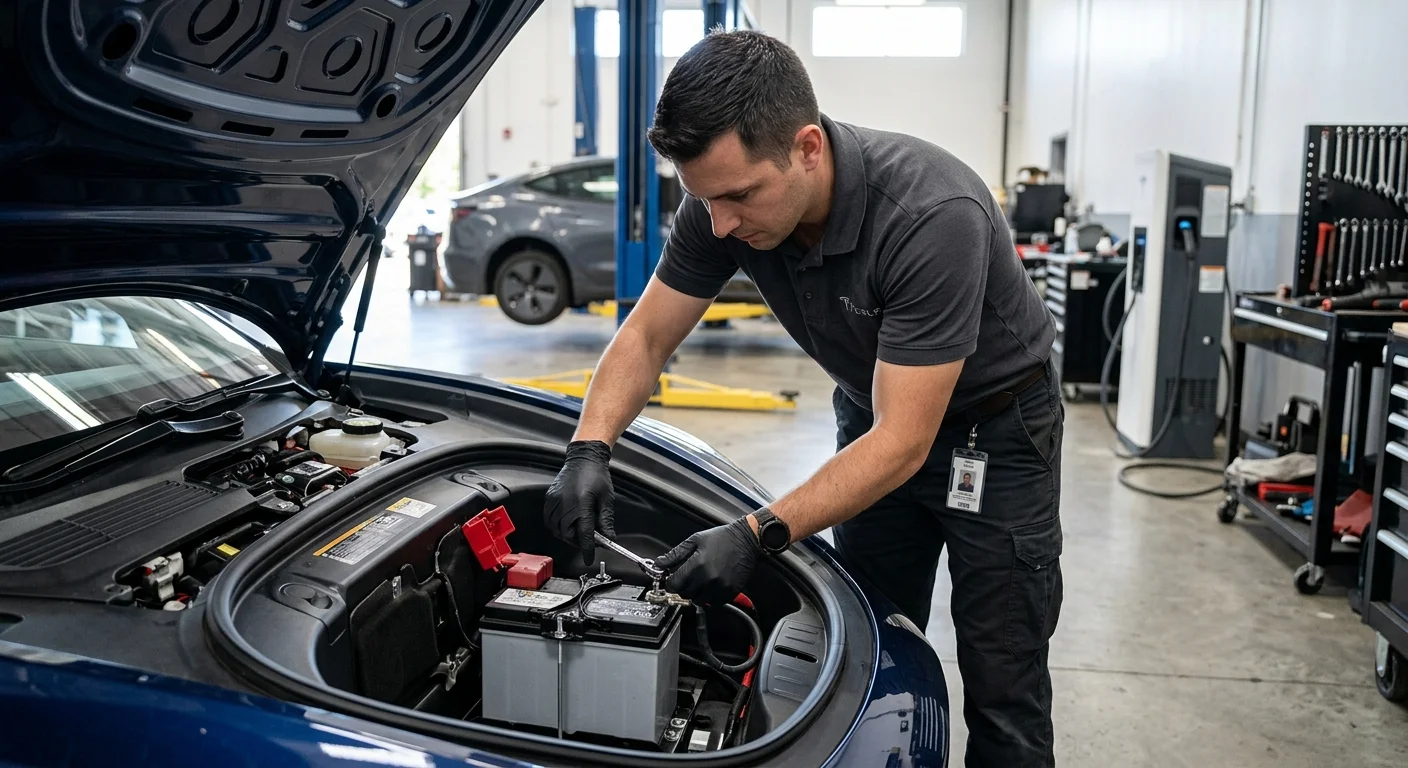
The most common reason a Hyundai Kona Electric won’t start is a dead 12V auxiliary battery, not a depleted traction pack. When the 12V dies, the car’s computers lose power entirely and the high-voltage system can’t wake up, even with 80% charge sitting in the main battery. A jump start or roadside rescue typically restores the car in under 30 minutes.
The Kona Electric (2018-present) has a documented tendency to drain its 12V battery faster than most EVs, particularly after firmware updates that affect sleep mode behavior. San Diego’s warm climate doesn’t cause the battery freeze-failure you’d see in colder states, but the heat accelerates battery aging, and a battery that’s three or four years old can drop without warning. Here’s how to figure out what’s wrong and how to fix it.
Symptoms of a dead 12V vs. a depleted traction battery
Knowing which battery is the problem saves you from calling a charger when you actually need a jump, or vice versa.
| Symptom | 12V dead | Traction battery depleted |
|---|---|---|
| Dashboard completely dark | Yes | No, you’ll see warnings |
| Key fob won’t unlock doors | Yes | No |
| Interior lights don’t respond | Yes | No |
| ”Ready” light won’t come on | Yes | Yes |
| Car drives a few miles then dies | No | Yes |
| Low-range warnings before stopping | No | Yes |
| Charging port accepts a cable | No (door may not open) | Yes |
If you get zero response when you press the Start/Stop button, no click, no dash lights, no sound, that’s a 12V problem. If you get some response and a cluster of warning symbols related to battery level, the traction battery is likely the issue and you need a mobile charge delivery, not a jump.
For a broader look at how the 12V fits into the EV electrical picture, read our post on what happens when an EV 12V battery dies.
Where the 12V battery is in a Kona Electric
Unlike many EVs that tuck the 12V battery in the frunk or under the cargo floor, the Kona Electric places it in the engine bay on the driver’s side, toward the rear of the compartment. It’s a standard 12V AGM battery, roughly the same size as the one in a compact gas car.
Access steps:
- Pop the hood using the interior release handle (if the 12V is fully dead you’ll need a portable jump pack to unlatch electronically, see the jump points section below).
- Look toward the rear driver’s side of the engine bay. The battery sits in a plastic tray with a securing strap or bracket.
- The positive terminal is covered by a red protective cap. The negative terminal is typically bare or covered with a black cap.
The battery is more accessible on the Kona than on many other EVs, which makes a roadside jump straightforward. That said, the location is still tight, a mechanic’s gloves and eye protection are worth the extra minute.
The Kona’s auxiliary battery save function
Hyundai added a 12V Battery Save function to the Kona Electric starting with the 2019 model year. It’s designed to prevent the kind of full discharge that bricks the car. Here’s how it works and how to use it if you catch a low-battery situation before it’s too late.
Where to find it: Settings > Vehicle > Charge Settings > 12V Battery Save (wording varies slightly by model year and trim).
When enabled, the system pulls a small amount of current from the high-voltage traction battery to top up the 12V pack if it falls below a threshold. This is not meant to run indefinitely, it’s a rescue mode to get you to a charger or service appointment.
Limitations to know:
- If the 12V is already fully dead, the function won’t appear on screen because the display has no power. You need an external jump first.
- The feature doesn’t replace a failing battery. If you’re using it regularly, the 12V is aging out and needs replacement.
- After a jump start on an older battery, enable the save function as a safety net for the drive home.
Some Kona owners near the 91011 zip code and Mission Valley report phantom drain events after OTA software updates (particularly updates in 2022 and 2024). If your car has had a recent update and the 12V dies within days, mention this to your dealer, it’s a known pattern, not just bad luck.
How to jump start a Hyundai Kona Electric
The Kona uses dedicated jump terminals under the hood rather than the battery posts themselves. This is safer and easier to access.
What you need: a portable jump pack (rated at least 400A peak) or a second vehicle with standard jump cables. Do not use a second EV as the donor, EVs aren’t designed to source current this way and can trigger fault codes in the donor vehicle.
Step-by-step:
- Open the hood. If it won’t release because the 12V is fully dead, locate the emergency hood release (check the owner’s manual, it’s typically a pull cord near the driver-side fender, accessed through the grille opening).
- Remove the red cap from the positive (+) terminal on the fuse box cover, driver’s side engine bay.
- Find a clean, unpainted metal ground point on the chassis, a bolt on the shock tower works well. Avoid the battery’s negative post directly if you can.
- Connect positive clamp to the Kona’s positive terminal, then connect to the jump pack or donor car positive.
- Connect the negative clamp to the jump pack or donor car negative, then to the Kona’s chassis ground point.
- Let the pack deliver current for 2-3 minutes before attempting to start.
- Press the Start/Stop button with your foot on the brake. The “Ready” light should appear within a few seconds.
Once running, drive directly to a Level 2 charger and leave the car plugged in for at least an hour. The traction battery will trickle-charge the 12V while connected. If the 12V dies again within a day or two, the battery itself needs replacement, a jump is only a bridge.
Our guide on how to jump start an EV safely covers the full process with additional safety notes that apply to all EV makes.
Common San Diego scenarios and what to do
The Kona Electric shows up stranded in predictable places around San Diego County. Here’s what we see regularly and the fastest path forward.
Parking garages downtown and Little Italy. Cars left for multi-day trips (Comic-Con, extended work travel, airport runs where someone else drove) are common victims. The 12V drains on its own over 5-10 days in standby. If you return to a dead car in a structure, call for mobile rescue, you can’t safely run jumper cables with clearance on all four sides in a tight garage space.
Coastal neighborhoods (Pacific Beach, Ocean Beach, La Jolla). Marine air doesn’t hurt the battery, but these areas have a high density of older Kona Electrics (2018-2020 models) whose 12V batteries are now past their 3-4 year typical lifespan. If your car is in this age range and dies once, replace the battery rather than waiting for a second failure.
I-5 and I-15 commutes. Short daily drives (under 20 minutes) don’t give the traction battery time to adequately top up the 12V. Drivers who primarily take surface streets in Mira Mesa, Santee, or Escondido are more likely to see slow 12V drain over weeks. The fix is occasional longer highway drives or plugging in to a Level 2 charger overnight, the charging session tops up the 12V alongside the main pack.
Stranded and not safe to stay put: call (858) 400-4465 immediately. We dispatch from multiple points across San Diego County and can typically reach you in 25-60 minutes.
For city-specific coverage, see our EV roadside assistance in Escondido page if you’re in North County inland.
Frequently asked questions
How do you jump start a Hyundai Kona Electric?
Use a portable jump pack (400A+ peak) connected to the dedicated positive terminal under the fuse box cover in the driver-side engine bay, and a clean chassis ground point for negative. Wait 2-3 minutes, then press Start/Stop with your foot on the brake. Don’t use another EV as a donor vehicle. After a successful start, drive to a Level 2 charger to let the system recharge the 12V properly.
Why does the Kona Electric 12V battery drain so fast?
The Kona Electric, especially 2018-2021 models, has a less aggressive sleep mode than some competitors, which means the 12V continues powering background systems longer. Software updates in 2022 and 2024 improved this, but cars that haven’t received updates are more prone to drain. Hot climates like San Diego also age AGM batteries faster than the national average, shortening effective life to 3-4 years versus the typical 4-5.
What does the 12V Battery Save mode do on a Kona Electric?
It draws a small amount of power from the high-voltage traction battery to keep the 12V pack above a minimum threshold. It’s a protective feature, not a permanent solution. If you find yourself enabling it regularly, the 12V battery is near end of life and should be replaced. The feature is found under Settings > Vehicle > Charge Settings on most Kona Electric trims.
Does Charge Pro SD come to Hyundai Kona Electric owners?
Yes. We serve all non-Tesla EVs, including every Kona Electric model year, across San Diego County. Our non-Tesla EV rescue service covers jump starts, 12V battery diagnostics, and mobile EV charge delivery if your traction battery is the issue instead. Dispatch is typically 25-60 minutes anywhere in the county.
What if a jump start doesn’t fix the problem?
If the Kona Electric doesn’t respond after a proper jump attempt, the most common culprits are a fully failed 12V battery that won’t hold any charge, a blown fuse in the junction box, or (less commonly) a communication fault in the BMS that prevents the high-voltage system from enabling. In those cases, the car needs tow to a Hyundai dealer or EV specialist. We can assess on-site and let you know whether a tow is necessary before you commit to one.
How much does mobile EV rescue cost in San Diego?
For a jump start or on-site 12V battery jump, mobile rescue typically runs less than a tow truck call-out. Towing a Kona Electric can cost $150-$300 depending on distance, and some tow operators aren’t equipped to safely handle EVs. Our cost comparison guide covers the full breakdown. Call us at (858) 400-4465 for current pricing.
If your Kona Electric isn’t responding and you’re stuck in San Diego County, call Charge Pro SD at (858) 400-4465. We bring the tools to your location, diagnose whether it’s a 12V or traction issue, and get you moving without a tow whenever possible.