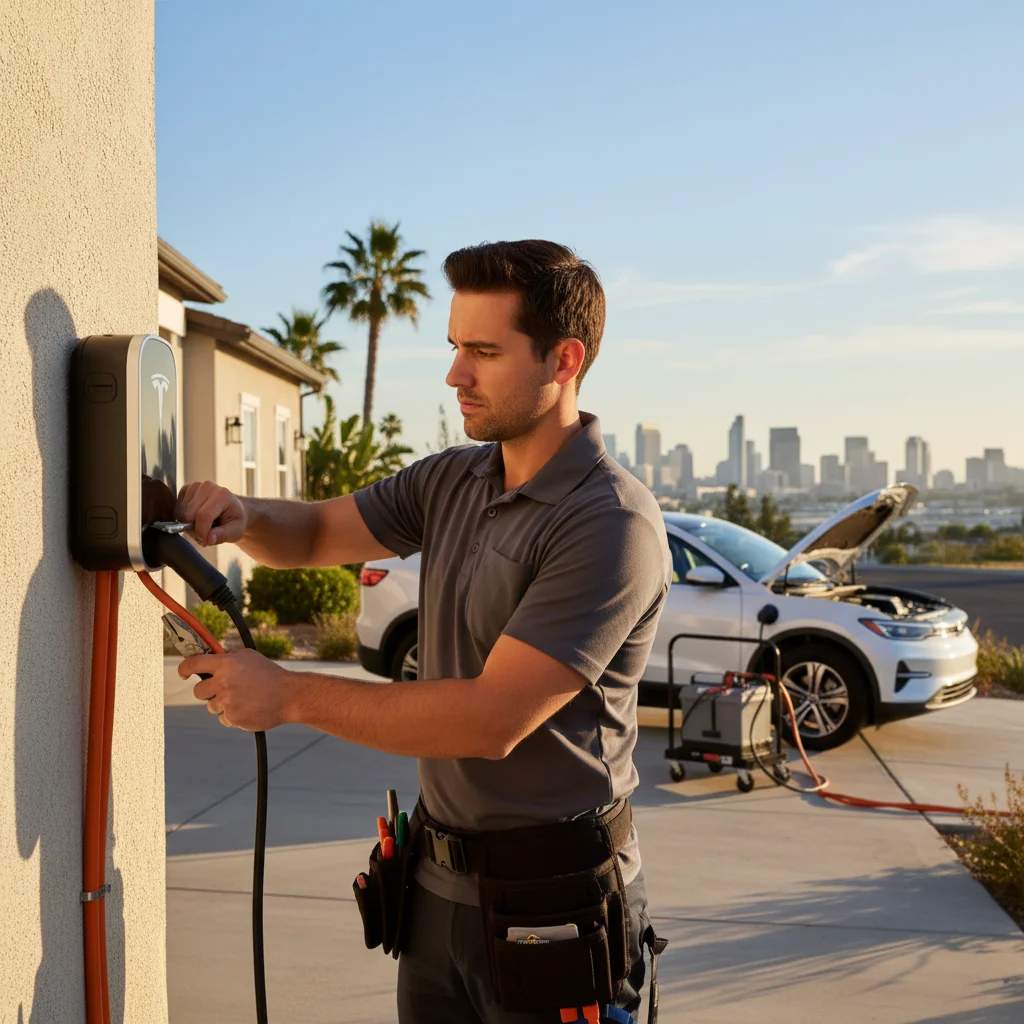
The most common reason a Honda Prologue won’t start is a dead or weak 12V auxiliary battery, not a problem with the big traction pack. The 12V powers every control module, the door locks, the dash, and the relay that wakes the high-voltage system. When it drops too low, the car goes dark and won’t respond to the fob, even with a nearly full main battery. Most of these resolve in under 20 minutes with a jump.
The Prologue is built on GM’s Ultium platform, the same architecture under the Chevy Blazer EV and Equinox EV. The Acura ZDX is its mechanical twin. So if you own a ZDX, or you’ve read about Ultium charging quirks, everything below applies to your car too. Same battery layout, same 12V dependency, same fixes.
Why the 12V battery strands a Honda Prologue
This surprises a lot of new EV owners. The Prologue’s large traction pack can be fully charged, and the car still won’t wake up if the 12V auxiliary battery is dead. The 12V is a small lead-acid or lithium battery, much like a gas car’s, and it powers the low-voltage electronics that close the contactors connecting the main pack to the rest of the car. If the 12V is dead, none of that happens, so the Prologue can’t start, can’t charge, and often can’t even unlock.
A 12V battery in San Diego usually lasts 3 to 5 years. Coastal humidity and the heat cycling in inland suburbs like Poway, Santee, and Chula Vista can push it toward the lower end. If you’re past three years on the original battery, treat any no-start as a probable 12V suspect first.
The symptoms that point to the 12V
A few signs make a weak 12V easy to spot before you call anyone:
- The dash, infotainment, and interior lights are dim or completely dead
- The key fob stopped working from a distance over the last few weeks
- The car was parked more than two weeks without being driven or plugged in
- The charge port door won’t respond, and the doors won’t unlock with the fob
- You hear no clicks or relay sounds when you press the brake
If the car has dim power but won’t go to “Ready,” that’s a borderline 12V. If it’s fully dark, the 12V is likely flat. Either way, a jump usually brings it back.
How to jump a Honda Prologue 12V
The Prologue keeps its 12V battery under the hood, in roughly the same spot as a gas car’s battery. There are labeled jump terminals under the hood for exactly this situation. The steps mirror jumping any modern EV’s auxiliary battery.
First, get the hood open. If the car is fully dead, the interior hood release may not work, so check your owner’s manual for your exact model year. Once you reach the labeled positive and negative terminals, a standard 12V jump pack or a donor car brings the electronics back on. You are jumping the small battery, never the high-voltage pack.
A few safety notes that matter on any EV:
- Only connect to the labeled 12V jump points, never the orange high-voltage cables
- Use a portable jump pack or a gas donor car, not another EV’s drive battery
- Once the dash powers up, leave the car on a few minutes before disconnecting
For the full walkthrough that applies to any model, read how to jump-start an EV safely. For the deeper why behind all of this, see what happens when an EV 12V battery dies.
When it’s the traction pack, not the 12V
Sometimes the Prologue starts fine but won’t move far, or it won’t charge. That points at the main traction pack or a charge fault, not the 12V.
If the dash is bright and the car goes to “Ready” but range is at or near zero, you’re simply out of charge. The Prologue’s Ultium pack uses a CCS or NACS charge port, so the fix is getting energy back in, either at a station or on-site. If the car refuses a charging session with full dash power, that’s usually an Ultium software charge fault, the same kind documented on the Blazer EV and Chevy Equinox EV. Trying a different charger or letting the car cool in a shaded spot often clears it.
If the charge connector won’t unlatch after a session, that’s its own issue. See the EV charge port won’t release guide for the steps.
San Diego scenarios where Prologue owners get stuck
The Prologue is growing fast as a mainstream family EV across San Diego’s suburbs, and a few patterns show up over and over.
The two-week driveway sit. A family in Carlsbad or Poway parks the Prologue for a vacation and comes back to a car that won’t unlock. The 12V drained slowly while it sat. A jump brings it right back.
Overnight Level 1 that quietly stopped. An owner in Santee plugs into a standard 120V garage outlet overnight. A software hiccup stops the session, the 12V keeps drawing, and the car is dead by morning.
Out of charge on the commute. A Chula Vista driver underestimates range on a hot day with the AC running and rolls into a lot near empty. That’s not a failure, just an empty pack that needs miles to reach a Supercharger or home.
San Diego’s coastal climate is gentle on EV batteries, but East County heat and the long gaps between charging stops on routes like I-15 and I-8 are where people get caught.
How our mobile rescue works for the Prologue
If a jump doesn’t bring it back, or you’re simply out of charge, you don’t need a tow to a dealership. Charge Pro SD’s non-Tesla EV rescue covers all 67 cities in San Diego County. Our Tesla Cybertruck rescue vehicle carries a 240V, 9.6 kW bed outlet with a CCS adapter, so it speaks to the Prologue’s charge port directly.
For a no-start, we test and jump the 12V on the spot, and we can do an on-site 12V replacement if the battery is finished. For an empty pack, out-of-charge recovery adds 30 to 60 miles of range in 15 to 30 minutes, enough to reach a Supercharger or get you home. If the car is a Tesla in your household instead, the same crew handles a Tesla 12V battery jump.
We’re 24/7. Call (858) 400-4465, tell us what the dash is showing, and we’ll bring the right gear on the first run.
Frequently asked questions
Why won’t my Honda Prologue start even though it’s charged?
A fully charged traction pack does not start the car on its own. The 12V auxiliary battery powers the control modules that close the high-voltage contactors and wake the drivetrain. If the 12V is dead or below about 11.8 volts, the Prologue can’t go to “Ready,” can’t charge, and often won’t unlock, no matter how much energy is in the main battery. A 12V jump almost always restores function.
Can I jump-start a Honda Prologue like a gas car?
You jump the 12V battery, not the high-voltage pack. The Prologue has a 12V battery under the hood with labeled jump terminals, and a portable jump pack or a gas donor car connects to those points just like a regular car. Never connect to the orange high-voltage cables. If the car is fully dead, check your owner’s manual, since the hood release may need emergency access first.
Is the Honda Prologue the same as the Acura ZDX or Chevy Blazer EV?
Mechanically, the Prologue, Acura ZDX, Chevy Blazer EV, and Equinox EV all share GM’s Ultium platform. They use the same battery architecture, the same 12V dependency, and similar charging behavior. The ZDX is the Prologue’s direct twin. Any 12V jump procedure or charge-fault fix that applies to one of these cars generally applies to the Prologue too.
Does Charge Pro SD reach Honda Prologue owners in the suburbs?
Yes. We cover all 67 cities in San Diego County, including Chula Vista, Poway, Santee, Carlsbad, and the rest of North and East County. Metro response runs 25 to 60 minutes, with East County and the Backcountry closer to 75 to 90 minutes. Call (858) 400-4465 and describe what the dash is doing, and we’ll bring the right equipment.
What does it cost to rescue a Honda Prologue in San Diego?
Dispatch is $149, which includes the roll and the first 15 minutes of service, then $1.80 per added mile. Most rescues run $149 to $225. A 12V jump starts at $149, and an on-site 12V replacement runs $220 to $380 depending on the battery. After-hours calls between 11pm and 6am add $50. You get a price before we dispatch.
If your Honda Prologue still won’t start after a jump, call Charge Pro SD at (858) 400-4465. We cover all of San Diego County and usually reach you faster than a traditional tow, and we fix the actual problem on the spot instead of hauling the car to a shop.