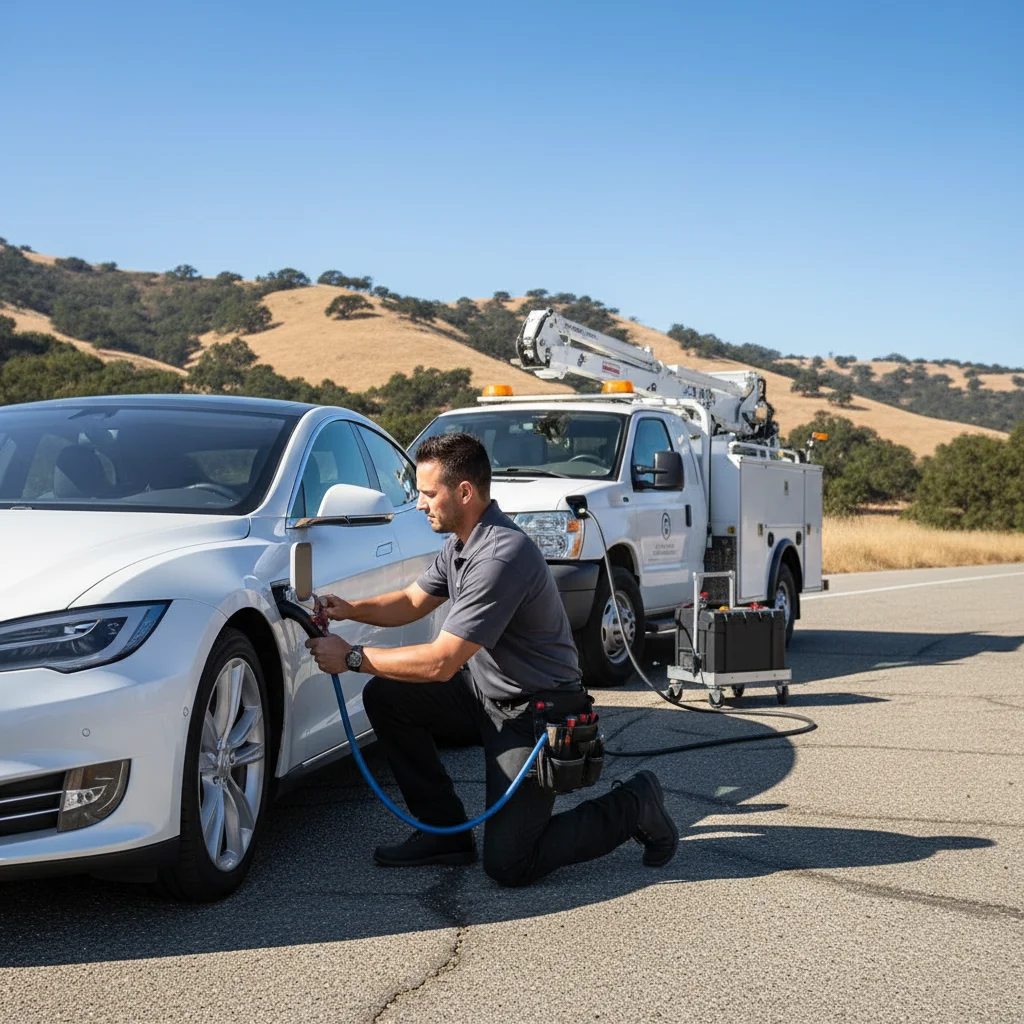
Your EV’s range estimate said you had twelve miles left. Then the hills happened. Poway’s terrain and spread-out geography create a specific kind of range anxiety that flat coastal cities don’t — and when the battery hits zero, you need someone who can actually come to you.

A white Tesla Model Y stopped on the shoulder of Pomerado Road in Poway with rol

Why Poway EV drivers get stranded — the local pattern

Poway sits at roughly 400–500 feet of elevation, ringed by steeper grades leading in and out. That matters for EVs because climbing burns range fast — often faster than the onboard estimate accounts for.

A driver leaving Mira Mesa or Rancho Bernardo heads uphill almost immediately. If they started the trip with 15% charge and assumed “that’s enough,” they may be walking by the time they hit Espola Road. The same thing happens in reverse: drivers coming down from the backcountry feel fine on regenerative braking, then park at Maderas Golf Course or the Lake Poway trailhead, run errands, and find themselves depleted on the return trip.

Poway also has a large population of longer-range EVs — Teslas especially — and their owners sometimes get overconfident. A Model Y Long Range that’s done 80,000 miles has real-world range that’s meaningfully shorter than its original EPA number. If you haven’t recalibrated your mental model of the car’s capacity, a day of canyon driving will do it for you.

There’s another pattern worth mentioning: the 12V battery failure. Teslas and other EVs carry a small 12V auxiliary battery separate from the main pack. When it dies, the car won’t power on at all, even if the high-voltage pack is fully charged. This isn’t a charging problem — it’s a different kind of stranding, and it’s more common than most owners expect. Our blog post on EV 12V battery failures walks through exactly what’s happening when this occurs.

Common spots where we get called: Pomerado, Scripps Poway Pkwy, I-15

We cover all of Poway, but certain locations come up over and over.

Pomerado Road runs the length of the city and sees consistent EV stranding calls, particularly in the stretch between Community Road and Espola. It’s a well-traveled road with limited shoulder in some sections, so getting off quickly matters.

Scripps Poway Parkway connects to the I-15 corridor and carries a lot of commuter traffic. EVs that make it through rush hour then try to swing by a Poway errand sometimes miscalculate — especially if they skipped a charging opportunity at a Mira Mesa or Scripps Ranch stop.

I-15 itself, specifically the section between Poway Road and Rancho Bernardo Road, generates calls from drivers who’ve already passed their last realistic charging exit. Our guide to what to do when you run out of charge on the freeway is useful reading before that moment hits — but if it already has, just call us.

Lake Poway Recreation Area is a genuine EV trap. Drivers underestimate the round trip, park for a few hours, and return to a car that won’t make it back to a charger. We’ve done rescues at the parking lot entrance more than a handful of times.

Maderas Golf Club sees similar patterns — a long drive in, hours spent on-site, then an unpleasant discovery in the parking lot.

Close-up of a CCS connector being plugged into an EV by a uniformed technician,

What we bring and how fast we arrive

Our rescue unit is a Cybertruck-based mobile charging truck carrying enough onboard power to add 20–40 miles of range to most EVs in 20–30 minutes — enough to get you to a proper charging station without a tow.

We carry adapters for the common connector types you’ll find on Poway roads: CCS1, CHAdeMO, and NACS. That covers Tesla models, Chevy Bolt, Nissan Leaf, Hyundai Ioniq 5, Ford F-150 Lightning, Rivian, and most other EVs currently on San Diego roads.

For Tesla-specific situations — including the 12V battery failure scenario described above — we carry the equipment to perform a Tesla 12V battery jump on-site, which restores the car’s ability to power on and drive without a tow.

Response times to Poway typically run 25–45 minutes depending on where we’re dispatched from and traffic on the I-15. We’ll give you an honest ETA when you call. You can check the US Department of Energy’s AFDC station map to see if there’s a faster option nearby while you wait — sometimes there is, sometimes there isn’t.

For a full breakdown of how our mobile EV charging service works, including what equipment we carry and how the process goes, that page has the details.

Mobile charging vs tow for Poway drivers

Towing an EV out of Poway isn’t cheap or fast. The nearest Tesla Service Center is in Kearny Mesa, and a flatbed tow from Lake Poway or the Pomerado Road corridor will run you meaningful money before you’ve even gotten a diagnosis.

More importantly, most out-of-charge situations don’t need a tow. If your EV is stranded because the battery is depleted, mobile charging solves the problem in under an hour at a fraction of the tow cost. Our comparison of mobile charging vs towing breaks down the cost and time math in detail.

The exception is a mechanical failure unrelated to the battery — a tire, a suspension issue, or a fault code that won’t clear with charging. In that case, a tow is the right call, and we’ll tell you that honestly if we diagnose it on-site. We’re not here to oversell a charge when you actually need a flatbed.

For Tesla owners specifically, it’s worth knowing that Tesla roadside assistance through the app will dispatch a tow by default for an out-of-charge situation. That’s often slower and more expensive than calling a local mobile charger first. Our overview of Tesla roadside assistance coverage explains how to think about when to use Tesla’s own program versus a faster local option.

Non-Tesla EV owners also have options — our non-Tesla EV rescue service covers Chevrolet, Ford, Hyundai, Kia, Rivian, Nissan, and others. Our complete EV roadside assistance guide walks through the full process regardless of what you drive.

For context on what other Poway-area drivers and EV owners across San Diego County have been dealing with, the California Energy Commission’s EV data shows just how fast EV adoption has outpaced the public charging infrastructure — which is part of why mobile rescue is filling a real gap.

How to call for help and what to tell dispatch

When you call, four pieces of information get us to you faster:

  1. Your exact location — cross street, parking lot name, or mile marker if you’re on the freeway. “Poway” is a big area. “Pomerado and Twin Peaks” is actionable.
  2. Your vehicle make, model, and year — so we confirm we have the right connector and can flag any known quirks for that car.
  3. Your current state of charge — even an estimate. “Two percent” tells us you’re not going to be able to creep to a better spot; “eight percent” might give us options.
  4. Whether the car will power on — if it won’t even wake up when you touch the screen or key, that’s the 12V failure scenario, not a depleted pack, and we’ll bring different equipment to the front of mind.

Don’t try to push the car further if you’re already at zero. Driving on a fully depleted pack stresses the battery and some manufacturers flag it as a warranty concern. Park safely, put on your hazards, and call.

Our emergency EV roadside assistance service dispatch line is available for Poway and all of San Diego County. We cover the I-15 corridor north through Escondido and south through Mira Mesa, plus the surrounding neighborhoods.

If you want to read how other drivers in nearby cities have handled similar situations, our posts on EV roadside assistance in Encinitas and Carlsbad cover comparable terrain and use cases.

When to call Charge Pro

If your EV is stranded in Poway — whether you’re out of charge on Pomerado Road, stuck in the Lake Poway lot, or sitting on the I-15 shoulder watching traffic pass — that’s exactly what we do. The same goes for a dead 12V battery that’s left your Tesla looking at you blankly, or any range emergency where you need juice now and a tow later doesn’t make sense.

Call us at (858) 808-6055 — we’ll roll a Cybertruck rescue truck to you.