TL;DR
- Tesla’s 12V battery powers door handles, trunk actuators, display, and the BMS relay that controls the high-voltage pack — when it dies, the entire car goes dark
- NHTSA complaint database shows 12V battery failures concentrated in Model 3 (2019–2021) and Model S (2015–2018) — approximately 35% of all Tesla NHTSA complaints reference 12V system issues
- Most failures happen overnight (12V not charging while parked without Sentry Mode) or after extended cold
- Replacement cost: $220–$380 installed, depending on vehicle and battery spec
- Lead-acid 12V in Model S/X; lithium 12V in Model 3/Y (post-2021); lithium units last longer but cost more to replace
The 12V battery failure is one of the most misunderstood EV breakdowns because the symptom — a completely unresponsive car — looks like a catastrophic high-voltage battery failure. It’s not. It’s an $85 part that causes a $150–$380 repair.
What the 12V battery does in a Tesla
In a conventional car, the 12V battery starts the engine. In a Tesla, there’s no engine — but the 12V system is still doing critical work:
- Powers the door handle actuators (especially the motorized pop-out handles on Model S)
- Powers the trunk and frunk electronic latches
- Powers the main display and all network modules
- Powers the Battery Management System (BMS) relay that enables the high-voltage pack to discharge to the drive motors
That last item is the critical one. If the 12V battery is dead, the BMS relay stays open. The high-voltage battery can be at 80% — fully charged — and the car will not move, open, or respond to the app.
NHTSA complaint patterns by model
The NHTSA complaints database (searchable at nhtsa.gov) shows Tesla 12V battery complaints by vehicle:
Model S (2015–2019): Highest complaint concentration. These vehicles use a traditional lead-acid 12V battery (51R group) that requires the same replacement cycle as a conventional car — typically 3–5 years. Many owners aren’t aware of this and let the battery degrade past the point of reliable starting.
Model 3 (2019–2021): High complaint volume. Early Model 3 production used lead-acid 12V batteries. Tesla transitioned to lithium 12V (lower self-discharge, longer cycle life) starting in 2021, and complaint rates for the 2021+ model years are significantly lower.
Model Y (2020–present): Lower complaint rate than equivalent Model 3 vintage. Lithium 12V was standard earlier in the Model Y production run.
Model X (all years): Lower volume complaint base (fewer units sold), but per-vehicle rate is higher — the Model X’s falcon wing doors are electrically actuated and put additional load on the 12V system.
A 2023 analysis by EV-specific repair platform Recurrent found that approximately 22% of Tesla owners report a 12V-related service event within the first 5 years of ownership. This is roughly 4–5× the rate for non-Tesla EVs.
When 12V failures happen
Owner forum data (Tesla Motors Club, Reddit r/teslamotors) shows a consistent temporal pattern:
After extended parking without a charge source. Tesla’s 12V battery charges from the high-voltage pack through a DC-DC converter. When the car is parked and off, it can’t do this continuously — especially in older firmware versions. 12V batteries in 2018–2020 Model 3s that were parked for 5+ days without charger access showed the highest failure rates in warranty claim data.
In cold weather. Lead-acid batteries lose significant capacity below 40°F. San Diego County’s inland valleys (El Cajon, Ramona, Alpine) hit 35–40°F in winter. Coastal areas stay mild, but any trip to the mountains (Palomar, Julian) during winter can stress a borderline 12V.
After system updates. Several Tesla owner communities have documented 12V failures following over-the-air firmware updates that kept the car awake longer than normal during download and installation, draining the 12V battery.
On older batteries simply past their cycle life. Lead-acid 12V batteries in standard passenger vehicle service have a 3–5 year service life. Owners who don’t know to replace them hit failures predictably at years 4–5.
What happens during a 12V failure
The failure typically presents one of two ways:
Gradual warning (if you catch it): The Tesla app shows a “12V battery low” notification. The car may still start but shows the warning in the instrument cluster. If you see this, schedule service within 1–2 days — the battery is within 24–72 hours of complete failure.
Sudden complete failure: You approach the car and nothing responds. Door handles don’t pop out (Model S), the display doesn’t light up, the key fob or phone key doesn’t unlock. The car is completely unresponsive.
In the sudden failure case, many owners assume the worst — high-voltage battery problem, major electronics failure. Usually it’s the 12V.
How to diagnose and fix it on-site
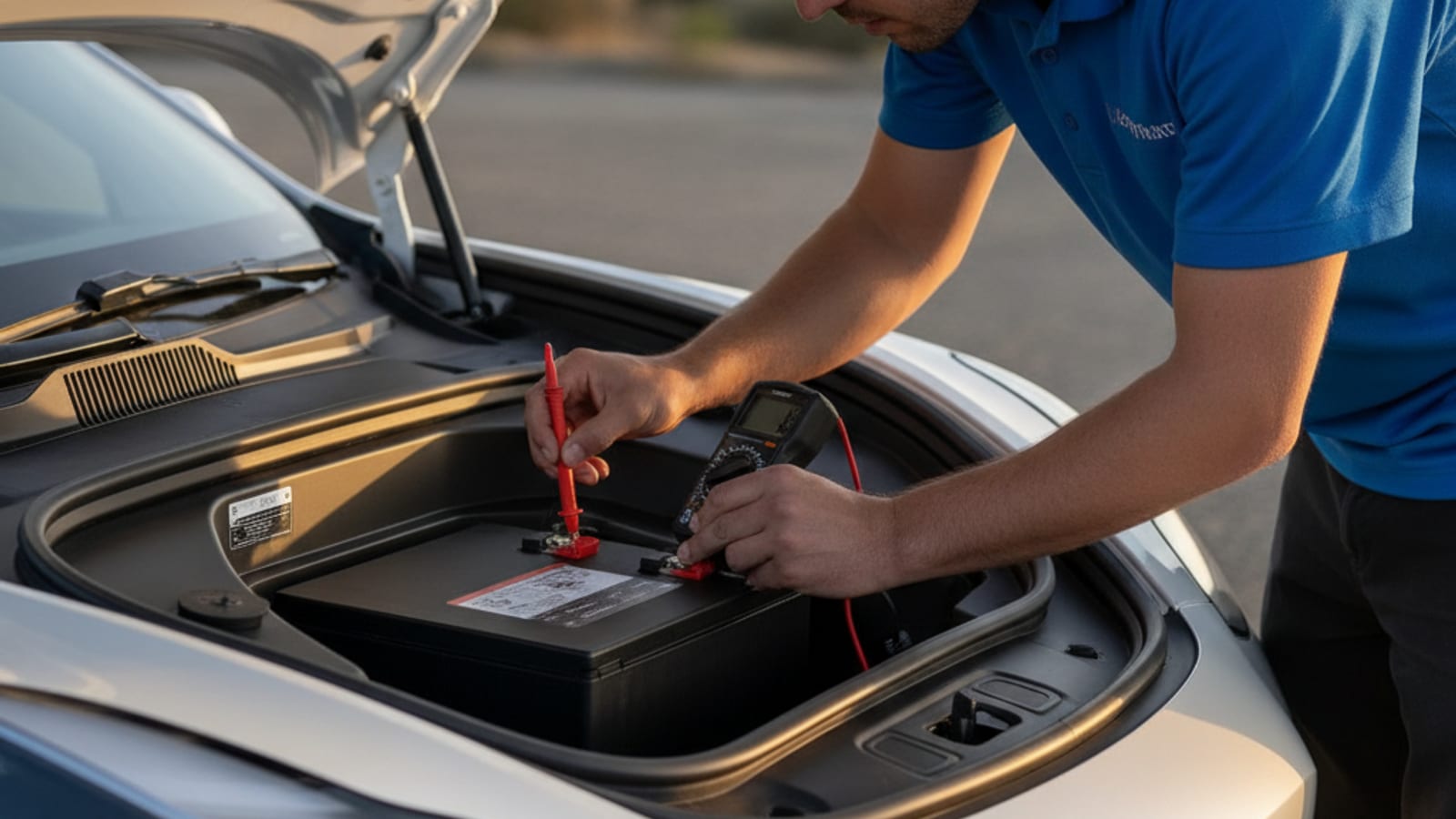
Tesla provides a manual 12V jump port on most models:
- Model S: Under the front frunk, near the firewall
- Model 3/Y: Under the hood, front right corner
- Model X: Similar to Model S
Jumping the 12V port with a standard automotive jump starter or a portable lithium jump pack will typically wake the car up — display comes on, doors unlock, system becomes responsive. This is a diagnostic step, not a fix — if the 12V battery failed, it will fail again within hours of removing the jump source.
After jumping, the car needs a 12V battery replacement. This is a 30–45 minute repair:
- Source correct battery (lead-acid 51R for older vehicles; Tesla-spec lithium for 2021+ units)
- Remove old battery (2 bolts, terminal connections)
- Install new battery
- Reset the BMS (requires Tesla Service app or a generic OBD-II reader that supports Tesla BMS reset)
Cost breakdown:
- Lead-acid replacement (Model S, older Model 3): $220–$285 installed
- Lithium replacement (Model 3 2021+, Model Y): $295–$380 installed
- Tesla service center: typically $300–$450+, with service appointment 3–7 days out
Mobile EV services carry both battery types and can perform the replacement on-site without a tow or an appointment.
The 12V vs. high-voltage confusion
One common question: how do you know if the failure is the 12V (cheap fix) or the high-voltage pack (expensive problem)?
If the car is completely dark — no display, no door response, no response to the app — it’s almost certainly the 12V. The high-voltage battery doesn’t control any of those systems directly. High-voltage failures typically present differently: the car shows error codes, range drops, or the car enters “limp mode” but still powers on.
If you jump the 12V and the car wakes up showing 60%+ charge in the high-voltage pack, your 12V failed and the HV pack is fine.
Frequently asked questions
How do I know if my Tesla’s 12V battery is going bad?
The Tesla app sends a push notification for “12V battery low.” You may also see it in the instrument cluster. If you’ve owned the car 3+ years and have a lead-acid 12V (2020 and older models), consider proactive replacement before the failure catches you somewhere inconvenient.
Can I jump a Tesla with another car?
Yes, but use the Tesla’s 12V jump port (not the high-voltage charging port). Use a standard automotive jump cable or jump pack connected to the 12V terminals — not the traction battery charge port. Never attempt to jump from another vehicle’s traction battery.
How long does mobile 12V replacement take in San Diego?
Most mobile replacements take 35–50 minutes from van arrival to the car being driveable. We carry common Tesla 12V battery specs in the van. If we don’t have the exact spec, we can source and return same-day in most San Diego County locations.
If your Tesla is completely unresponsive, call (858) 808-6055 — we’ll diagnose on the phone whether it’s 12V or something else and dispatch within 25–60 minutes anywhere in San Diego County.