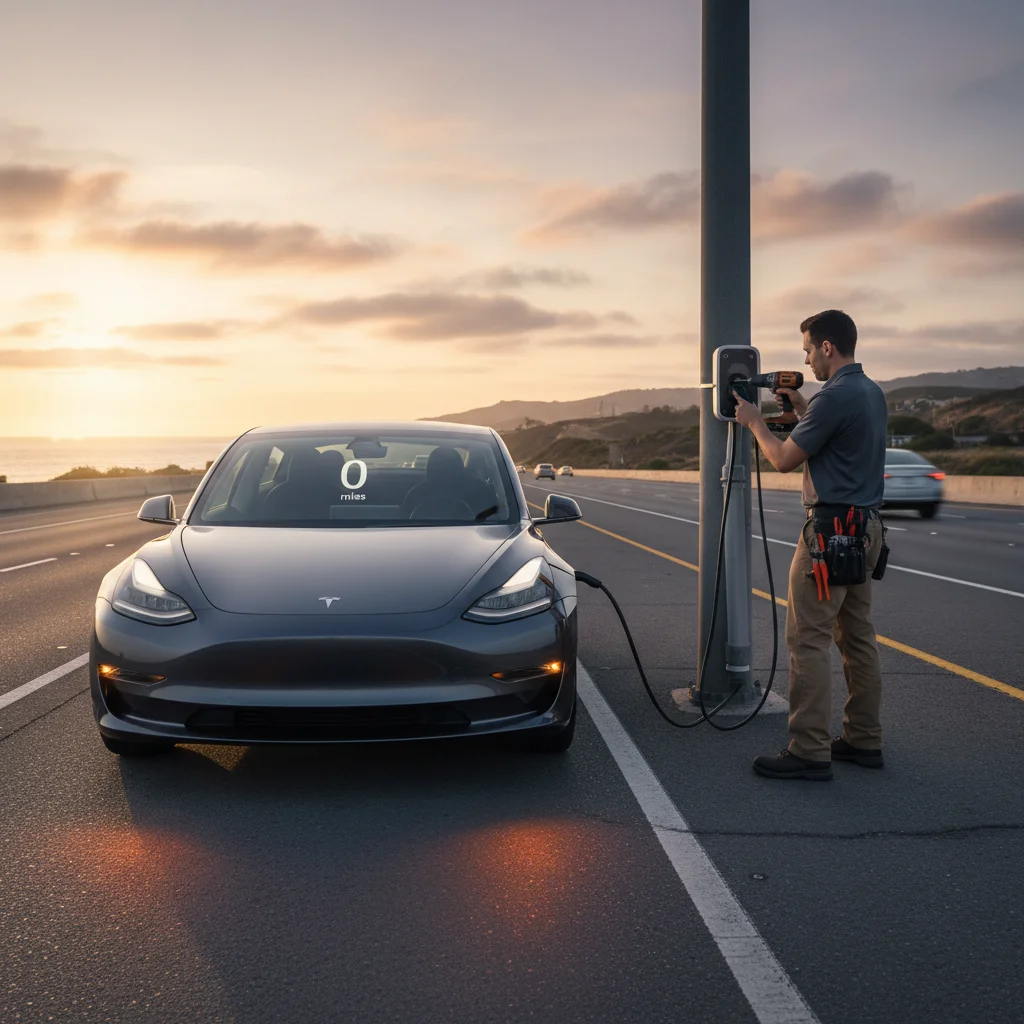
It’s a feeling every EV driver dreads: the estimated range on your screen drops to single digits, and the nearest charger is just a little too far. Seeing your Tesla’s battery display hit zero miles while you’re on the I-5 or a quiet street in Encinitas can be stressful. But it doesn’t have to be a catastrophe.

A Tesla Model 3 stopped on a San Diego shoulder with the dashboard reading 0 miles and hazard lights flashing, late afternoon light

Understanding what happens next, and knowing who to call, makes all the difference between a minor inconvenience and a major ordeal. Here’s exactly what to expect when your Tesla runs out of battery and how to get moving again safely and quickly.

What happens in the final miles before a Tesla shuts down

A Tesla doesn’t just abruptly die like a phone. It’s designed to give you ample warning to find a safe place to stop. As the high-voltage battery gets critically low, the car enters a power-saving state to maximize its remaining energy and protect its components.

First, you’ll see a series of alerts on the main display. A yellow warning will pop up, advising you to charge immediately. As the state of charge drops further, this warning will turn red and become more persistent. You’ll also notice a snowflake icon might appear next to your battery indicator, signaling that power is limited, even in warm San Diego weather. This is the car’s way of telling you it’s conserving every electron.

Next, the car will significantly reduce its available power. You’ll feel this as a loss of acceleration—it will feel sluggish, almost like a “limp mode.” The car is intentionally restricting the power sent to the motors. At the same time, it will begin shutting down non-essential systems. The climate control will turn off, the screen brightness might dim, and premium sound features will be disabled. The car’s sole focus is on propulsion and safety systems. For a more general overview of what to do in these final moments, our guide on what to do when your EV is running low on battery offers good advice for any EV driver.

Your main goal during this phase is to get off the road safely. Heed the warnings. Don’t try to push it to the next exit. Find the first safe shoulder, parking lot, or side street and pull over.

Buffer mode and the hidden reserve, model by model

Here’s the good news: when your Tesla’s display hits “0 miles,” it’s not entirely out of power. Tesla builds a hidden safety buffer into its battery management system. This reserve is designed to give you a few extra miles to get to a safe location after the display shows empty. It’s a critical safety feature, but it’s not something to rely on.

The size of this buffer varies by model, battery pack, and even the software version, but here are some general estimates:

  • Model 3 / Model Y: These models typically have a reserve of around 4-5 kWh. Depending on conditions and driving style (slow and steady is key), this can translate to an extra 10 to 15 miles of range after hitting zero.
  • Model S / Model X: The larger battery packs in these flagship models often have a slightly larger buffer, sometimes providing up to 20 miles of post-zero range. Older models might behave differently than newer “Raven” or “Palladium” versions.

However, factors like terrain, temperature, and your speed will drastically affect how far you can actually go on this reserve. Trying to climb the grade on the I-15 near Poway will deplete the buffer much faster than coasting along a flat road in Coronado. The car will eventually stop providing power to the motors to protect the high-voltage battery from being completely drained, which can cause damage. Once propulsion power is cut, you will still have power for a limited time for hazard lights, locks, and windows, running off the 12-volt battery.

Why you can’t just push or tow a Tesla like a gas car

When a gasoline car runs out of fuel, you can often push it to the shoulder or have a friend tow it with a rope. You absolutely cannot do this with a Tesla, especially an All-Wheel Drive (AWD) model. Attempting to do so can cause thousands of dollars in damage to the drive units.

The reason lies in how EVs work. The wheels are permanently connected to the motors. When the wheels spin, the motors spin. In a normal driving scenario, this is how regenerative braking works to recapture energy. But if you tow the car with all four wheels on the ground, the motors are forced to spin without the proper lubrication and cooling systems being active. This can quickly overheat and destroy the motors and inverters.

To be moved, a Tesla must be put into “Tow Mode” or “Transport Mode.” This electronically disengages the parking brake and puts the car in Neutral, allowing the wheels to spin freely. You can access this mode through the touchscreen: Controls > Service > Towing.

However, there’s a catch. Activating Tow Mode requires power from the 12-volt battery. If the high-voltage battery is completely depleted and the 12V battery also dies, the car becomes a brick. You won’t be able to engage Tow Mode, and the car cannot be rolled. This is a common scenario in an out-of-charge situation and why you need a rescue service that understands Teslas. Any tow operator must use a flatbed truck and may need to use wheel dollies or skates to winch the car onto the bed without the wheels turning. This is non-negotiable for the health of your vehicle.

Tesla being loaded onto a flatbed in neutral tow mode with the wheels straight, technician guiding the winch, photorealistic

Mobile charge vs flatbed: which gets you moving faster

When you’re stranded with a dead Tesla, you have two main options: call a flatbed tow truck to take you to a charger, or call for a mobile charging service to bring the charger to you. In almost every situation in San Diego County, mobile charging is the faster and more convenient solution.

A flatbed tow involves multiple steps and significant waiting. First, you have to wait for the tow truck to arrive, which can take an hour or more depending on traffic. Then, the operator has to carefully load your Tesla, ensuring it’s in Tow Mode and winched properly. After that, you’re in for a slow ride to the nearest Supercharger or your home. Once there, the car must be carefully unloaded before you can even begin to charge. The entire process can easily consume 2-3 hours of your day. If you’re out of charge on the freeway, this can be a particularly long and stressful experience.

A mobile charging service like Charge Pro SD streamlines the process. Our rescue truck comes to your exact location. We connect our mobile Level 2 charger directly to your Tesla, providing a direct-to-battery charge on the spot. Within 30-60 minutes, we can add 20-25 miles of range—more than enough to get you safely to the nearest public charging station or back to your home garage. There’s no loading, no towing, and no extra travel time. It’s the most direct path from “stranded” to “on your way.” Our out-of-charge recovery service is specifically designed to be the quickest solution for this exact problem.

How to call for help in San Diego County and what to say

Finding yourself with a dead Tesla on the side of SR-56 or in a La Jolla parking garage can be jarring, but getting the right help is straightforward if you know what to do.

First, your safety is the priority. Pull over to a safe location as far from traffic as possible, and turn on your hazard lights.

Next, you have a few options for assistance. You can use the Tesla app to request roadside assistance. They will typically dispatch a local third-party tow company. Another option is to call a dedicated EV roadside service directly. For specialized help, our Tesla roadside rescue team is equipped with mobile chargers and the expertise to handle these situations efficiently.

When you make the call, being clear and specific will get you the right help faster. Here’s what you should tell the dispatcher:

  1. Your Vehicle: “I’m in a Tesla Model [3, Y, S, or X].” This immediately tells the provider what kind of equipment is needed.
  2. The Problem: “My high-voltage battery is dead and the car won’t move.” Specify that it’s an out-of-charge event, not a mechanical failure.
  3. Your Exact Location: Be as precise as possible. Use your phone’s GPS, a street address, cross-streets, or a freeway mile marker. Mention landmarks if you can. “I’m on the shoulder of the westbound 94, just past the 28th Street exit.”
  4. The Service You Need: Clearly state your preference. “I need a mobile charge to get to the nearest Supercharger,” or, if you have other issues, “I need a flatbed tow to the service center.”

Being prepared with this information ensures the dispatcher sends the right truck and the right technician the first time, saving you time and frustration.

When to call Charge Pro

If your Tesla is dead on the side of a San Diego road, don’t waste hours waiting for a tow truck. When you’re facing a range emergency or a dead 12V battery has you locked out, we’re the fastest solution to get you moving again.

Call us at (858) 808-6055 — we’ll roll a Cybertruck rescue truck to you.