A weekend in Julian, a border run, or a North County loop can all look simple on a map. In a Rivian, the plan only holds if the next charger, the connector, and the heat on I-8 still match what you checked this morning. A Rivian road trip planner is a live checklist, not a promise that the stall will work when you arrive.
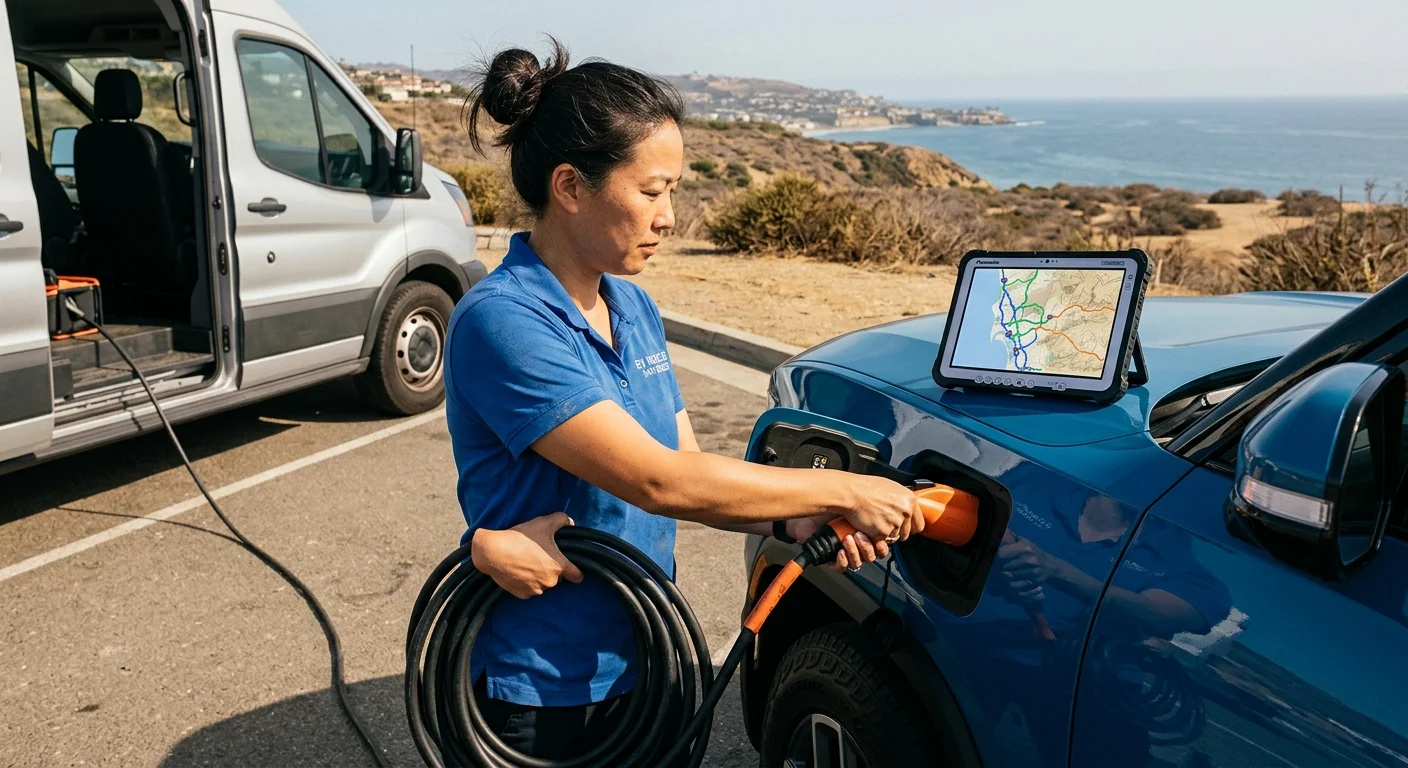
Verify Rivian’s current planning tools
Start in the truck and in the current Rivian app, on the morning you drive. Station lists, connector labels, and predicted arrival charge change. A screenshot from last month can send you to a stall that is offline today.
Confirm the destination, the suggested charge stops, and the predicted state of charge at each stop. Then check the same stops in a second source. Network apps, PlugShare-style maps, and the EV charging apps that matter before you’re stranded often disagree. When they disagree, use the live status, not the prettiest pin.
Do not assume the planner knows your exact day. Range depends on speed, cargo, climate control, elevation, and outside temperature. A morning run up I-15 through Escondido in August is not a February loop along Encinitas. The U.S. Department of Energy notes that charging time also depends on state of charge, battery capacity, the vehicle’s onboard charging capacity, equipment output, and the electrical service at the site.
If the in-vehicle estimate looks tight, add a buffer stop before you leave the driveway. Tight plans fail first on I-8 east of El Cajon, where heat and grade stack, and on the San Ysidro approach, where traffic can sit still with the cabin cooling running.
Rivian can push over-the-air updates that change menus. If a feature name in an old forum post does not match the screen, use what is in the truck today. Charge Pro SD does not operate Rivian’s software. It cannot promise a route, a stall, or a charge result.
Write the planned stops into your phone notes anyway. If nav drops in a canyon or a parking garage, you still need the next confirmed plug, the network account, and a second option within a conservative remaining range.
Check charging options before leaving
Pin down the connector before you pack. It is not the same on every Rivian. Rivian lists an approved J1772 AC adapter for compatible 2026 and newer vehicles with NACS ports. That adapter is for AC chargers only. It must not be used with a DC charger. Confirm your model year, port, and any included adapter in the truck and in Rivian’s current gear notes.
If you are unsure which plug your truck takes on the road, read what charger a Rivian uses at roadside and match it to the live station details. The U.S. DOE Alternative Fuels Data Center shows J1772 and J3400 (NACS) for AC Level 2. A CCS inlet uses the J1772 portion for AC and adds two lower pins for DC fast charging. Connector shape still does not prove voltage or power. A stall labeled fast can be a modest DC unit or a high-power cabinet. Confirm the number on the live listing.
Public charging along San Diego County routes is a mix of Level 2 and DC fast sites. Per DOE figures, Level 2 in typical residential use is 240 V, and commercial sites often sit at 208 V, with equipment ranging from 2.9 to 19.2 kW. DC fast charging is the corridor tool. Home Level 2 is the overnight tool. Do not plan a Julian day trip on a single unconfirmed Level 2 post in a lot that may close at dusk.
Before you roll, confirm each planned stop is open for your arrival window, the plug and adapter match, your network account works, and a second stop sits within a conservative remaining range. Confirm you can wait if a stall is occupied or faulted.
Do not treat a blog list as inventory. Stations are added, broken, and gated. The California Energy Commission tracks statewide charging buildout, but your truck still needs a working plug on the day you drive.
If you are already low and the next confirmed DC site is too far, that is an out-of-charge recovery situation, not a planning tweak. An independent operator still has to confirm the vehicle, port, location, and whether they can help.
Plan for coastal and inland route changes
San Diego County is not one climate. Plan the road, not the county name.
I-5 hugs the coast from Oceanside through Carlsbad, Encinitas, and Del Mar into downtown, then south through National City, Chula Vista, and San Ysidro. Marine layer and stop-and-go traffic are the usual range drains here, not mountain grades. Charging density is generally higher along this corridor than in East County, but stadium events, border backups, and closed lots still strand people who trusted a pin.
I-15 runs inland through Escondido, Rancho Bernardo, Mira Mesa, and Mission Valley. Summer heat is higher off the water. Cabin cooling and faster freeway speeds cut into the arrival percentage the planner showed at 7 a.m.
I-8 is the East County and Imperial County line. El Cajon, Lakeside, Alpine, and the climb toward the desert change the math. Grade, wind, and heat stack. A plan that looks fine from Mission Valley can get tight past Alpine if you skip the confirmation step.
SR-78 cuts east from Oceanside through Vista and San Marcos into Escondido. It is a short connector on a map and a common place to underestimate remaining range when you leave the coast for a hike or a family stop.
If you are heading toward Julian, Palomar, or the lagoon towns and then back the same day, build the return into the first plan. Many drivers charge for the scenic leg and forget the HVAC on the way home. Keep a confirmed DC option on both the outbound and inbound path, even if the truck says you can do it in one shot.
Speed matters. A posted 70 mph stretch on I-8 is not the same energy use as crawling I-5 through the South Bay. The planner’s arrival number is an estimate. Leave room.
Save vehicle and location details
If a plan fails, the next person you talk to needs facts.
Write this into your phone notes before you leave: model, model year, and trim; charge port type and any approved adapter in the glove box; whether the truck is a 2026 or newer NACS vehicle using Rivian’s J1772 AC adapter; current software version if the truck shows it; whether you can open the Rivian app; and a photo of the port with the door open.
If you contact Rivian, they will want the vehicle and the situation. Rivian says roadside assistance is included for the duration of the New Vehicle Limited Warranty and is accessed 24/7 through the Rivian app and the center display. Keep the app working, the phone charged, and a small battery pack in the frunk or a backpack.
If you are on the shoulder, save the exact location. Freeway, direction, mile marker or exit, and the city. “On I-15” is not enough. “Northbound I-15, south of the Rancho Bernardo Road exit, right shoulder” is. If the truck is in a travel lane or a dangerous spot, California Highway Patrol says to call 911. In metropolitan areas, other roadside requests can go through 511 by saying “Roadside Assistance.”
Do not start electrical DIY on the truck to make the planner work. Port faults, 12-volt issues, and pack-level faults are not trip-planning tweaks. A licensed independent operator can confirm what they can do on site. Charge Pro SD does not send its own crew and does not own charging trucks.
Know when roadside help may fit
A Rivian road trip planner cannot cover a dead stall, a closed lot, a missed turn into East County heat, or a truck that will not wake. That is when you separate warranty roadside from a local recovery referral.
Rivian’s roadside terms (last updated July 16, 2026) say roadside services are at the owner’s cost except complimentary towing or other services Rivian offers for warranty obligations, and only in Rivian’s supported regions. For an inoperable vehicle, Rivian describes complimentary emergency towing to the nearest authorized Rivian service location or a mutually agreed location for warranty-related issues. Non-warranty towing may be charged. Listed services include over-the-air updates, 12-volt battery jumpstart, flat-tire assistance including spare install if equipped, and lockout assistance including remote unlock via OTA if the vehicle has connectivity. Complimentary roadside applies only if the vehicle is disabled due to a warrantable issue during a non-void new-vehicle limited warranty. That is not coverage for simply running the pack down on SR-78.
Read the local breakdown of Rivian roadside assistance in San Diego before a long weekend, not after you are on the shoulder.
If the problem is an empty traction pack, a public charger that will not start, or a non-Tesla that needs a mobile charge attempt, that is a different path. Charge Pro SD is a referral service. It matches you with licensed, independent local EV charging professionals. It does not perform the work, own equipment, set prices, or promise an arrival window. Before any job is accepted, the independent operator should confirm the exact make, model, year, port, adapter, symptoms, location, proposed service, price, and timing.
Non-Tesla EV rescue is the service path for a Rivian that needs that kind of on-site help. Nobody can promise a specific truck, a specific kW, or a specific result in advance. Ask.
If you are already at zero on I-5 through the South Bay, I-15 inland, I-8 toward Alpine, or SR-78 in North County, stop treating it as a routing problem. Get the vehicle out of a live lane if you can do so safely, call 911 if you cannot, then decide between Rivian’s process and a local operator referral.
When to call us
Call when the Rivian is low or stranded in San Diego County and the next confirmed charger is out of reach, or when the truck will not take a charge at a public stall. Charge Pro SD will not roll a truck of its own. Call us at (858) 400-4465 and we’ll connect you with a local EV rescue operator.