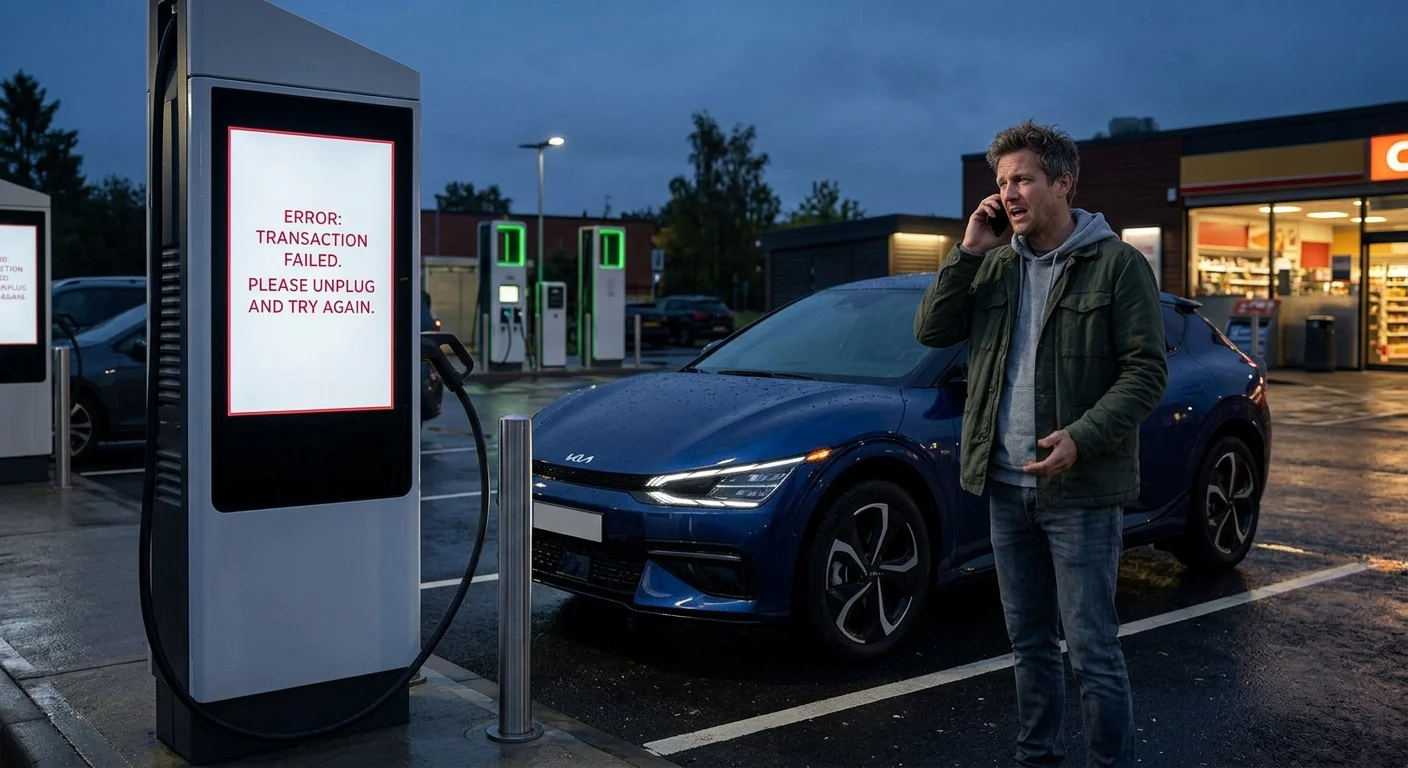
It’s frustrating when your Kia EV6 won’t charge, especially when you’re counting on getting around San Diego County. You pull up to a public station, plug in, and… nothing happens. This situation can be confusing and stressful, leaving you wondering if it’s the charger, the car, or something else entirely.

A Kia EV6 parked at a charging station at dusk, with an error message visible on

Common reasons a Kia EV6 stops charging

When your Kia EV6 doesn’t accept a charge, several common issues could be at play. It’s often something straightforward, not a major vehicle problem. First, check the charger connection itself. Make sure the charging cable is fully seated into the EV6’s charge port and locked securely. Sometimes a loose connection is all it takes to prevent charging from initiating.

Next, consider the charging station itself. Public chargers can experience technical glitches, be out of service, or have payment processing errors. Always try a different port or even a different charging station if possible. Environmental factors can also play a role, though less common. Extreme temperatures, hot or cold, can sometimes affect charging speeds or even halt charging altogether as a safety measure. The car’s battery management system protects the battery in these conditions.

Your EV6’s charging schedule settings might also be an issue. If you’ve programmed your car to charge only at specific times or only up to a certain percentage, it might simply be waiting for those conditions. Double-check your vehicle’s infotainment system settings to ensure no schedules are preventing immediate charging. Also, a common but often overlooked reason is a tripped circuit breaker at your home charging station. If you’re using a Level 2 home charger, head to your electrical panel and check if the breaker for the EV charger is in the “off” position. Resetting it might be all you need to do.

Finally, the car’s 12V auxiliary battery, not the main high-voltage traction battery, can cause charging issues. An unexpected low charge or failure in the 12V battery can prevent the car’s systems from communicating with the charger, halting the process. We’ll dive deeper into this specific issue next, as it’s a frequent culprit for EVs that seemingly refuse to take a charge. Understanding these initial checks can save you time and frustration, helping you narrow down the potential cause quickly.

Is it a public charger issue or the car’s 12V battery?

Distinguishing between a public charger malfunction and an issue with your Kia EV6’s 12V battery is a critical troubleshooting step. When you connect your EV6 to a public charging station and it fails to initiate a charge, the first question is always: “Is it the charger or my car?”

A simple way to test the public charger is to observe its screen. Does it show an error message? Is it completely dark or unresponsive? If the charger appears dead or throws an error code, it’s likely a station-side problem. Trying another charger at the same location, or a completely different charging network, can quickly confirm if the issue lies with the infrastructure. If your EV6 charges fine at a different station, you’ve isolated the problem to the original charger.

However, if multiple public chargers refuse to charge your EV6, or if you’re having trouble charging at home, the focus shifts to your vehicle. This is often where the 12V auxiliary battery comes into play. Unlike gasoline cars, EVs use a separate 12V battery to power the car’s electronics, including the onboard computer that manages charging. If this 12V battery is low or dead, your EV6 might not “wake up” to communicate with the charging station. Symptoms of a struggling 12V battery can include unresponsive infotainment screens, flickering lights, or the car simply not recognizing the charging cable connection. For more details on this common EV issue, read our post on what happens when an EV 12V battery dies.

Your EV6 might even display a warning on the dashboard related to the 12V system. If you suspect the 12V battery, you can try to jump-start it just like a gasoline car, using a portable jump starter or another vehicle. Be sure to consult your owner’s manual for the correct jump-starting procedure to avoid damaging your vehicle’s sensitive electronics. If a jump-start revives your EV6 and allows it to charge, then you’ve found your culprit. You’ll likely need to replace the 12V battery soon.

How to safely perform a vehicle system reset

Sometimes, electronic glitches can prevent your Kia EV6 from charging. A system reset can often clear these temporary software bugs, much like restarting your computer. This process is generally safe for your vehicle, but you should always follow the correct steps outlined in your owner’s manual to avoid any unintended consequences. The basic principle involves disconnecting the 12V battery to cut power to the vehicle’s electronic control units (ECUs), allowing them to “reboot.”

Before you start, make sure your EV6 is parked safely, the parking brake is engaged, and the vehicle is turned completely off. You’ll need a basic wrench to loosen the battery terminals. Locate your 12V battery, which is typically under the hood, but Kia EV6 models might have it in a different location, so check your manual if you’re unsure. Once located, identify the negative terminal first (usually marked with a ”-” sign and a black cable). Loosen the nut on the negative terminal clamp and carefully remove the cable from the battery post. To be extra cautious, you can also disconnect the positive terminal.

After disconnecting, wait for at least 5-10 minutes. This gives the vehicle’s capacitors time to discharge and ensures a complete system reset. During this time, you might hear some clicks or faint noises as residual power drains. Once the waiting period is over, reconnect the positive terminal first (if you disconnected it), then the negative terminal. Ensure all connections are tight and secure. Close the hood, start your EV6, and then try connecting it to a charger again.

A system reset can often resolve minor communication errors between the car and the charger. It’s a troubleshooting step many EV owners find helpful before escalating to more complex diagnostics. Remember, if you’re uncomfortable performing this step yourself, or if it doesn’t resolve the charging issue, it’s time to seek professional assistance. Your safety and the integrity of your vehicle’s systems are paramount.

Infographic illustrating a troubleshooting flowchart for a Kia EV6 that won't charge, starting with simple checks and progressing to professional help.

Checking for fault codes on the dashboard

When your Kia EV6 encounters an issue, its onboard diagnostic system often generates fault codes that display as warning lights or messages on your dashboard. These indicators are crucial for understanding why your car isn’t charging. Different symbols and text messages can point to specific problems, from a minor system glitch to a more significant electrical fault.

Pay close attention to any warning lights that appear when you try to initiate charging or after a failed attempt. Common indicators related to charging issues might include a “Check EV System” light, a battery symbol, or a specific text message indicating a “Charging Fault” or “Service EV System.” Consult your Kia EV6 owner’s manual to understand what each specific warning light or message signifies. The manual will often provide troubleshooting steps associated with each code.

Sometimes, the fault code might not be immediately obvious but stored in the vehicle’s computer. A standard OBD-II scanner, which mechanics use, can retrieve these deeper diagnostic trouble codes (DTCs). While owning an OBD-II scanner isn’t common for every driver, some auto parts stores offer free code reading services. If you get a specific code, researching it online or consulting your dealer can provide more insight.

However, many charging system fault codes require specialized equipment and expertise to interpret and address correctly. What might seem like a simple warning light could be a symptom of a more complex underlying issue with the car’s charging control unit, wiring, or even the high-voltage battery system. Attempting to clear codes without addressing the root cause is usually a temporary fix, and the problem will likely recur. When dashboard warnings persist, especially after trying basic troubleshooting, it indicates a need for professional diagnostic services.

When you’re stranded in San Diego: getting a mobile diagnosis and charge

If you’ve gone through the troubleshooting steps and your Kia EV6 still won’t charge, or if you’re simply stuck and out of options, don’t despair. Being stranded with a non-charging EV in San Diego County can be frustrating, but you’ve got a reliable solution. Charge Pro SD specializes in bringing the solution directly to you.

Our mobile EV rescue service is designed for exactly these situations. We’ll dispatch a technician with a specialized vehicle equipped to diagnose and, if possible, provide an emergency charge to your Kia EV6 right where you are. This means you avoid the hassle and expense of towing your vehicle to a dealership or service center. Our team has the tools and expertise to pinpoint whether the problem is with your 12V battery, a specific charging component, or a more complex system fault.

We understand the unique challenges of non-Tesla EVs and their charging systems. Whether you’re in downtown San Diego, Encinitas, or further inland, our goal is to get you back on the road quickly and safely. We offer comprehensive non-Tesla EV rescue services, ensuring your Kia EV6 receives expert attention without leaving its location. When you’re facing a critical charging issue, trust us to provide prompt and efficient emergency EV roadside assistance across the county. We’re here to help you get moving again.

When to call us

If your Kia EV6 still isn’t charging after these troubleshooting steps, or if you’re seeing persistent fault codes, it’s time for professional help. Diagnosing complex EV charging issues and safely working with high-voltage systems requires specialized training and equipment. Call us at (858) 400-4465 for a same-day estimate.