A straightforward home EV charger installation in San Diego County typically runs $500 to $2,500, and the number climbs from there mainly when your electrical panel needs an upgrade.
Quick note first: Charge Pro SD does mobile roadside rescue and mobile charging, not home charger installation. This guide is here to help you plan a permanent charger, and it points you to the real facts, not a pitch for a service we don’t offer.
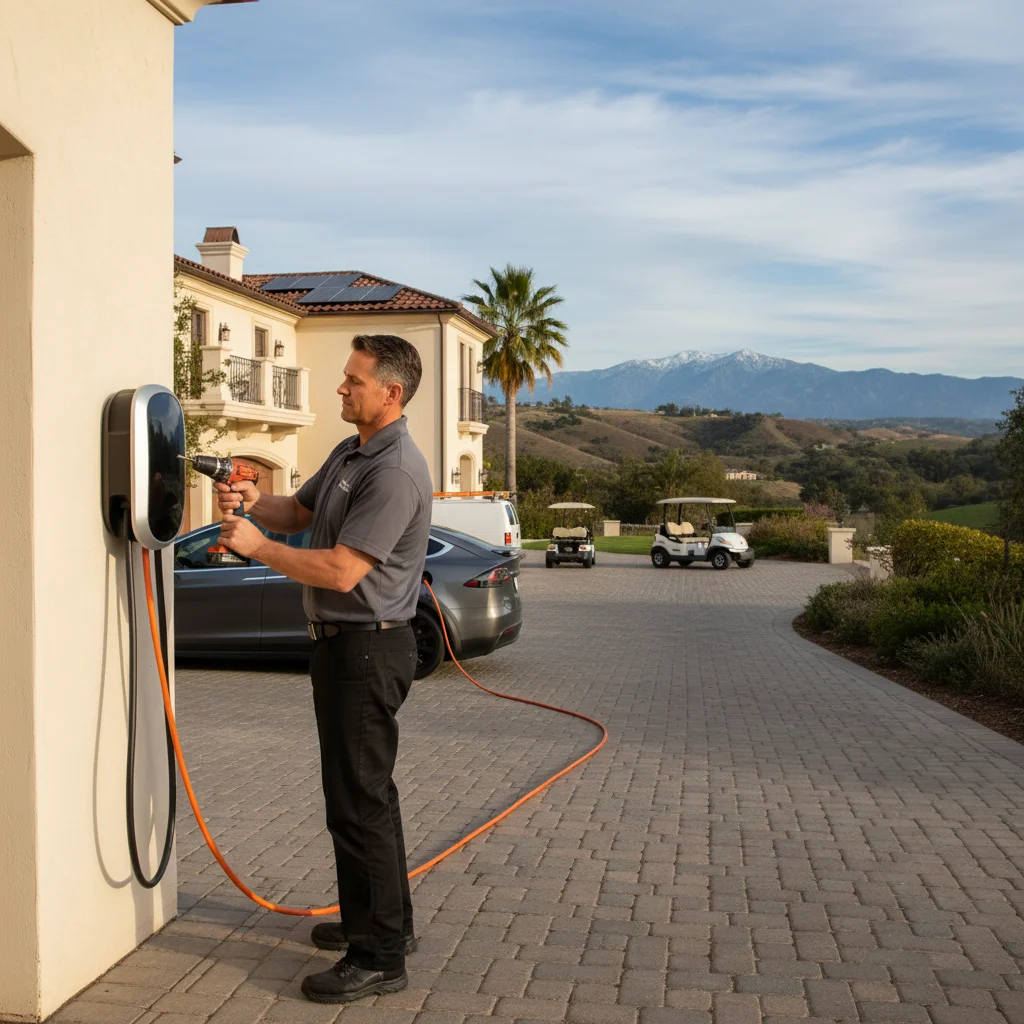
What you’re actually paying for
An install quote isn’t one number, it’s several stacked together. Understanding the pieces helps you tell a fair quote from a lowball one that’s about to turn into a change order.
- The charger itself. A basic Level 2 charger runs a few hundred dollars. Premium units with wifi, load management, or a longer cable cost more.
- Labor and materials. This covers running a new dedicated 240V circuit from your panel to your parking spot, including the wire, conduit, and breaker.
- The permit. Nearly every San Diego County jurisdiction requires an electrical permit for a 240V install. A licensed electrician typically pulls this for you and schedules the inspection.
- Panel work, if needed. This is the variable that swings your total the most, covered below.
Put together, a home with a modern 200-amp panel and a short wire run from panel to garage often lands on the lower end of that $500 to $2,500 range. A longer run, an older home, or a panel near capacity pushes it higher.
The panel question is the real cost driver
Before any electrician quotes you a firm number, they should run a load calculation, adding up your home’s existing electrical demand to see if there’s headroom for a charger pulling 40 to 48 amps.
Here’s roughly how panel size plays out across San Diego County homes:
- 200-amp panels usually have enough spare capacity. Most homes built from the 1990s on fall into this category, and the charger circuit is often a straightforward add.
- 100-amp panels are the borderline case. A lot of San Diego housing stock from the 1960s through the 1980s still runs 100 amps, and whether it can take a charger without an upgrade depends on what else is already drawing power, central air, an electric range, an electric dryer.
- 60-amp panels usually need an upgrade. These are older and increasingly rare, but if your home hasn’t been touched electrically in decades, it’s worth checking.
If your panel is tight, you’re not automatically looking at a full panel upgrade. A load management device that throttles the charger during high-demand periods is often cheaper and avoids replacing the panel entirely. A full panel upgrade, when it’s needed, is the piece most likely to push your total installation cost well past $2,500.
Tesla Wall Connector and NEMA 14-50 pricing separately
Two of the most common home charging setups have their own cost profile worth knowing before you get quotes. If you’re specifically looking at a Tesla Wall Connector, we cover that pricing in detail in our Tesla Wall Connector cost guide. If you’re weighing a simpler plug-in NEMA 14-50 outlet instead of a hardwired charger, that’s broken down in our NEMA 14-50 outlet cost guide, and it’s often the more affordable route.
What’s changed on the incentive side
For a while, the federal 30C tax credit covered 30 percent of a residential charger’s cost, up to $1,000, for installs completed by June 30, 2026. That window has closed. If your install happens after that date, don’t count on it in your budget, and don’t let a contractor quote you a price that assumes it’s still available.
SDG&E doesn’t currently run a dedicated rebate program for home chargers or panel upgrades. The real savings comes from enrolling in a time-of-use EV rate plan, which prices overnight charging (typically midnight to 6 a.m.) far below daytime rates. If you schedule your charging into that window, the rate plan does more for your long-term cost than any one-time rebate would.
Amperage: more isn’t always worth paying for
It’s tempting to ask your electrician for the biggest circuit possible, but most EVs, Tesla included, don’t actually use much past 40 to 48 amps of onboard charging. Paying extra for a 60-amp or 100-amp circuit when your car can’t use it is money spent on headroom you’ll never touch. Ask your electrician what amperage your specific vehicle actually supports before you agree to size up the circuit.
Where San Diego’s inland and East County costs differ
Coastal San Diego and inland San Diego are not the same install. Older housing stock, smaller original panels, and longer permit timelines in cities like El Cajon, Santee, and Lakeside tend to push costs and wait times higher than what you’d see closer to the coast. If you’re in one of those areas, our East County EV charger installation guide covers the panel and permit reality city by city.
Keeping your EV charged while you wait
Between getting quotes, scheduling an electrician, and waiting on a permit, a home install can take anywhere from about a week to over a month if a panel upgrade is involved. That’s a real gap if charging is your only concern in the meantime. Our mobile EV charging service delivers a charge directly to wherever you’re parked, so a slow permit office doesn’t leave you stuck. We’ve also written a full comparison of home charger vs. mobile charging if you’re deciding how to split your charging needs between the two.
Frequently asked questions
What’s the average cost to install a home EV charger in San Diego?
Most straightforward installs land between $500 and $2,500, covering the charger, labor, and permit. If a panel upgrade is needed, the total can climb well beyond that.
Is the federal tax credit for home EV chargers still available?
The 30C federal credit covered 30 percent of the cost, up to $1,000, but only for installs completed by June 30, 2026. That deadline has passed, so it’s no longer part of the math for new installs.
Does SDG&E offer a rebate for home chargers?
Not currently. The bigger savings comes from SDG&E’s time-of-use EV rate plan, which makes overnight charging significantly cheaper than daytime power.
How do I know if my panel needs an upgrade?
Ask your electrician for a load calculation before accepting a quote. It tells you exactly how much spare capacity your panel has and whether a charger fits without additional work.
What if I need to charge my EV before the install is finished?
That’s exactly what mobile charging is for. We can deliver a charge to your home while you wait on quotes, permits, or panel work, so your daily driving doesn’t stall out.
Whether you’re gathering quotes or already stuck waiting on an install, we can keep you moving in the meantime. Call Charge Pro SD at (858) 400-4465 and we’ll be on our way.