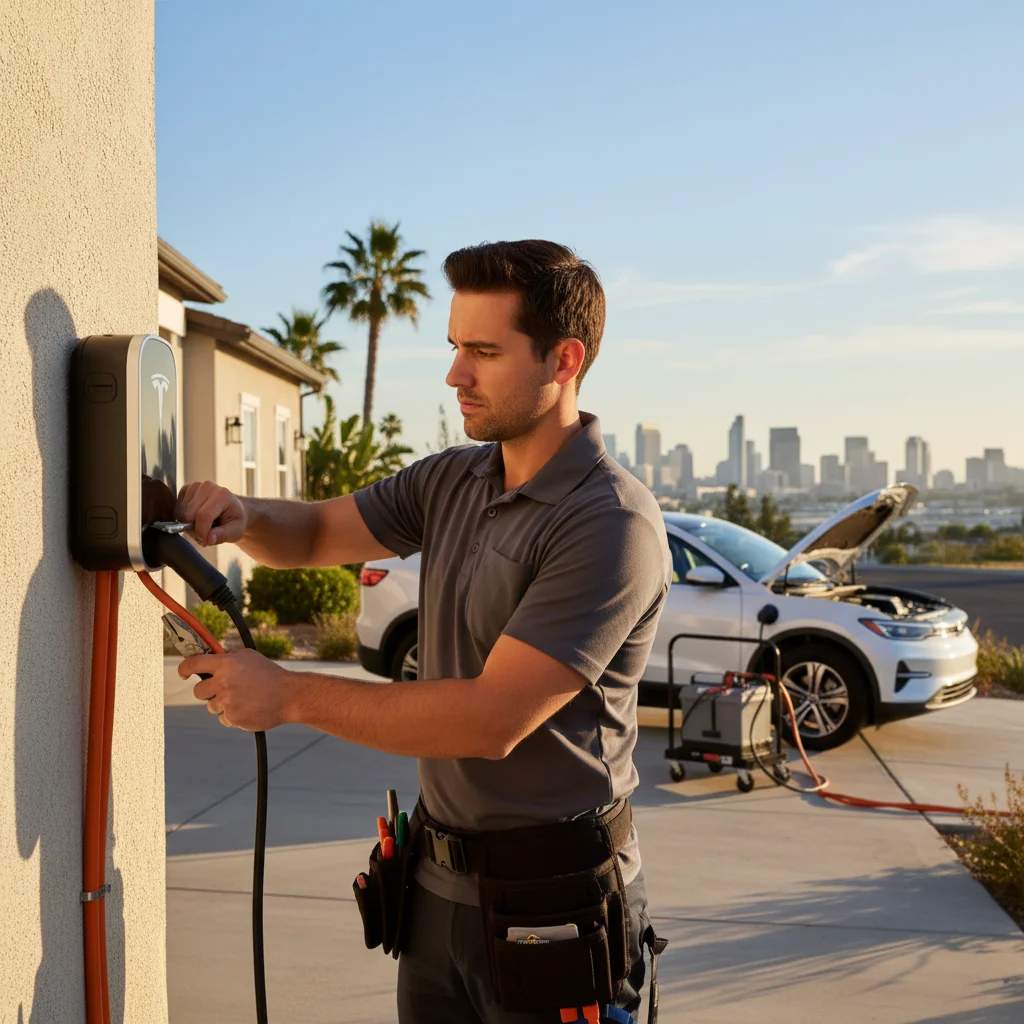
When a Genesis GV60 or Electrified GV70 won’t start, a dead 12V auxiliary battery is almost always the cause, not an empty traction pack. Both models ride on the same E-GMP platform as the Hyundai Ioniq 5 and Kia EV6, so they share the same 12V weak point. If that small battery drains, the car goes dark and ignores the start button, the key, and the door handles. The state of charge in the main pack doesn’t matter.

Genesis builds a quiet, polished EV, but the underlying electrical architecture is the same one we rescue across the Hyundai and Kia lineup. This guide covers why the GV60 and GV70 go dark, where the 12V battery actually lives, how to jump it safely, and what to do if you’re stranded somewhere in San Diego County.

Why a Genesis EV goes completely dark

Every E-GMP vehicle runs two batteries. The large traction pack moves the car. The 12V auxiliary battery wakes everything else: the computer that boots the high-voltage system, the door locks, the displays, the lighting, and the network that lets all the control modules talk. If the 12V dies, the traction pack stays locked out. The car can’t power up no matter how full the main battery is.

There’s a known E-GMP behavior that catches Genesis owners off guard. When the traction battery drops to a very low state of charge, the management system can stop topping off the 12V. Let the car sit a few days after that, and the 12V drains all the way down. So a GV60 with plenty of range left can still go dark if it parked low and sat with a marginal 12V battery.

San Diego heat speeds this up. The coastal marine layer doesn’t shield a 12V battery from heat cycling the way people assume. Parking in direct sun in places like El Cajon, Poway, or Escondido during summer ages auxiliary batteries fast. A two or three year old GV60 or GV70 12V battery is worth keeping an eye on here.

What happens when an EV 12V battery dies walks through the full cascade if you want to understand the system before you start troubleshooting.

The symptoms that point to a dead 12V

A drained 12V battery looks different from a car that’s just out of range. Watch for these signs:

  • The car is completely unresponsive. No interior lights, no chime, no display when you open the door.
  • The flush door handles won’t present or won’t unlock with the key.
  • The frunk and charge port won’t open with the button.
  • The key fob does nothing, even with a fresh fob battery.
  • You may hear a single faint click, then nothing.

If the dash lights up but the car refuses to go into drive, or it warns you about low range, that’s a different problem. That points to the traction pack, covered further down.

Where the 12V battery is on a GV60 and GV70

This is the part that trips people up, and it splits by body style. On the GV60 crossover, the 12V auxiliary battery sits up front under the hood, similar to the Ioniq 5. On the Electrified GV70, the layout follows the sedan-style E-GMP pattern, so the battery can be tucked away under trim rather than sitting in plain view. Either way, you usually don’t jump from the battery’s own terminals.

The correct jump points are in the engine bay. Here’s the general setup:

LocationWhat’s there
Under hood, driver’s side fuse boxPositive (+) jump terminal (red cap)
Under hood, engine bayBare chassis bolt for negative (ground)
Front compartment or under trimActual 12V auxiliary battery

Pop the hood with the interior release and look for the black fuse box cover on the driver’s side. Lift the red cap to expose the positive terminal. Find a clean, unpainted metal bolt for your ground. Year and trim vary, so check the owner’s manual for your exact model year if the layout doesn’t match what you see.

How to jump-start a Genesis GV60 or GV70

You’ll need a portable jump pack or a second vehicle with working jumper cables. The procedure is safe as long as you use the right points.

  1. Open the hood using the interior release.
  2. Find the black fuse box cover on the driver’s side of the engine bay.
  3. Lift the red plastic cap to expose the positive (+) terminal.
  4. Connect the red (positive) clamp to that terminal.
  5. Connect the black (negative) clamp to a bare, unpainted metal bolt on the chassis, like a strut tower or firewall bolt. Don’t clamp it to the battery’s negative post.
  6. If you’re using a donor car, connect the other ends to its battery, positive to positive and negative to negative, then start the donor.
  7. Wait two to three minutes for the Genesis 12V to take some charge.
  8. Try to start the car. The boot sequence takes a few seconds longer than normal after a dead 12V.

If it starts, drive straight to a charger. A drained 12V won’t recover from a single jump without time topping back up. If it dies again within an hour, the 12V needs replacement, not another jump. The same safe sequence applies to the EV6 and Ioniq lineup, since the platform is shared. For the full walkthrough, see how to jump start an EV safely.

When it’s the traction pack instead

Not every dead Genesis is a 12V problem. If the dash powers up, the displays work, and the car simply warns that it’s out of range or won’t enter drive, the traction pack is empty. That’s a charging problem, not a jump.

In that case a jump does nothing. You need real range added back. We bring charge to you with a mobile setup, enough to reach the nearest Supercharger or fast charger. If your charge port won’t open at all, that can be its own issue, covered in EV charge port won’t release. For a fully depleted pack, our out-of-charge recovery service is the right call.

San Diego scenarios where this happens

Dead 12V calls follow a pattern in San Diego County, and Genesis owners cluster in a few areas. We get GV60 and GV70 calls most often from La Jolla, Carmel Valley, and Rancho Santa Fe, where these cars are common.

Long-term parking near the airport. A GV60 left at a surface lot for 10 to 14 days, parked low on charge, often won’t restart on return. The 12V drained while it sat.

Estate and gated-community garages. In Rancho Santa Fe, a second or third car can sit for weeks. If the 12V was already two years old, it can go flat without warning.

Coastal heat cycling in La Jolla and Carmel Valley. Marine humidity plus afternoon sun ages a 12V faster than the cool mornings suggest. A car fine on Monday can be dead by the weekend.

East County summer heat. El Cajon and Santee push past 100 degrees in July and August. Extreme heat is the fastest way to age a 12V battery, so test yours if the car parks outdoors.

Charge Pro SD covers all 67 cities in San Diego County. We reach most metro locations in 25 to 60 minutes, with 75 to 90 minutes out in East County and the Backcountry.

How our rescue works

Our rescue vehicle is a Tesla Cybertruck with a 240V, 9.6 kW bed outlet, a native NACS plug, and a CCS adapter for non-Tesla EVs like your Genesis. For a dead 12V we carry the gear to get your system back online. For an empty traction pack we add range on the spot, usually 30 to 60 miles for a non-Tesla, enough to reach a charger or home.

Pricing is straightforward. Dispatch is $149, which includes the roll and the first 15 minutes of charge, then $1.80 per added mile. Most rescues land between $149 and $225. After-hours calls between 11pm and 6am add $50. We run 24/7. For any Genesis or other non-Tesla EV stranded here, our non-Tesla EV rescue service is built for exactly this. Call (858) 400-4465 and we’ll get someone headed your way.

Frequently asked questions

How do you jump-start a Genesis GV60?

Use the positive terminal under the hood in the driver’s side fuse box, not always the battery’s own posts. Connect the positive clamp to the red-capped terminal in the engine bay, and the negative clamp to a bare metal chassis bolt. Wait two to three minutes, then try to start the car. Check your owner’s manual for the exact layout on your model year.

Where is the 12V battery in a Genesis GV60 or GV70?

On the GV60 crossover the 12V auxiliary battery is up front under the hood, like the Ioniq 5. On the Electrified GV70 it can sit under trim rather than in plain view. Regardless of where the battery is, the jump terminals you want are in the engine bay under the hood.

Can a Genesis EV die if the traction battery still has charge?

Yes. If the 12V auxiliary battery dies, the car loses all power no matter how full the main pack is. The 12V wakes the computer that boots the high-voltage system. No 12V power means the car can’t start, even with plenty of range left in the traction battery.

Does Charge Pro SD come to Genesis owners in San Diego?

Yes. Charge Pro SD serves all 67 cities in San Diego County and handles Genesis, Hyundai, Kia, and every other non-Tesla EV. We get a lot of these calls in La Jolla, Carmel Valley, and Rancho Santa Fe. Typical metro dispatch is 25 to 60 minutes. Call (858) 400-4465.

Why do Genesis, Hyundai, and Kia EVs share the same 12V problem?

The Genesis GV60 and Electrified GV70 ride on the same E-GMP platform as the Ioniq 5 and Kia EV6. They share the electrical architecture, including the 12V auxiliary battery design and its drain behavior. So the failure mode, and the fix, carry across all of them.

Since these cars share a platform, our Hyundai Ioniq 5 won’t start guide covers the same architecture in even more detail.