Your Ford Mustang Mach-E is usually a reliable performer, but what happens when it suddenly won’t power on? Seeing a blank screen or getting no response can be frustrating and confusing for any EV owner. It’s a common issue, and understanding the potential causes is the first step toward getting your Mach-E moving again.

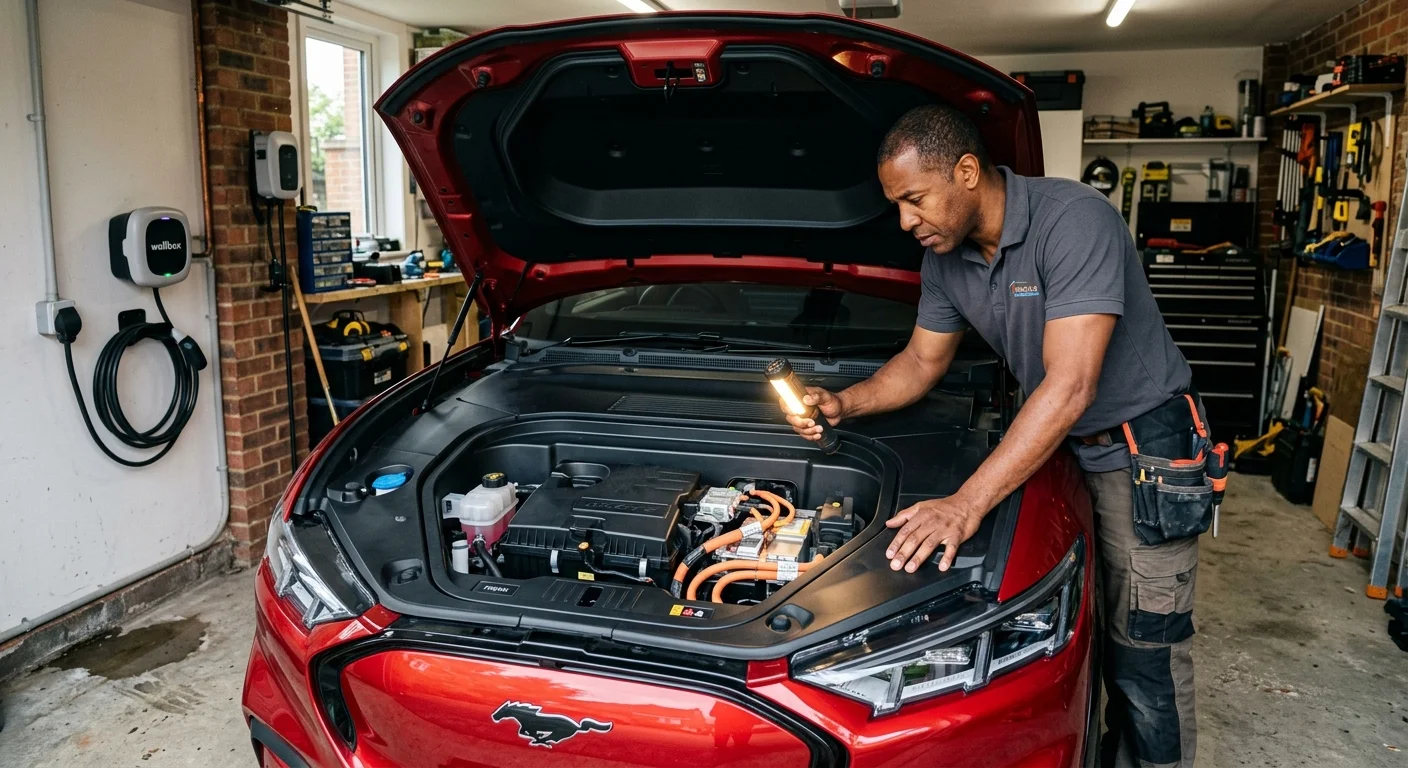
A Ford Mustang Mach-E parked in a garage with the hood open, as the owner looks at the engine bay with a flashlight, looking concerned.

Is it the 12V battery or the high-voltage system?

Many EV owners assume a dead EV battery means the main propulsion battery is drained. However, it’s often the smaller, conventional 12V battery at fault. Just like a gas car, your Mach-E relies on a 12V battery to power its auxiliary systems. This includes the vehicle’s computer, infotainment, lights, door locks, and the contactors that connect the high-voltage battery. If the 12V battery is dead, your Mach-E can’t “wake up,” even if the main high-voltage pack is fully charged.

A failing 12V battery will prevent your Mach-E from starting, charging, or even recognizing your key fob. You might experience no power at all, or perhaps just a flicker of lights and clicking noises. In contrast, a low high-voltage battery means your car might turn on, but it won’t allow you to shift into drive or accelerate. You’ll likely see specific warnings on your display about low battery charge or restricted power. Knowing the difference helps you decide your next steps. For more on this, we’ve got a detailed guide on what happens when EV 12V battery dies.

Common error messages and what they actually mean

When your Mach-E isn’t starting, its display might show various error messages. These messages can offer crucial clues about what’s going on.

  • “System Off to Save Battery” or “Vehicle will shut down in X seconds”: This often points to a low 12V battery. The vehicle is trying to conserve the remaining power.
  • “Key Fob Not Detected”: While sometimes a key fob issue, this can also indicate a weak 12V battery struggling to power the car’s receivers. Try replacing the fob battery first.
  • “Stop Safely Now”: This is a more serious message, typically indicating an issue with the high-voltage system or other critical components. It usually means the car can’t safely operate.
  • “Service Vehicle Soon” or specific warning lights: These are general alerts that need professional diagnosis. They don’t usually prevent starting immediately but warn of underlying problems.
  • Completely blank screen/no power: This is the classic symptom of a completely dead 12V battery. The car simply can’t power its internal systems to even display a warning.

If you see these messages, don’t ignore them. They’re your Mach-E’s way of telling you it needs attention. If the message clearly points to a battery issue, a jump start might resolve it. If it’s more complex, you’ll need professional assistance.

How to find and test the Mach-E’s 12V battery

Locating the 12V battery in an EV like the Mach-E isn’t always as straightforward as in a gas car. Ford chose to place the 12V battery for the Mach-E under the hood, within the “frunk” (front trunk) area.

To access it:

  1. Open the frunk: Use your key fob or the interior release button.
  2. Locate the cover: You’ll find a plastic cover on the passenger side of the frunk that conceals the battery.
  3. Remove the cover: There are usually a few clips or fasteners holding it in place. Carefully unclip or unscrew them.
  4. Identify the battery: Once the cover is off, you’ll see the 12V battery. It looks like a typical car battery, just a bit smaller.

Testing the 12V battery requires a multimeter.

  1. Set the multimeter: Turn it to DC Volts (V=) and select a range like 20V.
  2. Connect the probes: Attach the red (positive) probe to the positive (+) terminal of the battery and the black (negative) probe to the negative (-) terminal.
  3. Read the voltage: A healthy 12V battery should read around 12.6 volts when fully charged. If it’s below 12V, especially around 11.5V or lower, it’s likely discharged or failing.

It’s important to note that even if the voltage reads low, the battery might just be discharged, not completely dead. A jump start could bring it back to life temporarily. However, if it repeatedly dies, it’s time for a replacement.

Diagram showing the location of jump start terminals and the 12V battery in a Ford Mustang Mach-E's frunk and underhood area.

Steps to safely jump start your Mach-E

Jump starting a Ford Mustang Mach-E is similar to a traditional car, but with a few key differences and safety considerations. You’re not jump-starting the high-voltage battery; you’re only reviving the 12V system.

Here’s how to do it safely:

  1. Gather your equipment: You’ll need jumper cables and a working 12V vehicle (gas or electric) or a portable jump starter pack. Make sure both vehicles are turned off.
  2. Locate the Mach-E’s jump start terminals: While the 12V battery is under the frunk cover, Ford provides more accessible jump-start terminals. Open the frunk. Look for a positive (+) terminal, usually under a red cap, and a negative (-) ground point, which is typically a bare metal bolt or bracket on the chassis nearby.
  3. Connect the cables – Mach-E (dead battery):
    • Attach the red (positive) clamp to the Mach-E’s positive (+) jump start terminal.
    • Attach the black (negative) clamp to the Mach-E’s designated negative (-) ground point.
  4. Connect the cables – Donor Vehicle/Pack (good battery):
    • Attach the red (positive) clamp to the donor vehicle’s positive (+) battery terminal.
    • Attach the black (negative) clamp to the donor vehicle’s negative (-) battery terminal or a bare metal ground point.
  5. Start the donor vehicle (if applicable): Let it run for 5-10 minutes to charge the Mach-E’s 12V battery. If using a jump pack, simply turn it on.
  6. Attempt to start the Mach-E: Try to power on your Mach-E. If it starts, it means the 12V battery received enough charge.
  7. Disconnect the cables (in reverse order):
    • Remove the black (negative) clamp from the donor vehicle.
    • Remove the red (positive) clamp from the donor vehicle.
    • Remove the black (negative) clamp from the Mach-E.
    • Remove the red (positive) clamp from the Mach-E.
  8. Keep the Mach-E on: Once started, drive your Mach-E for at least 30 minutes, or plug it into a charger. This allows the car’s internal DC-DC converter to recharge the 12V battery from the high-voltage pack. If the 12V battery struggles to hold a charge again, it might need replacement. Always follow your vehicle’s owner’s manual for specific instructions.

Getting roadside help in San Diego when you’re stranded

Finding yourself stranded with a Mach-E that won’t start, especially in a busy area like San Diego County, can be stressful. While the steps above can help diagnose and sometimes resolve a 12V battery issue, not every situation is a simple fix. Maybe you don’t have jumper cables, or perhaps the problem is more complex than a dead 12V battery.

That’s where professional EV roadside assistance comes in. Charge Pro SD specializes in non-Tesla EV rescue across San Diego, understanding the unique needs of electric vehicles like your Ford Mustang Mach-E. We can come to your location – whether you’re in downtown San Diego, Encinitas, Chula Vista, or anywhere in between – and provide the specific help your EV needs.

Our technicians are trained to diagnose issues that prevent EVs from starting, from a truly dead 12V battery to more intricate high-voltage system faults. We carry specialized equipment for safely jump-starting EVs and can even provide a mobile charge if your main battery is critically low, though a non-starting Mach-E is more often a 12V issue. Don’t risk improper towing or DIY fixes that could void warranties or cause further damage. If your Mach-E won’t start and you’re unsure about troubleshooting it yourself, or you need immediate help, it’s best to call in the experts who understand EV systems. We’ll get you safely back on the road.

When to call us

If you’ve tried the troubleshooting steps and your Ford Mustang Mach-E still won’t start, or if you’re not comfortable performing a jump start yourself, it’s time to call an EV charging specialist. Complex electrical issues or high-voltage system problems require specialized tools and expertise to avoid damage to your vehicle or personal injury. Call us at (858) 400-4465 for a same-day estimate.