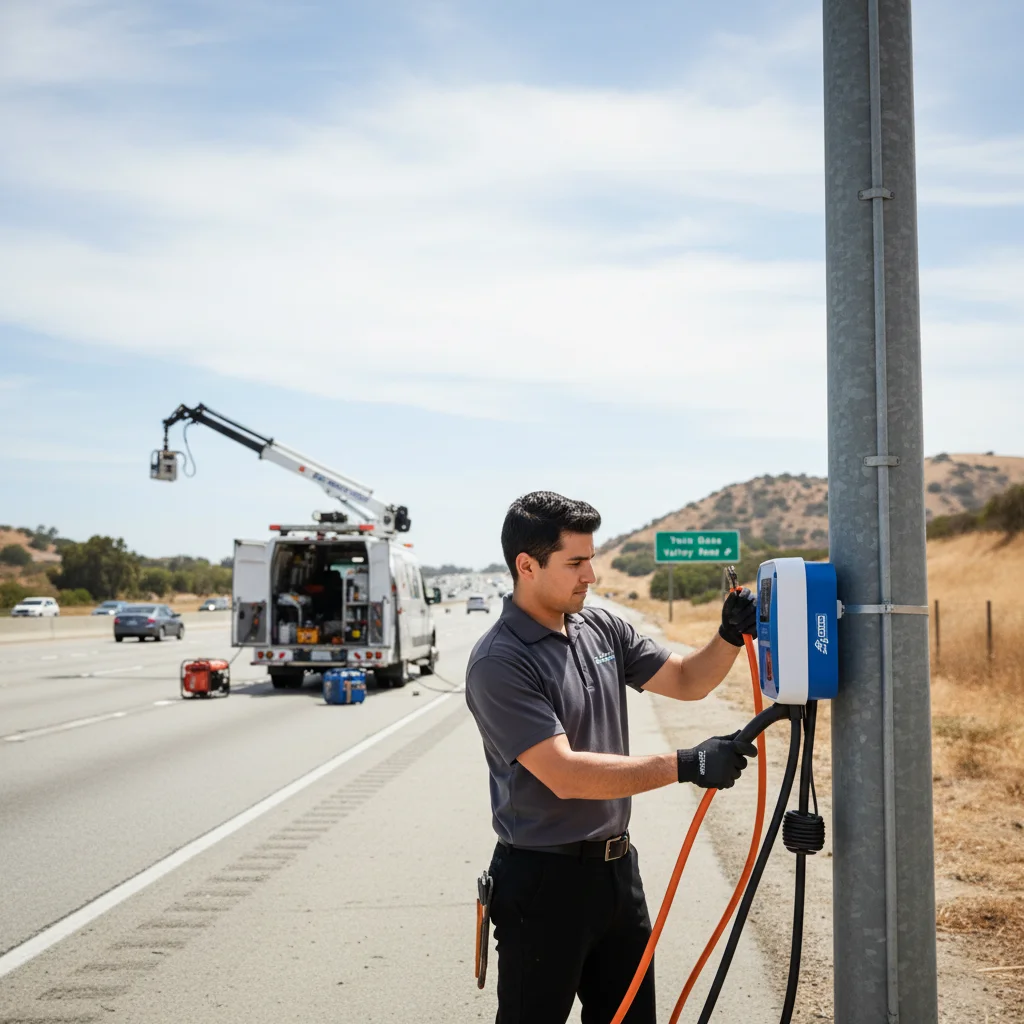
Your EV battery meter hits zero faster than the nav app promised, and the nearest charger is still two exits away on SR-78. San Marcos drivers face that exact scenario more often than they’d expect — the city’s mix of freeway commutes, hilly neighborhoods, and a large commuter university creates the kind of range math that catches people off guard. When it happens, our mobile EV rescue team comes to you — no tow truck, no waiting lot, no guesswork.
Why San Marcos EV drivers strand more often than they expect
San Marcos sits in a pocket of inland North County where geography quietly drains batteries. The city isn’t flat. Residents in San Elijo Hills regularly climb 400-plus feet from the valley floor, and that elevation change adds real load to a pack that might already be running lean after a freeway stretch on SR-78.
Range estimates on cold mornings aren’t the only culprit. San Marcos has grown fast — the population has roughly doubled since 2000 — and the public charging infrastructure hasn’t kept up with the rate of EV adoption. PlugShare shows clusters of Level 2 stations around the Creekside and Palomar College areas, but long stretches of Discovery Street and Grand Avenue have almost nothing. A driver who plans to “top off at the grocery store” may find every stall occupied or broken.
There’s also a fleet-mix issue. San Marcos has a high concentration of longer-range Teslas and Ioniq 5s, but also older Nissan Leafs and Chevy Bolts with degraded packs. A Leaf with 60,000 miles might show 80 miles of estimated range but deliver 55 on a warm inland afternoon with the A/C running. The California Energy Commission’s data consistently shows inland counties log more per-mile energy use than coastal ones — warm afternoons mean more cooling load, and SR-78 means more 70-mph cruise drain.
The result: San Marcos sees a steady trickle of EV breakdowns that traditional AAA units aren’t equipped to solve. They can push you to a tow yard. We can push enough charge into your pack to get you home.
SR-78 and Twin Oaks Valley Road hotspots
SR-78 is the artery that connects San Marcos to Oceanside in the west and Escondido in the east, and it’s where we get the most calls from this city. The stretch between the Twin Oaks Valley Road interchange and the Nordahl Road exit is particularly unforgiving — wide shoulders, 65-mph traffic, and nowhere to duck off safely if you’re losing range fast.
Twin Oaks Valley Road itself creates a secondary problem. It runs north from SR-78 through a corridor of newer housing developments before climbing toward San Elijo Hills. Drivers who underestimate that climb — especially heading home after a long commute — sometimes run out of margin before they reach their garage. We’ve responded to stranded EVs on that road more times than we can count, usually within 20-25 minutes from our North County staging area near Escondido.
The SR-78 / Barham Drive area near the Westfield North County mall is another hot zone. Large parking structures mean EVs circle longer than expected burning charge they didn’t plan to burn. By the time someone exits onto SR-78 eastbound toward home, the buffer is gone.
If you’ve ever read our breakdown of EV roadside situations in Escondido, the pattern will feel familiar — inland North County cities share the same freeway geometry and the same gap in charging infrastructure.
Cal State San Marcos and Restaurant Row patterns
CSUSM sits on a mesa above the city, and getting there requires a sustained climb regardless of which route you take. The university has added EV charging in its parking structures, but demand from students, faculty, and staff frequently outpaces supply. On days when the lots are full and the chargers are all occupied, drivers sometimes leave campus with less charge than they arrived with — they waited, didn’t get a stall, and burned energy idling.
Restaurant Row, the commercial strip along Twin Oaks Valley Road near Discovery Street, generates a different pattern. People drive in from Escondido, Vista, or Carlsbad for dinner, park for two hours, then discover their range estimate has dropped below what they need to get home — especially in warm weather when the pack has been sitting hot. There’s very little public fast-charging in that immediate area.
The same issue shows up near the Palomar Medical Center on Melrose Drive. Visitors and staff park for long shifts, return to a warm car after dark, and realize the range anxiety wasn’t anxiety at all — it was accurate.
For non-Tesla owners in particular, the options narrow quickly. Our mobile EV charging service handles any vehicle — Ioniq 5, Rivian, Mach-E, Bolt, Leaf — not just Teslas. We carry adapters for CCS, CHAdeMO, and J1772, so make and model don’t slow us down.
What we bring and how fast we arrive from North County staging
Our Cybertruck rescue rigs carry mobile DC fast-charging equipment rated to deliver meaningful range — not a token 5-mile trickle, but enough to comfortably reach a home charger or the nearest public station. Typical delivery gets a driver 20-40 miles of added range depending on vehicle and pack chemistry. That’s enough to clear SR-78 and get home in virtually any San Marcos scenario.
Response time from our North County staging area to San Marcos runs 20-35 minutes under normal conditions. The SR-78 corridor and Twin Oaks Valley Road are both well within that window. We’re faster than waiting for a flatbed, and we don’t require you to arrange a pickup from a tow yard later.
Our technicians are familiar with San Marcos terrain specifically. The approach to San Elijo Hills, the parking structure exits near the mall, the tight residential streets off Craven Road — none of that requires a GPS orientation call. We know where you’re likely to be and we know the fastest route.
We also handle more than empty batteries. If your 12V auxiliary battery has failed and your car won’t power on at all, that’s a separate fix that doesn’t need a tow either. Our Tesla 12V battery jump service has resolved dozens of those calls in North County. For a full picture of what a mobile rescue call involves, the inside look at our mobile EV charger truck breaks down exactly what we carry and why.
Mobile charge vs tow for inland North County drivers
Towing an EV isn’t the same as towing a gas car. Many EVs can’t be flat-towed without damaging the drivetrain — they require a flatbed, and flatbeds in inland North County during commute hours can take an hour or longer to arrive. Once the truck shows up, you still have to coordinate getting the car somewhere with a charger, and you may not get it back the same day.
Mobile charging skips all of that. If the only problem is an empty battery — which is the most common reason San Marcos drivers call us — you need electrons, not a tow yard. The comparison between mobile charging and towing is worth reading before you’re stranded, because the decision feels very different when you’re sitting on a SR-78 shoulder in traffic.
The exception is real mechanical failure: a blown tire, a damaged charging port, a collision. Those need a tow. But empty or nearly-empty batteries don’t — and that’s the majority of what we see in San Marcos. The US Department of Energy’s AFDC notes that range anxiety and charging availability are the top barriers to EV ownership in suburban markets. San Marcos fits that profile exactly.
If you’re unsure whether your situation needs a charge or a flatbed, call us first. We’ll tell you honestly, and we won’t dispatch a truck you don’t need.
When to call Charge Pro
Call us when you’re stranded with a dead or nearly-dead pack, when your 12V battery has killed all power to the car, or when your range estimate says you won’t make it home and you can’t find an open charger. Those are the exact situations our emergency EV roadside assistance service is built for — mobile, fast, and specific to San Marcos roads.
Call us at (858) 808-6055 — we’ll roll a Cybertruck rescue truck to you.