Driving an electric vehicle has benefits. Running out of charge on I-5, I-15, or the I-8 climb toward Alpine is still a location problem. Check live, vehicle-compatible stalls rather than assuming a charger near Camp Pendleton. A mobile charger truck is one possible response, not a guaranteed Charge Pro rescue. Charge Pro SD refers an independent operator. Charge Pro owns no trucks.
Charge Pro SD does not run a familiar Charge Pro rescue truck on San Diego roads. An independent operator may bring charging hardware they actually carry. This post explains what a mobile EV charger truck is in general, how a referral works, and what Charge Pro does not publish as Charge Pro equipment.
What is a mobile EV charger truck?
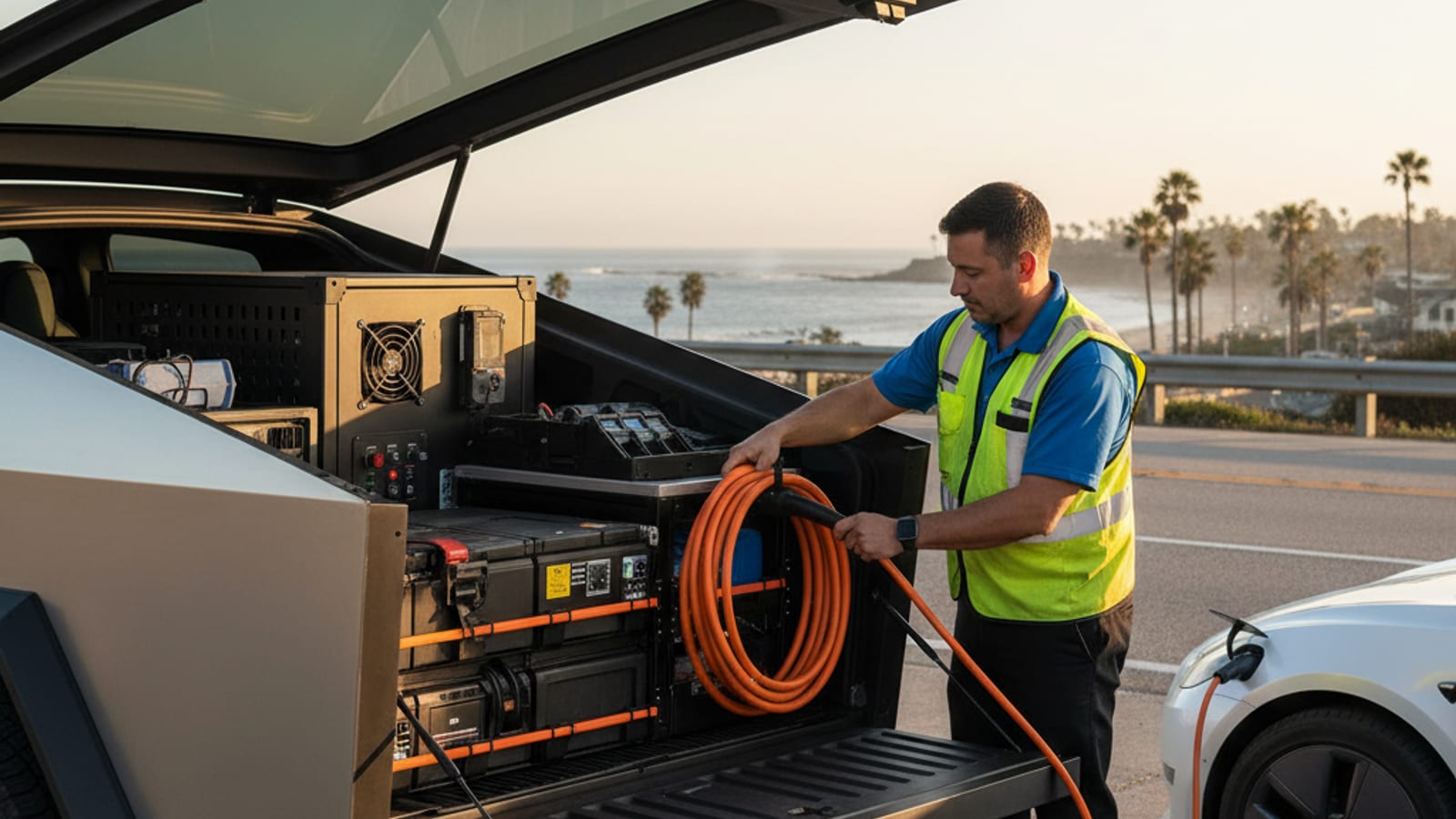
A mobile EV charger truck is a roadside assistance vehicle specifically designed to deliver emergency electric vehicle charging on-site. Unlike a traditional tow truck, which simply transports a stranded vehicle, a mobile charger truck provides immediate power. Its primary goal is to give an EV enough charge to reach the nearest charging station or safely get home. This service directly addresses the unique challenges of EV breakdowns, particularly running out of battery far from a charging point.
More than just a tow: On-site power delivery
The core difference between a mobile EV charger truck and a traditional tow truck lies in its function. When an internal combustion engine vehicle runs out of gas, a service can bring a few gallons of fuel. For an EV, simply bringing a battery isn’t enough; the vehicle needs to charge. A mobile charger truck, when the independent operator can work the pin, brings charging hardware to the stranded EV. That does not eliminate a tow. Feasibility, price, and timing are confirmed on the call. You pay the operator.
This on-site power delivery is especially valuable on San Diego’s busy freeways like SR-163 or I-805, where a breakdown can cause significant traffic disruptions. Getting a quick boost allows drivers to move their vehicle safely and efficiently.
The technology inside a mobile EV charger truck
The heart of a mobile EV charger truck is its power delivery system. These vehicles are equipped with significant battery storage and advanced power inverters. This setup allows them to convert their stored energy into usable electricity for an EV.
An independent operator may use Level 2 hardware they actually carry. Charge Pro SD does not publish a 240V / 9.6 kW bed outlet, a NACS plug, or a CCS adapter as Charge Pro equipment, and we do not claim nearly every EV on the road. Connector fit is confirmed on the call.
How a Charge Pro SD referral works
When you call Charge Pro SD because an EV is out of charge, Charge Pro matches you with an independent operator. Charge Pro owns no rescue truck. The operator confirms feasibility, equipment, price, and timing. You pay them.
Charge Pro SD is a referral. We do not publish a 240V / 9.6 kW bed outlet, a NACS plug, or a CCS adapter as Charge Pro equipment. An independent operator confirms what they actually carry, whether they can work the pin, price, and timing. You pay them.
Safety protocols for roadside EV charging
Roadside work is the independent operator’s safety setup, not a Charge Pro inspection program. Charge Pro does not claim NHTSA adherence. If the car is in a traffic lane or another dangerous place, call 911 first. NHTSA publishes general roadside safety material at nhtsa.gov.
Why mobile EV charging is essential in San Diego
San Diego County has a lot of EVs on the road. That does not make Charge Pro a truck that solves every pin. Public stall maps still have thin spots. Check live, vehicle-compatible stations.
San Diego’s unique EV landscape
- High EV density: Coastal cities like La Jolla, Del Mar, Encinitas, and Carlsbad have particularly high Tesla density. While these areas often have good charging infrastructure, unexpected low battery situations still occur. Coastal San Diego winters are milder than many inland or mountain climates. Inland heat can still cut remaining range. Check the vehicle’s reading against the route. This page will not freeze a 10-20% heat figure or a 100°F clock.
- Freeway network challenges: San Diego’s extensive freeway system (I-5, I-15, I-8, SR-163, SR-52, SR-56, I-805) is crucial for daily commutes and road trips.
- The I-5 stretch between Oceanside and San Clemente is notorious for the Camp Pendleton “charging desert,” a nearly 20-mile gap with no public charging options. Running out of charge here is a common and stressful scenario.
- The I-8 climb from El Cajon to Alpine gains over 1,500 feet of elevation. This significant incline consumes a heavy amount of range, making eastbound trips particularly susceptible to “out of charge” events.
- Popular EV road trips from SD, such as to Anza-Borrego Desert State Park, Julian (mountain town), or Temecula wine country, often involve areas with sparse charging infrastructure.
Addressing range anxiety head-on
Public stall counts change. Confirm live, vehicle-compatible stations. East County towns such as Alpine, Ramona, and Julian often show sparser public options than the coast. This page will not freeze a 2,000-port inventory or SDG&E TOU hours. Check SDG&E for current home-charging programs.
Charge Pro SD does not bring power as a Charge Pro crew, including in remote areas or dense freeway traffic. An independent operator confirms whether they can work that pin. See out of charge on the freeway.
Comparing mobile charging to other options
When your EV runs out of power, you have a few recourse options. Understanding the differences highlights the value of a mobile EV charger truck.
Mobile EV charging vs. traditional towing
| Feature | Possible on-site charge (independent operator) | Tow truck |
|---|---|---|
| Primary Service | Charge in place if the operator can work the pin | Vehicle transport |
| Immediate Benefit | May add enough energy to move | Relocates the vehicle |
| Convenience | Confirmed on the call | Requires transport to a charger |
| Time Investment | Operator confirms | Tow time plus later charging |
| Cost | Operator quote | Towing fees |
| Movement | No promised no-tow result | Vehicle leaves the pin |
| Goal | Feasible charge, then you drive | Get the vehicle to a charger |
As this table shows, a possible on-site charge and a tow are different jobs. See mobile EV charging vs tow. Neither result is promised in advance.
Limitations of public charging networks
While San Diego’s charging infrastructure is growing, it still has gaps. Tesla Superchargers are available in Mission Valley, Carlsbad, Escondido, Chula Vista, and National City, but significant areas in East County and the mountains lack coverage. Public Level 2 and DCFC stations can also be occupied, out of service, or require specific apps and payment methods. Finding an available, working charger when you’re already at 0% can be a major challenge.
Individual portable chargers
Some EV owners carry small portable chargers. These are typically low-power (Level 1, 120V) and charge very slowly, often adding only 2-5 miles of range per hour. They are meant for overnight trickle charging or minor top-offs, not emergency roadside rescue. A mobile EV charger truck delivers significantly more power, much faster, making it a true emergency solution.
The future of mobile EV roadside rescue
As EV adoption continues to soar, particularly in forward-thinking regions like San Diego, the demand for specialized EV services will only grow. The California Energy Commission actively promotes EV infrastructure development, but roadside emergencies will always be a factor. Mobile EV charger trucks represent the evolution of roadside assistance, adapting to the unique needs of electric vehicles.
Technological advancements in battery storage and charging speeds will make these rescue vehicles even more efficient. Imagine future trucks offering even faster charging, nearing DC fast charging speeds on demand. This ongoing innovation ensures that range anxiety will become less and less of a concern for EV drivers. For more information on EV technology and infrastructure, visit the DOE Alternative Fuels Data Center.
Frequently asked questions
How much charge can a mobile EV charger truck provide?
A Charge Pro SD referral is not a Charge Pro truck with a published mile clock. An independent operator may attempt Level 2 charging. Charge Pro does not publish 15-25 miles in 15-30 minutes. Session length depends on the car and the hardware they actually brought.
Is mobile EV charging safe?
Safety depends on the independent operator and the car. Charge Pro does not publish trained Charge Pro technicians, specialized Charge Pro equipment, or a Charge Pro cable-handling protocol. If the car is in a traffic lane, call 911 first.
What types of EVs can a mobile charger truck assist?
Connector fit is on the car and on the hardware the independent operator actually brings. Charge Pro does not publish CCS and NACS as Charge Pro equipment and does not cover all EV types on San Diego roads. Call with make, model, and year.
How long does it take for a mobile charger truck to reach me?
Response times vary based on your location, traffic conditions, and demand. In San Diego County, Charge Pro SD passes your call to the nearest available operator, who confirms their own arrival window with you.
Is mobile EV charging different from a portable charger I can buy?
Yes, significantly. A mobile EV charger truck carries powerful, commercial-grade charging equipment capable of delivering Level 2 (240V) power, providing a substantial range boost quickly. Personal portable chargers are typically low-power Level 1 (120V) devices, offering a very slow charge rate meant for minor top-offs over many hours, not emergency rescue.
Charge Pro SD is a San Diego County referral for possible on-scene charging. Charge Pro owns no specialized rescue truck. An independent operator confirms equipment, access, price, and timing. You pay them. Call (858) 400-4465. Mobile EV charging is the matching start.