EV roadside assistance for rideshare drivers needs to answer one question fast: how do I get back to earning, not just how do I get my car off the road.
A gas car driver who runs low on fuel loses ten minutes at a gas station. An EV rideshare or delivery driver who gets stranded is looking at a very different math problem. Generic roadside plans, the ones built for jump-starting a Camry or hooking a flatbed to a truck with a blown alternator, aren’t built around getting a working driver back to fares fast. That gap is exactly where Charge Pro SD operates.
Why rideshare drivers need a different kind of roadside plan
A personal EV owner who gets stranded can usually afford to wait. Worst case, they call a friend, order a rideshare themselves, and deal with the car tomorrow. A rideshare or delivery driver doesn’t have that luxury. The car is the job. Every hour it sits dead is an hour of income gone, and if it happens during a busy Friday or Saturday night shift, that hour is worth more than an average weekday hour.
That changes what “good” roadside assistance looks like. Speed matters more. Getting the car mobile again, not just safely parked, matters more. And knowing the difference between a five-minute fix and a real breakdown matters more, because a driver needs to know fast whether to wait it out or call it a night.
What generic roadside assistance misses for EVs
Most roadside programs, whether through your car insurance, a AAA membership, or an app-based service, were built around internal combustion problems: dead alternators, empty gas tanks, flat tires, lockouts. Jump-starting a gas engine and jump-starting an EV’s 12V auxiliary battery are similar in concept but different in practice, and none of those generic services carry equipment to add range to a fully depleted high-voltage battery pack. If your EV ran out of charge rather than suffering a mechanical failure, a standard roadside dispatch usually ends in a tow, because that’s the only tool in their kit.
We wrote a full comparison of what standard insurance-based roadside coverage does and doesn’t do for EVs in San Diego in our AAA versus mobile charging breakdown, and the pattern holds across most generic programs, not just AAA.
What EV-specific roadside assistance from Charge Pro SD covers
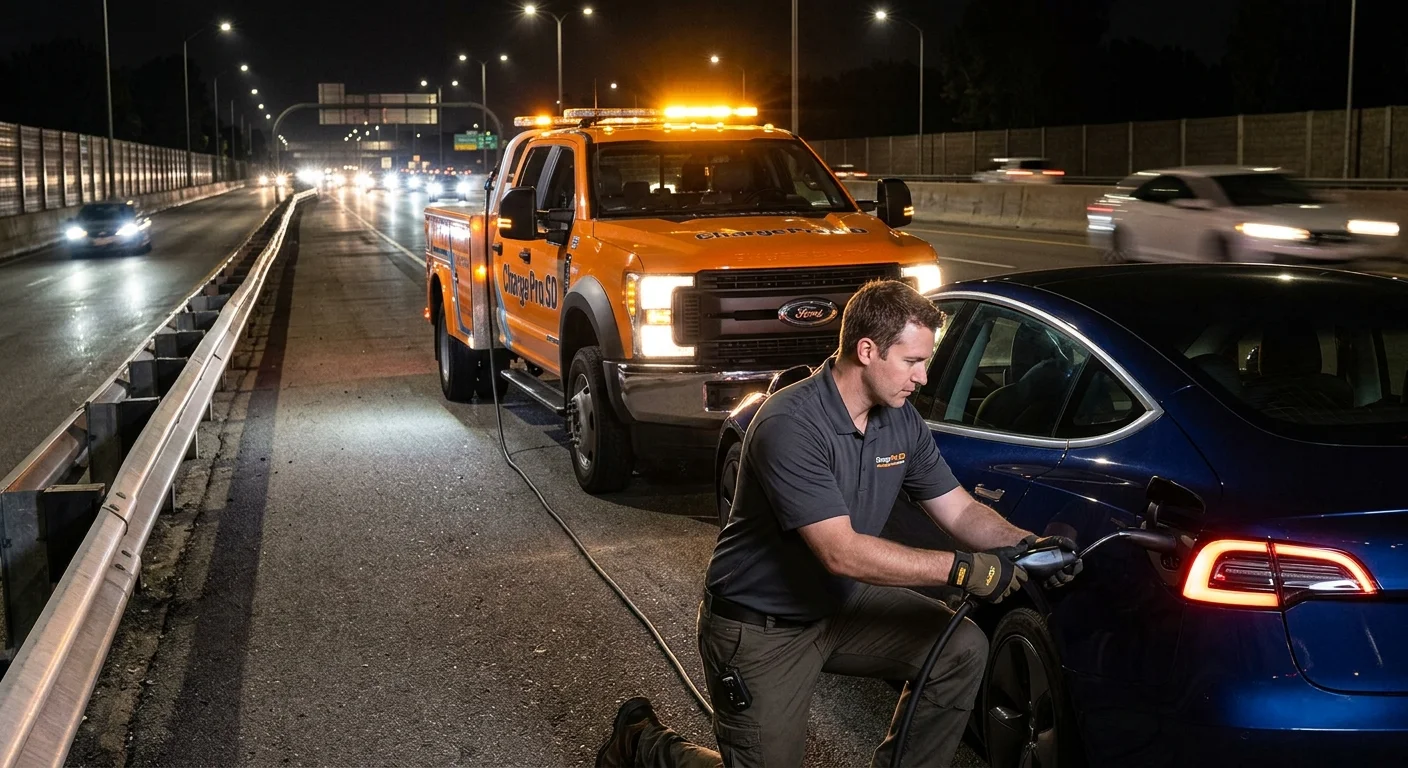
Our trucks carry a 240V bed outlet and the cabling to add real range, plus 12V jump equipment for the auxiliary battery issue that causes a huge share of “won’t start” calls. In practice that means we can handle:
- A fully depleted main battery pack, delivering roughly 10 to 20 miles of range on site.
- A dead 12V battery that’s leaving the car unresponsive even though the main pack has charge.
- A broken or occupied public charger that’s left a driver stuck with no way to finish a charging session.
- Roadside recovery on freeways, surface streets, delivery lots, and rideshare staging areas across San Diego County.
Most calls resolve in under an hour from dispatch to a driver back on the road. See the full detail on what’s included in our EV roadside assistance service.
Fleet and multi-car operators
If you run more than one rideshare or delivery vehicle, whether that’s a small family fleet or a handful of drivers under one operator, a single dead-battery incident can ripple across your whole schedule if you don’t have a fast option lined up. We work with individual drivers and small operators the same way: one call, one truck, one fix, no towing paperwork unless the vehicle genuinely needs a shop. Keeping a card with our number in the glovebox of every car in your fleet is the cheapest insurance you can buy against a lost shift.
The California push toward electric rideshare
San Diego’s rideshare fleet is going electric faster than most people realize. California’s Public Utilities Commission approved a program in July 2026, funded through the state’s Clean Miles Standard, that will offer eligible Uber and Lyft drivers meaningful purchase or lease incentives on zero-emission vehicles, plus help with charging costs, once it launches later this year. That’s on top of drivers who’ve already made the switch on their own for lower fuel costs.
More electric rideshare vehicles on the road means more mid-shift 12V failures and more empty-pack strandings, simply because there are more EVs out there logging long hours. Roadside assistance built specifically for that reality, not retrofitted from a gas-car playbook, is going to matter more every year, not less.
Frequently asked questions
Is EV roadside assistance different from a regular tow company?
Yes. A tow company’s job is to remove your car from where it’s stuck. Our job is to make the car drive again on the spot whenever possible, which is faster and usually cheaper for the kinds of failures rideshare drivers hit most.
Do I need a subscription to use Charge Pro SD?
No. We’re a call-when-you-need-it service, not a membership. You pay per rescue, and there’s no monthly fee sitting on your books between incidents.
What if I don’t know whether it’s the 12V battery or the main pack?
Call (858) 400-4465 and describe the symptoms. If the screen and locks are completely dead, that’s usually the 12V. If the screen works but the car has no range, that’s the main pack. Either way, our tech figures it out on site.
Can you get to me during a busy Friday or Saturday night?
Yes, that’s when we get the most calls. Typical San Diego city arrival windows run 25 to 60 minutes even during peak hours.
Does this replace my Uber or Lyft in-app roadside option?
It doesn’t have to replace it, but it’s usually faster for the specific problem of an empty pack or dead 12V. Read how the in-app option stacks up in our comparison of Uber’s roadside partner versus mobile charging.
For more on how mobile charging compares to a traditional tow, read mobile EV charging versus tow and see what mobile EV charging actually costs.
Call Charge Pro SD at (858) 400-4465 and we’ll be on our way.