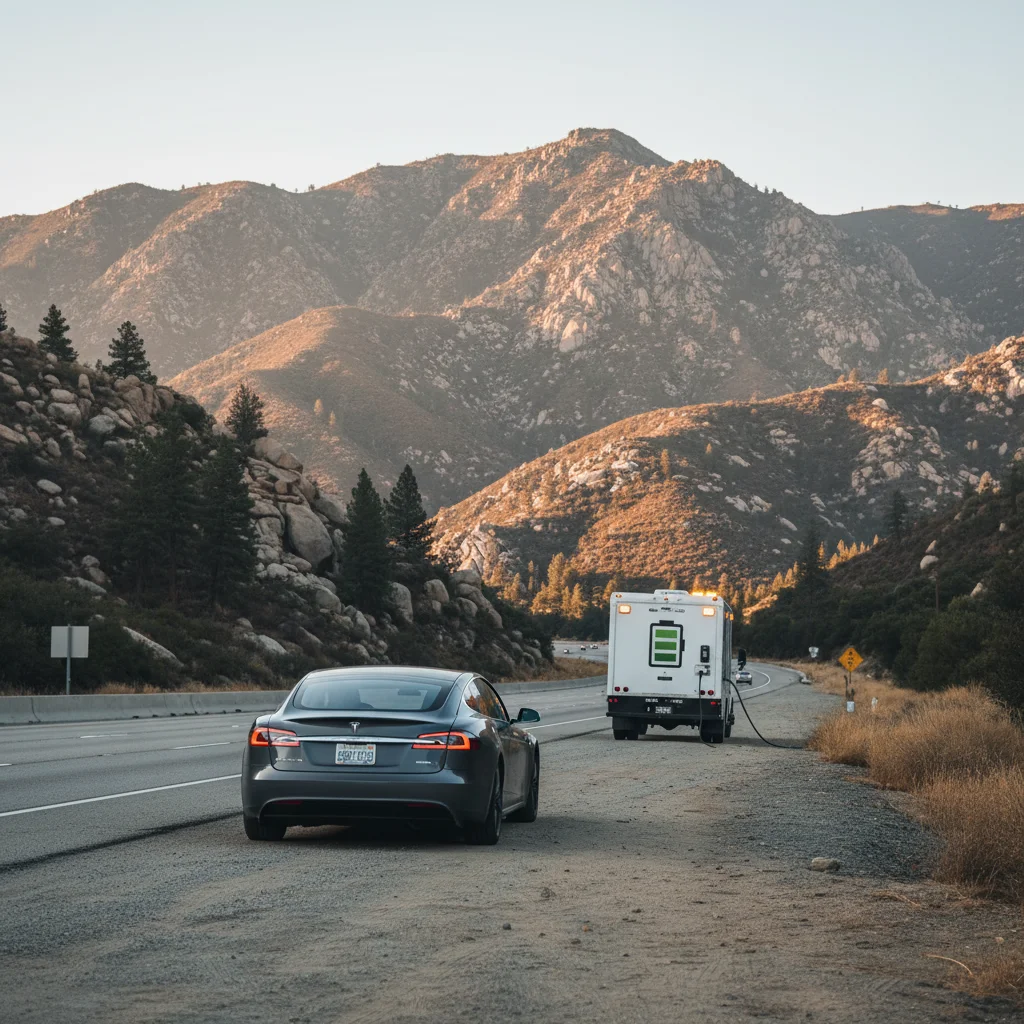
You’ve passed the Viejas Casino & Resort, the climb out of San Diego is behind you, and the landscape is turning rugged. Then you see the sign: “Next Services 60 Miles.” For an EV driver, that sign on Interstate 8 east of Alpine is more than just a warning; it’s the start of a serious challenge. This stretch of highway is notorious for catching drivers off guard, turning a scenic drive into a stressful, range-watching ordeal.

An EV stopped on the shoulder of I-8 east of Alpine with the rocky Cuyamaca and

Why I-8 east is the worst EV corridor in the county

San Diego County has made great strides in EV infrastructure, but our freeway corridors are not created equal. While the I-5 and the I-15 corridor heading north are relatively populated with DC fast chargers, I-8 east is a different story. Once you leave the dense suburbs, the support network for electric vehicles thins out dramatically, creating a perfect storm of conditions that can easily leave a driver stranded.

Unlike the relatively flat coastal routes, like the stretch through Camp Pendleton, the I-8 east corridor involves a significant elevation change. You climb from near sea level in San Diego to over 4,000 feet at the Laguna Summit. This sustained uphill battle demands a massive amount of energy from your battery, far more than cruising on level ground.

Compounding the problem is the extreme weather. The mountains and high desert are known for scorching summer days that can easily top 100°F and surprisingly cold winter nights. Both extremes negatively impact battery performance and efficiency. Running the A/C on full blast to combat the desert heat is not a luxury; it’s a necessity, and it’s a significant drain on your available range. The combination of steep grades, extreme temperatures, and a profound lack of charging stations makes this route the most challenging for EV drivers in Southern California.

The charger desert: Alpine to El Centro in one shot

Let’s be specific about the problem. The last cluster of reliable, high-speed DC fast chargers is in Alpine. Once you pass those, you enter what we call the “charger desert.” The next reliable set of DC fast chargers is in El Centro, approximately 80 miles away. An 80-mile trip might sound easy, but the factors we discussed, grade and temperature, make it a much tougher journey than the mileage suggests.

While apps like PlugShare might show a few Level 2 chargers at locations like hotels or RV parks in between, these are not practical solutions for a quick top-up. A Level 2 charger might add only 20-30 miles of range per hour. If you’re low on battery, that’s not a rescue; it’s an overnight stay you didn’t plan for. You cannot rely on these as a backup plan.

This formidable i-8 ev charging gap means you have to make the entire journey from Alpine to El Centro in one go. There is no safety net. If you leave Alpine with a 50% state of charge, thinking you have 120 miles of range, you are likely to be disappointed. The strenuous conditions can easily reduce your effective range by 30-40%, putting you in a precarious position long before you see the agricultural fields of the Imperial Valley. This is the stretch where most drivers get into trouble.

Heat, grade, and how they accelerate range loss

Your EV’s dashboard gives you an estimated range, but this number is a prediction, not a promise. It’s based on recent driving conditions. When those conditions change dramatically, as they do on I-8 east, that estimate can become wildly inaccurate, very quickly.

The impact of elevation gain

Climbing a mountain is the automotive equivalent of sprinting a marathon. The I-8 ascends from about 1,800 feet in Alpine to over 4,000 feet through the Cleveland National Forest. Your electric motor has to work incredibly hard to pull the weight of the vehicle against gravity. This sustained, high-power draw depletes the battery at an accelerated rate. While you’ll regain some energy on the long descent into the desert through regenerative braking, it’s never enough to offset the massive amount of energy spent on the climb. It’s common for EVs to use 2-3 miles of estimated range for every 1 mile of actual distance traveled on this incline.

The strain of extreme temperatures

Your EV’s battery has an ideal operating temperature, and the car’s thermal management system works hard to maintain it. In the 100°F+ heat of a Jacumba Hot Springs summer afternoon, that system is running constantly, pulling power from the main battery just to keep the battery itself from overheating.

On top of that, your cabin’s air conditioning is also working overtime. The A/C compressor in an EV is powered directly by the high-voltage battery. On a hot day, this can account for a 15-25% reduction in your total range. When you combine the energy costs of the steep grade, the battery cooling system, and the cabin A/C, an 80-mile drive can easily consume 120-140 miles of your car’s estimated range.

Driver checking a phone showing a sparse charger map on the I-8 east corridor wi

What we can reach and where we have to hand off

At Charge Pro SD, we believe in being upfront and honest about our capabilities. Our mobile service trucks are dispatched from central San Diego, and our goal is to provide the fastest, most reliable mobile EV charging in the county. However, the geography of I-8 east creates logistical challenges.

We provide expert EV roadside assistance throughout San Diego County. If you find yourself stranded on I-8 in areas like El Cajon, Santee, or Alpine, you are well within our primary service zone. We can typically reach an ev stranded i-8 alpine driver quickly and provide an emergency charge. Our service is a dedicated out-of-charge recovery; we arrive with a Level 2 or DC fast charging unit on our truck to add 20-40 miles of range, getting you safely to the next charging station without a tow.

Once you get past the Viejas Grade and into areas like Pine Valley, Descanso, and farther east toward the Imperial County line, our response times naturally increase. While we will always do our best to help, this vast, remote area pushes the limits of our standard service range. For an imperial county ev rescue, we may still be your best option, but it’s important to understand that the travel time for our truck can be significant. In some cases deep into the desert, coordinating with a local flatbed tow truck might be a more practical first step.

How to plan I-8 east trips so you don’t get stranded

Range anxiety on this corridor is justified, but it can be managed with smart planning. Running out of charge here isn’t a failure of your car; it’s a failure to account for the harsh conditions.

  1. Start with a full battery: Before you even think about heading east, charge your vehicle to 100%. Don’t leave San Diego with anything less. This gives you the maximum possible buffer.
  2. Top off in Alpine: This is the most critical step. Even if your car says you have more than enough range to make it to El Centro, stop at the DC fast chargers in Alpine (near the Viejas Casino) and top off. Treat Alpine as your last chance for fuel, because it is. Check your charging apps to ensure those stations are operational before you leave.
  3. Drive for efficiency: This isn’t the time for setting speed records. Engage your car’s “Eco” or “Chill” mode. Stick to the speed limit or slightly below it. Avoid aggressive acceleration. The smoother you drive, the less energy you’ll use.
  4. Manage your climate control: Pre-cool your car’s cabin while it’s still plugged in and charging in Alpine. This uses grid power instead of your battery. Once you’re on the road, use the A/C sparingly if possible, or set it to a more moderate temperature rather than full blast.
  5. Watch your consumption, not the guess-o-meter: Pay attention to your car’s efficiency screen (often shown as kWh/mile or miles/kWh). This is a more accurate, real-time indicator of your energy use than the estimated range number. If you see your efficiency dropping, slow down even more.

When to call us

If your planning fails or you get caught by surprise, don’t panic. If you’re out of charge anywhere on I-8 between the coast and the mountain communities of Alpine or Pine Valley, we can get to you. Our mobile charging trucks are designed for exactly this kind of emergency out-of-charge recovery.

Call us at (858) 400-4465 for a same-day estimate.