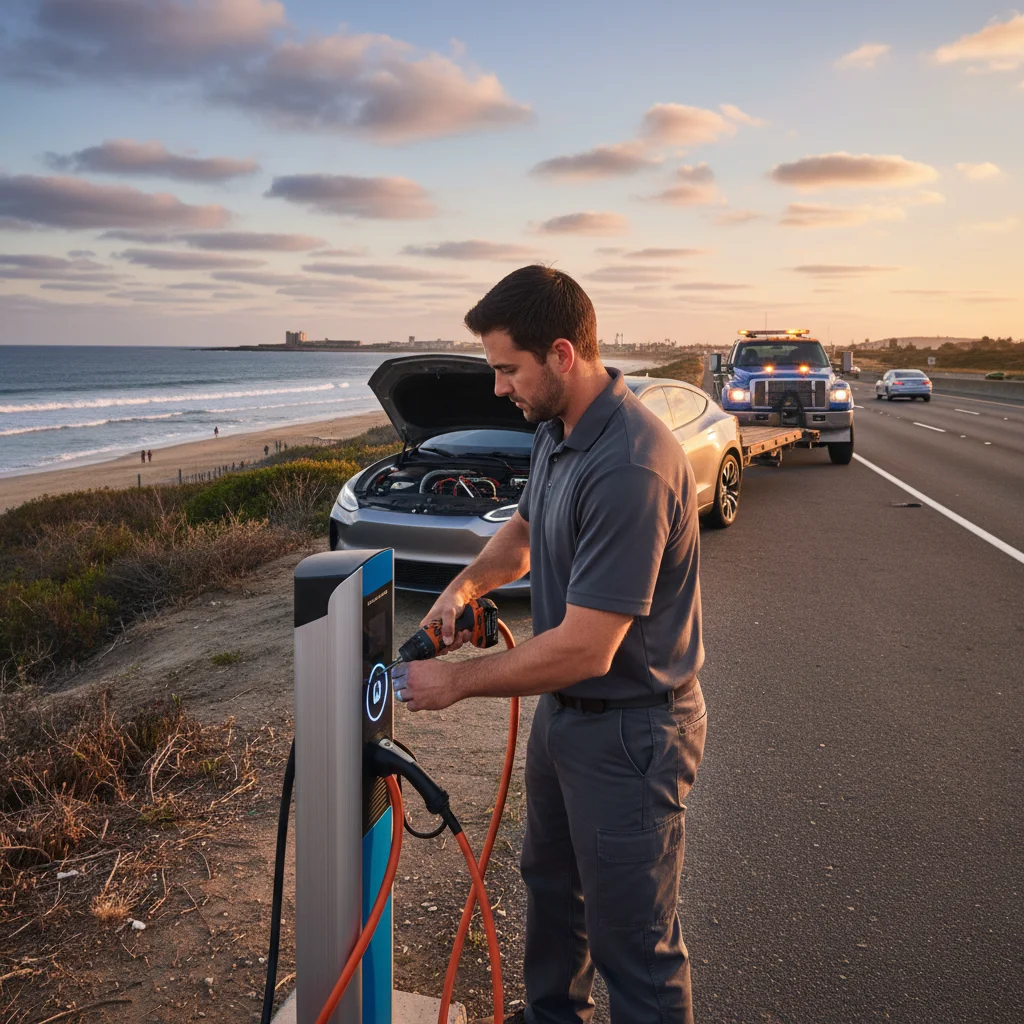
You cleared the last Oceanside exit with 18 miles of range showing. San Clemente is 17 miles up the road. That math looks fine until you remember there’s nothing in between — no exits with public chargers, no quick detour, and a Marine base fence running the length of the highway to your right.
Why this stretch of I-5 strands more EVs than people realize
The Oceanside-to-San Clemente run looks short on any map. In practice, it’s one of the trickiest legs on the entire Southern California EV corridor. The topography plays a role — northbound I-5 climbs through rolling coastal terrain that pushes consumption higher than flat-road estimates. Air conditioning adds load in summer. Marine layer cold in winter nudges battery efficiency down. And California traffic means you might creep through the stretch at 20 mph, heater running, range ticker dropping faster than your speed.
The bigger issue is psychological. Drivers leaving San Diego on a full charge often coast through Carlsbad and Oceanside without stopping, assuming they’ll charge in Orange County. That’s a reasonable plan on paper. It falls apart when range anxiety kicks in at mile 12 of the 17-mile gap and there’s no exit to take.
Q1 2026 Caltrans stranded-EV data shows a consistent cluster of incidents on this exact stretch. It’s not random bad luck. It’s a predictable outcome of a charger desert combined with a no-exit corridor. The US Department of Energy’s AFDC station locator confirms what drivers find out the hard way: public DC fast chargers simply don’t exist on the active Pendleton stretch of I-5.
Military families driving between San Diego installations and points north hit this corridor constantly. So do civilian commuters who moved to north San Diego County for affordability and now make a daily I-5 run. If that describes your household, this stretch deserves specific planning — not just a general “charge before you leave” reminder.
Charger desert: the gap between Oceanside and San Clemente
Let’s be specific about the geography. The last reliable DC fast charger southbound before the gap is in San Clemente at the Avenida Pico area. Northbound, the last option before the dead zone is in Oceanside — there are a handful of stalls near the 76 interchange and at the Oceanside Transit Center, but nothing after Las Pulgas Road until you’re well into San Clemente.
That 17-mile window has zero public charging. No Tesla Superchargers. No Electrify America. No EVgo. You can verify this yourself on PlugShare — filter for DC fast chargers and watch that stretch go blank.
What makes it worse is the lack of exits. Between Las Pulgas Road and Basilone Road, there are two gated military access points. They’re not public exits. A driver running low has no off-ramp option — you stay on I-5 and hope the math works out.
For most modern EVs with 250-plus miles of real-world range, a topped-off battery handles this easily. The problem hits vehicles with degraded batteries, drivers who didn’t charge fully, or anyone who didn’t account for uphill grade and climate load. Our out-of-charge EV recovery calls from this corridor almost always follow the same pattern: the driver had “enough” range when they left the last charger and ran the math wrong.
If you’re reading this before a trip and want the deeper picture on range anxiety patterns across San Diego County, the EV range anxiety data post breaks down where drivers most often misjudge.
What military-base rules mean if you strand near Pendleton
This is a question we get from military families more than anyone else: can you tow onto base?
The short answer is no — not unless you have base access credentials and the tow operator does too. Marine Corps Base Camp Pendleton controls its own gates. A civilian tow truck from a commercial dispatch service cannot enter the base to retrieve your vehicle, and your vehicle cannot be towed to an on-base facility by an outside provider. Gate procedures exist for good reason, and they don’t make exceptions for roadside emergencies.
What this means practically: if you strand on the I-5 shoulder within the Pendleton corridor, your vehicle stays on the shoulder or goes to a civilian yard off base. Towing to Las Flores Road or the Oceanside area is the realistic outcome if the vehicle can’t be driven away.
The better outcome — the one that skips the tow entirely — is a mobile charge delivery that puts enough electrons in your battery to reach the next station under your own power. That’s exactly what EV roadside assistance is designed for. A mobile unit rolls to your location on the shoulder, delivers a charge, and you drive out. No tow, no gate complications, no impound hassle.
Military families who live or work near Pendleton and make regular north-south runs should keep our number in their contacts. The corridor isn’t going to get public chargers on the base side of the fence anytime soon. Planning around that reality beats learning it the hard way at mile 14 with 8 miles of range left.
Our staging and response from North County
Charge Pro SD operates out of San Diego County, and our north county coverage is specifically built for this corridor. We stage in the Oceanside and Carlsbad area, which means when a call comes in from the I-5 Pendleton stretch, we’re not driving up from Mission Valley.
Our response vehicle is a Cybertruck-based rescue unit. It carries enough charge capacity to deliver 20-40 miles of usable range to most EVs — enough to get you from the I-5 shoulder to the San Clemente Supercharger or back down to Oceanside, depending on your direction and vehicle. We’ve run this exact call multiple times: driver stranded between Las Pulgas and Basilone, we’re on scene within 30-45 minutes, they’re rolling again before the tow truck the other driver called has even dispatched.
Response time on this stretch depends on traffic, time of day, and where exactly you are on the corridor. Northbound calls during afternoon rush can add time because we’re working against the same congestion. Calling us earlier in your range depletion — when you’re at 10 miles, not 2 — gives us more options and gives you more time to safely slow and pull right.
For a full picture of what our north county response covers, the Oceanside EV roadside assistance page has the broader city-level detail. This corridor article is the drill-down for the specific I-5 gap where the stakes are highest.
What to tell dispatch to get help to you faster
When you call, three pieces of information cut response time significantly.
Your exact mile marker. I-5 has green mile markers on the right shoulder every mile. Find yours and lead with it. “Mile 63” tells us exactly where you are. “Near Pendleton” narrows it to 17 miles of highway — not helpful when we’re routing.
Your direction of travel. Northbound and southbound shoulders are physically separated. We approach from a different direction depending on your lane. Tell us northbound or southbound immediately.
Your vehicle and current range. Make, model, and how many miles the dash shows. A Rivian R1T with 8 miles left needs a different response than a Tesla Model 3 with 4 miles left. Knowing your vehicle helps us confirm whether our charge delivery gets you to the next station or whether towing is the safer call.
If you’re not sure of your mile marker, drop a pin in your navigation app and share it when we answer. Google Maps and Apple Maps both give a pin-share option. That single action gets us to you faster than any verbal description of landmarks.
For general guidance on what to do the moment range drops to critical on a freeway, the out-of-charge on a freeway guide walks through the full sequence — from when to pull over to how to stay safe on the shoulder while you wait.
When to call Charge Pro
If you’re stranded on the I-5 Pendleton corridor with low or zero range, a dead 12V that won’t wake your car, or you’re watching the battery drop and you know you won’t make the next charger — that’s our call. We don’t do installations or home setups; we do roadside rescue, and this corridor is exactly the kind of job we’re built for.
Call us at (858) 808-6055 — we’ll roll a Cybertruck rescue truck to you.