Running out of charge on I-805 is a location problem. Confirm live, vehicle-compatible stalls rather than assuming a charger off every exit. This page will not freeze a 23-mile dead zone, a 5-mile remaining figure, or a named merge as the last chance. If the car is in a travel lane, call 911.
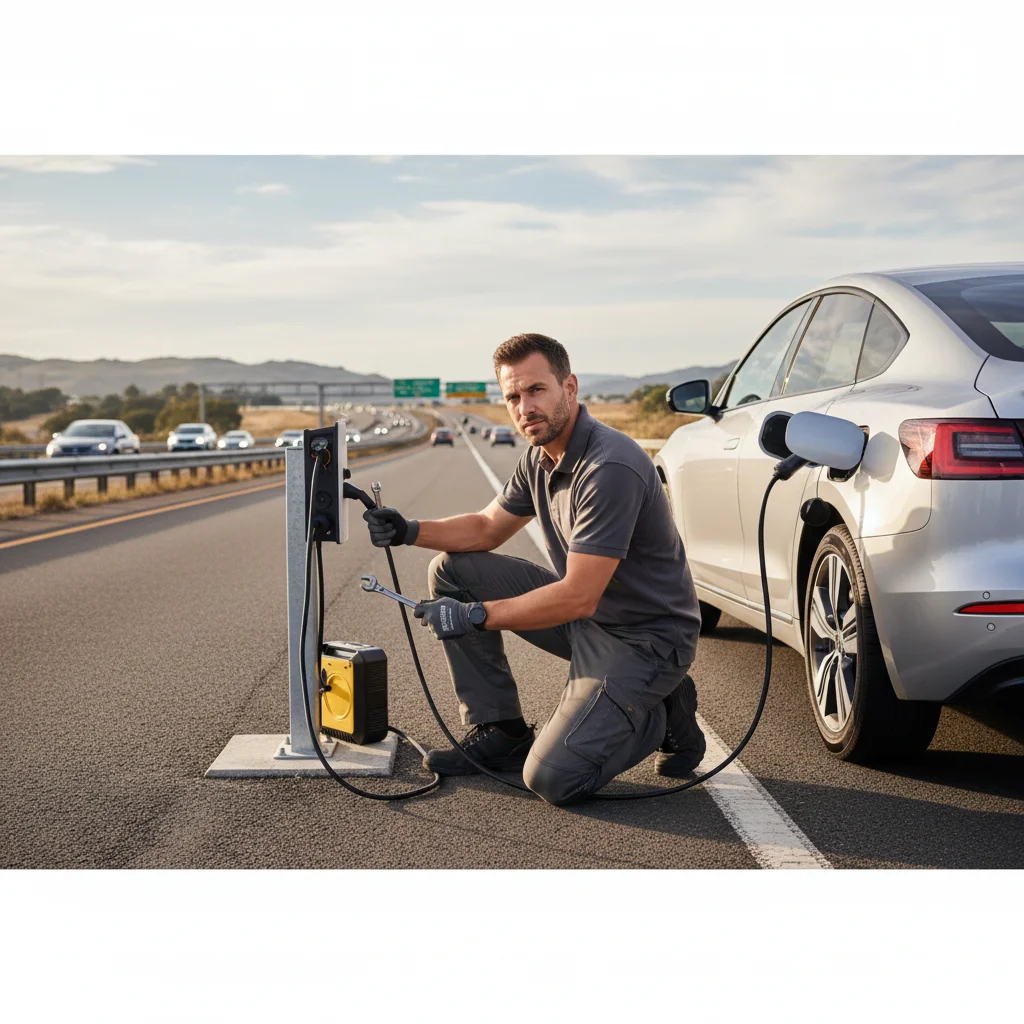
Why I-805 charging is uneven
Confirm live, vehicle-compatible stalls. This page will not inventory Superchargers, CCS, Costco, Walmart, or Level 2 grocery lots off I-805, and it will not freeze a sea-level-to-Kearny-Mesa grade figure. Northbound climbs still use more energy than a coastal estimate.
The I-805 corridor segment by segment
The table below maps each major segment of I-805, the approximate charging situation, and the nearest realistic option if you’re running low.
| Segment | I-805 miles (approx.) | Fast-charge gap on corridor | Nearest practical option |
|---|---|---|---|
| I-5 split (Sorrento Valley) to Mira Mesa Blvd | 0 to 3 | Thin, no on-ramp DC fast charger | Mira Mesa area shopping centers (Level 2); Tesla Supercharger off Mira Mesa Blvd area |
| Mira Mesa Blvd to CA-163 (Kearny Mesa) | 3 to 8 | Moderate gap, some Level 2 off Balboa Ave exits | Kearny Mesa commercial strip (Level 2); limited DC options |
| CA-163 to I-8 (Mission Valley) | 8 to 12 | Dangerous gap, high traffic, few nearby fast chargers | Fashion Valley / Mission Valley area (Supercharger cluster west on I-8); requires exiting onto surface streets |
| I-8 to CA-94 (City Heights / Mid-City) | 12 to 16 | Longest fast-charge gap on the corridor | No convenient DC fast charger near the freeway; closest options require several miles off-corridor |
| CA-94 to E Street / Chula Vista | 16 to 22 | Improving but still thin | National City and Chula Vista areas have growing Level 2 coverage; some DC options near H Street |
| E Street to I-5 merge (border) | 22 to 23 | Better, Chula Vista has more charging density near Eastlake | Eastlake and Chula Vista mall area Level 2 / DC options |
The I-8 to CA-94 section through City Heights and Mid-City is a high-speed stretch with a narrow shoulder. If the car is in a travel lane or another dangerous place, call 911. Charge Pro does not rank a mobile rescue as faster or safer than a tow. An independent operator confirms whether they can work that pin.
Safe shoulder protocol on I-805
I-805 carries heavy commuter and commercial traffic through its full length, and the shoulder geometry changes dramatically by segment. What’s safe behavior on the wide Mira Mesa section becomes more critical near the Mission Valley interchange or the narrower cuts through City Heights.
When your battery warning appears, start moving right immediately. Don’t wait until the car stops. I-805 has limited merge zones in several segments, and getting safely onto the shoulder is harder at 65 mph than at 30. Here’s what CHP expects and what keeps you safest:
Pull completely onto the right shoulder, as far from the travel lane as the surface allows. On sections with dirt runoffs or concrete barriers, hug the barrier rather than straddling the line.
Turn on your hazard lights before you’re fully stopped. This signals other drivers before they’re close enough to react. On a busy urban freeway like I-805, this matters from the moment your speed drops significantly below traffic flow.
Exit through the passenger-side door if possible. On a right-shoulder stop, the driver’s door opens toward live traffic. Use the passenger door and stay between your car and the barrier or embankment, never between your car and the lane.
Don’t walk the shoulder toward an exit. On urban freeway shoulders, pedestrians are difficult for drivers to see, especially at night. Stay near your vehicle, well behind the rear tire.
If the car is in a travel lane or another dangerous place, call 911. In metropolitan areas, other roadside requests can go through 511 by saying “Roadside Assistance.” Charge Pro is not traffic control. Give direction of travel, last exit, and vehicle description when you call.
A mobile EV charging referral may attempt a charge on the shoulder. Charge Pro does not publish 15 to 30 miles or a faster-than-tow result.
Towing an EV off a busy interstate: the real cost
Many drivers assume a tow is the backup plan when their EV dies on the freeway. On I-805, that assumption is worth examining.
Towing an EV off a major interstate in San Diego County involves three layers of cost and delay that most drivers don’t anticipate. First, tow trucks dispatched to live freeway lanes require a CHP clearance before they can enter the shoulder in many zones. That process adds time regardless of how fast the tow company actually responds.
Second, EVs need flatbed towing in almost every scenario. The all-wheel-drive systems and regenerative braking configurations on most modern EVs mean standard dolly tows can cause drivetrain damage. Flatbeds cost more and there are fewer of them available on short notice during peak commute hours.
Third, flatbed delivery drops you at whatever shop or lot is convenient for the tow company, not necessarily near a charger. You’re then paying for a Level 2 charge time, a public DC session, or a separate trip home before you can move the car.
Charge Pro SD does not publish a delivered-mile result, a 9.6 kW Charge Pro outlet, or a no-tow guarantee. An independent operator confirms equipment, access, price, and timing. You pay them.
How a referral works on I-805
Charge Pro SD can refer an independent operator along I-805 from the Sorrento Valley split toward the border. Charge Pro owns no corridor fleet and publishes no 240V / 9.6 kW bed outlet or adapter kit as Charge Pro equipment. The operator confirms equipment, access, price, and timing. You pay them.
When you call from I-805, share direction of travel, last exit or milepost, year/make/model/color, and whether the car still wakes. The independent operator confirms connector, access, price, and timing. Charge Pro does not publish an ETA or a south-versus-north approach.
Emergency EV roadside assistance is the matching start. Charge Pro does not cover a 23-mile corridor as a Charge Pro crew. See Chula Vista EV roadside assistance and out-of-charge recovery.
Frequently asked questions
What should I do first if my EV dies on I-805?
If you can, get fully onto the right shoulder with hazards on. If you are in a travel lane or another dangerous place, call 911 first. Then call Charge Pro SD at (858) 400-4465 for a referral. Charge Pro does not rank a shoulder charge as faster than a tow.
Does Charge Pro SD cover the full I-805 corridor?
Charge Pro SD can refer an independent operator along I-805 from the Sorrento Valley split toward the border, including Mira Mesa, Kearny Mesa, Mission Valley, City Heights, National City, and Chula Vista. Charge Pro does not publish a 23-mile Charge Pro cover or a dispatch clock.
What does mobile EV charging cost on I-805 compared to a tow?
The operator quotes before they start. This page previously published $175 to $350 for an I-805 flatbed as a published figure, not a live invoice. Confirm with the tow company. Charge Pro does not rank mobile charging as cheaper or faster, and does not promise a charged car.
Are there any fast chargers directly off I-805?
Confirm live, vehicle-compatible stalls. This page will not inventory Fashion Valley Superchargers or call City Heights and National City a charger desert.
Can Charge Pro SD refer a non-Tesla EV on I-805?
Charge Pro SD can refer an independent operator for a non-Tesla EV on I-805. Charge Pro publishes no NACS-plus-CCS rig as Charge Pro equipment. The operator confirms connectors they actually carry. See non-Tesla EV rescue.
What if I barely have enough charge to reach the next exit?
You can call before the pack hits empty. Charge Pro does not guide you to an exit, meet you off the shoulder, or decide whether the next exit is realistic. Getting off the freeway before a stop is often safer. That is still your read of the car and the road.
If the pack just died on I-805, or remaining range looks tight, call (858) 400-4465. Charge Pro SD refers an independent operator. Charge Pro does not publish no-tow, no-lot, or charge-where-stopped as Charge Pro outcomes.