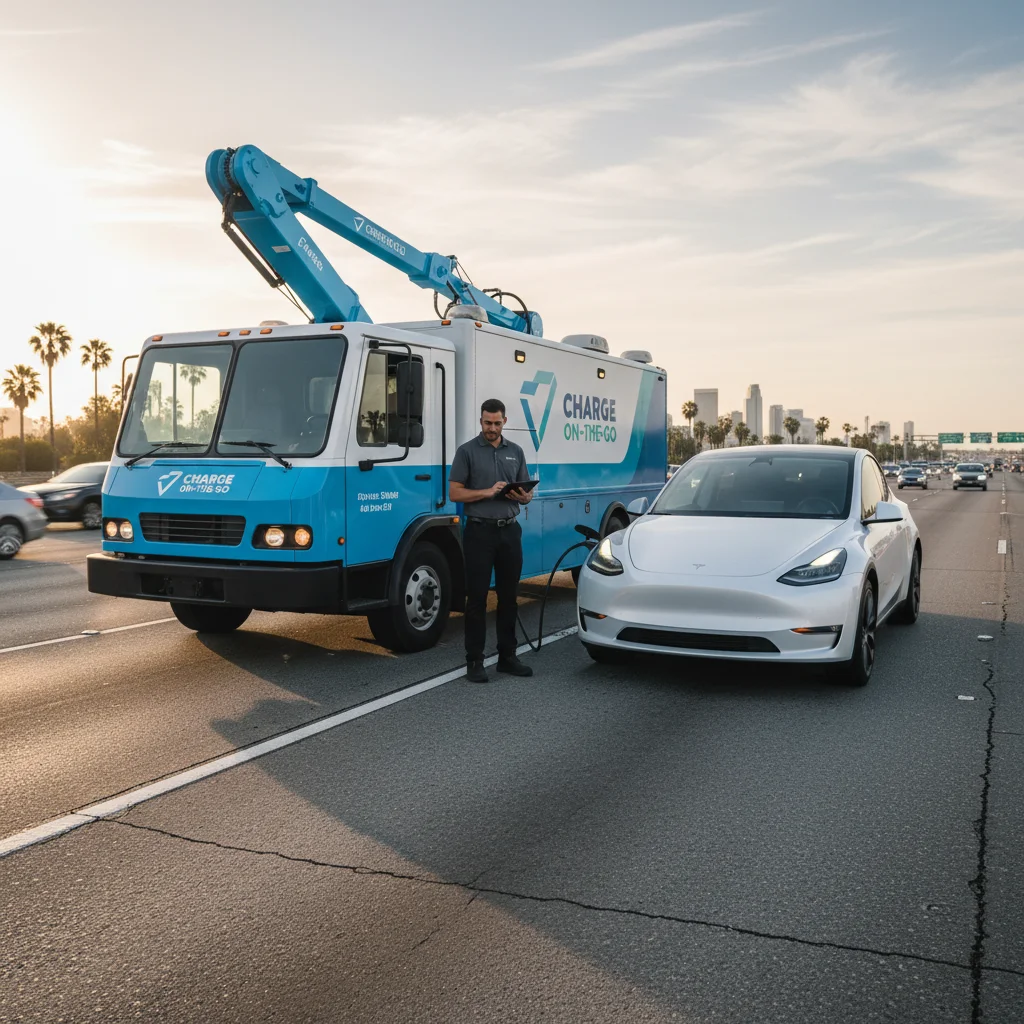
It’s a scenario every electric vehicle driver has considered: you misjudge the distance, a planned charger is out of service, and you see the battery percentage dip into the single digits. Then it hits zero. You’re stranded. A decade ago, this meant a flatbed tow truck was your only option, but today, there’s a much better solution: the EV charging truck.
This specialized vehicle is essentially a mobile DC fast charger, designed to get you back on the road without the hassle and potential damage of towing. But how does it actually work? We’ll break down the technology inside, the real-world performance you can expect, and how our rescue service operates right here in San Diego County.
What an EV charging truck actually is in 2026
An EV charging truck is a purpose-built vehicle equipped with a large battery pack, a power inverter, and the hardware needed to deliver a Level 3 DC fast charge to a stranded electric vehicle. Think of it as a giant, powerful battery bank on wheels, the modern equivalent of bringing a can of gasoline to a friend who ran out of fuel.
The base vehicles are often commercial-grade electric vans or trucks, like the Ford E-Transit or a retrofitted Ford F-150 Lightning. The key is that the entire system is self-contained. It doesn’t need to plug into the grid to work. It arrives at your location with stored energy ready to transfer directly to your car’s high-voltage battery.
This technology has moved from a niche concept to a critical piece of roadside assistance infrastructure. As EV adoption grows across California, the need for a faster, more efficient rescue solution than a tow truck has become obvious. A mobile charge is safer for the complex electronics and all-wheel-drive systems in many EVs and gets drivers moving again in a fraction of the time. While some early concepts were wild, like the Cybertruck-based rescue vehicle we’ve explored before, the most practical models in service today are focused on maximizing capacity and reliability in a conventional truck or van platform.
Onboard battery vs onboard generator: the two designs
Not all mobile charging stations for electric vehicles are created equal. They generally fall into two categories based on how they generate or store the electricity they deliver.
Onboard Battery (Battery Electric Service Equipment - BESE)
This is the cleanest and most common design used by modern EV rescue services, including Charge Pro SD. These trucks carry a massive onboard lithium-ion battery pack, completely separate from the one that might power the truck itself. This energy is stored and ready for immediate deployment.
- How it works: When our truck arrives, we connect a DC fast charging cable from our unit to your vehicle. The power flows directly from our battery pack, through an inverter to match your car’s voltage, and into your battery.
- The benefits: It’s a completely silent and zero-emissions operation. This is crucial when working on the shoulder of a busy San Diego freeway or in a quiet residential neighborhood. It’s pure, grid-quality power, just delivered remotely.
Onboard Generator
An older and less common approach involves using a generator to create electricity on-site. These trucks are typically equipped with a large diesel, gasoline, or propane-powered generator.
- How it works: The generator is fired up, producing AC power. This power then runs through an inverter and rectifier to convert it to the DC power an EV needs for fast charging.
- The drawbacks: This method is noisy and produces tailpipe emissions, which defeats one of the key benefits of driving an EV. It also adds mechanical complexity and requires carrying a separate fuel source. It’s essentially a gas-powered car charging an electric one, which feels a bit counterintuitive.
At Charge Pro SD, we exclusively use battery-electric systems. It’s the most efficient, environmentally friendly, and reliable way to provide a rescue charge.
How many miles of range we can deliver in 20 minutes
The most common question we get is: “How much of a charge can you actually give me?” The goal of a mobile rescue is not to charge your car to 100%. It’s to provide enough range to get you safely to the next public DC fast charger or all the way home.
Our mobile EV charger trucks are equipped with DC fast chargers capable of delivering power at rates up to 75 kW. In a typical 20-minute roadside charging session, we can deliver between 15 and 25 kWh of energy to your vehicle.
So, what does that mean in terms of miles? It depends on your EV’s efficiency.
- Tesla Model Y or Model 3: These are highly efficient, getting around 4 miles per kWh. A 20 kWh charge adds about 80 miles of range.
- Ford Mustang Mach-E or Hyundai Ioniq 5: These popular crossovers average around 3.3 miles per kWh. That same charge would add about 66 miles of range.
- Rivian R1T or Ford F-150 Lightning: Electric trucks are heavier and less efficient, typically getting 2 to 2.5 miles per kWh. A 20 kWh charge delivers about 40-50 miles of range.
In every case, this is more than enough range to escape a low-battery situation. If you’re stranded on the I-15 near Miramar, 50 miles of range can easily get you to fast chargers in Kearny Mesa, Poway, or even home to Carmel Valley with miles to spare. The focus is on providing a meaningful, rapid boost that solves the immediate problem.
Connector mix: NACS, CCS1, J1772, and adapters
The EV charging world has a few different plug standards, and a professional rescue service needs to be able to handle all of them. Our trucks are outfitted to be universal charging stations, ensuring we can help any EV driver in San Diego.
Here’s a quick breakdown of the connectors we carry:
-
NACS (North American Charging Standard): This is the plug developed by Tesla. For years, it was exclusive to their vehicles, but it has now been adopted by Ford, GM, Rivian, and many other major automakers for their new models. It’s a compact, easy-to-use connector that handles both AC and DC charging. Our trucks have native NACS cables ready to go.
-
CCS1 (Combined Charging System): This is the dominant DC fast charging standard for nearly all non-Tesla EVs in North America, including brands like Hyundai, Kia, Volkswagen, Porsche, BMW, and Chevrolet. It’s a larger plug that adds two big DC pins below the standard J1772 connector. We carry native CCS1 cables to serve these vehicles directly.
-
J1772: This is the universal standard for Level 1 and Level 2 AC charging in North America. While our rescue service provides faster DC charging, we carry adapters to ensure compatibility with any vehicle or situation that might arise. Every non-Tesla EV has a J1772 port, and CCS1 is just an extension of it.
By having the right native plugs and adapters on every EV rescue truck, we eliminate any guesswork. Whether you’re driving a brand new Rivian with a NACS port or a five-year-old Chevy Bolt with CCS1, we can connect and start charging the moment we arrive.
How dispatch works in San Diego County
When you run out of charge, you need help fast. Our entire dispatch system is built around speed and accuracy for drivers throughout San Diego County. The process is simple and designed to minimize your wait time.
- You Call Us: The moment you realize you’re stranded, you call our dispatch line. We don’t use confusing apps or automated systems for emergencies. You’ll speak directly with a member of our team.
- Pinpoint Location: We’ll ask for your location. You can give us a cross-street, a freeway exit, or simply drop a pin on your phone’s map and text it to us. We can find you anywhere, from the shoulder of the I-5 in La Jolla to a parking lot in Chula Vista.
- Dispatch the Nearest Truck: Our system identifies the closest available mobile ev charger truck to your location. We have units strategically positioned to cover major corridors like the I-15, I-8, I-805, and SR-78, as well as surface streets across the county.
- Clear ETA: We provide you with a realistic estimated time of arrival. In most of the metro area, our goal is to be on-site in 30 to 60 minutes, which is often significantly faster than the wait for a traditional tow service.
- Safe, Professional Service: Our trained technician arrives, secures the area with safety cones, and immediately begins the charging process.
This entire system is the core of our mobile EV charging service. It’s a seamless process created to turn a stressful situation into a minor inconvenience. If you want to learn more about our specific coverage areas, our guide to finding mobile EV charging near me in San Diego provides additional detail.
When to call us
If your EV battery is completely drained and you can’t reach a charging station, don’t call for a tow. A mobile rescue charge is faster, avoids the potential risks of loading your car onto a flatbed, and gets you back on your journey in minutes. We’re here to provide that critical roadside power, anytime you need it.
Call us at (858) 400-4465 for a same-day estimate.