An EV battery in San Diego doesn’t face one set of conditions. A car that lives in Carlsbad and one that lives in Ramona see different heat, different grades, and different charging options, even though both are the “same” county. This is a decision guide for sorting through that, not another mileage chart.

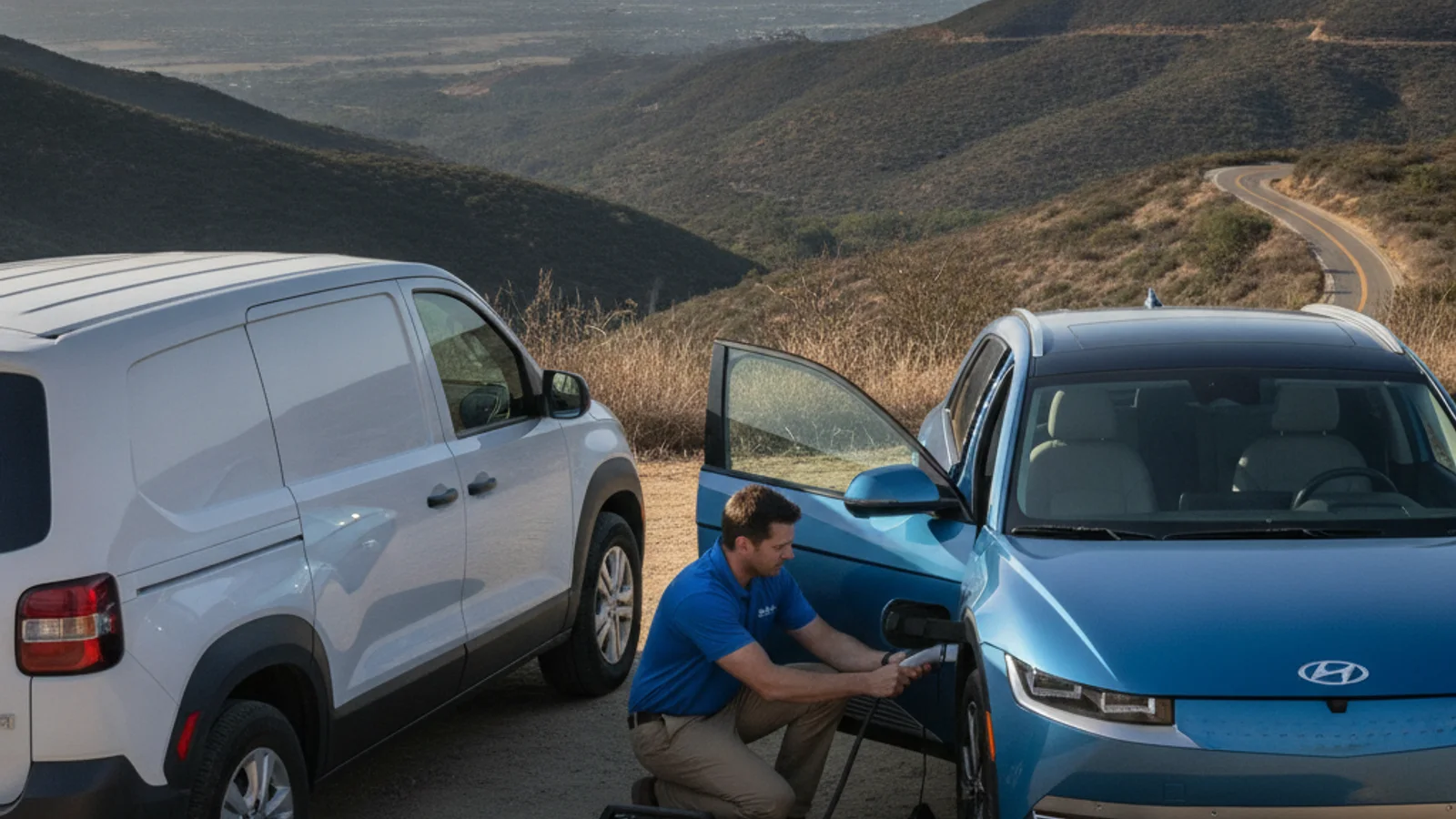
An electric vehicle traveling a San Diego County road between coastal and inland terrain

Start with the vehicle maker’s guidance

Every EV maker publishes its own guidance for the traction battery, and that guidance is the correct starting point, not a general county-wide rule. Tesla’s owner support pages, Rivian’s current documentation, and the manuals for Ford, Hyundai, Chevrolet, and Kia EVs each set their own recommended charge limits, software update cadence, and service intervals. Those figures differ by model and by battery chemistry, and they change as manufacturers update their guidance.

We can’t confirm a single degradation rate, charge-limit percentage, or “ideal” charging window that applies across every EV in San Diego County, and no reputable source publishes one that covers every make and model. Any post that hands you a specific percentage for what heat, grade, or charging habits cost your pack is guessing. The honest answer is that your owner’s manual or the manufacturer’s app is the only source built for your specific vehicle, and it should be the first thing you check, not the last.

That also means the maintenance calendar in your glovebox is more useful than a blog post. If you want the general non-battery service items, like tire rotation intervals and cabin filter timing, our EV maintenance schedule guide walks through what most owners need to track. This post focuses specifically on the traction battery and the decisions that come up when something feels off with it, using San Diego geography as the backdrop.

Account for coastal and inland driving conditions

San Diego County is not one climate, and it’s not one set of roads. Coastal North County towns like Carlsbad, Encinitas, and Oceanside sit close to the marine layer, with milder daytime temperatures for most of the year. Drive inland along SR-78 or I-15 toward Escondido or Ramona and the temperature swing is real. Those inland North County communities routinely see hotter summer afternoons than the coast, with less marine influence to moderate them.

The central city sits in between, with its own mix of coastal-adjacent neighborhoods and warmer valleys. East County, including Alpine and Lakeside, adds elevation and grade to the equation. The I-8 corridor climbing east out of the city gains real elevation before it reaches the mountains, and a loaded EV working against a sustained grade behaves differently than one cruising flat coastal streets. The South Bay, from Chula Vista to San Ysidro, has its own microclimate and its own mix of surface streets and freeway access via I-805 and SR-905.

We won’t tell you that any one of these conditions costs your battery a specific amount of range or life, because that figure isn’t something we can verify for your vehicle. What we can say is that heat, sustained climbing, and charging habits are all things your manufacturer’s guidance addresses directly, and a car that spends most of its time in inland North County or climbing the I-8 grade toward Alpine is worth checking against that guidance more often than one that only sees flat coastal miles.

Separate traction-battery care from 12V warning signs

One of the most common mix-ups we hear about is treating every “battery” symptom as the same problem. An EV has two separate battery systems, and they fail differently.

The traction battery is the large pack that powers the drive motors and shows up as your range estimate on the dashboard. When it runs low, the car keeps functioning right up until it doesn’t. You’ll see the range countdown, you may get low-charge warnings, and the vehicle will eventually stop moving under its own power once the pack is too depleted to continue.

The 12V auxiliary battery is a different, much smaller battery that runs the low-voltage systems: door locks, the infotainment screen, and the computer that wakes up the high-voltage system in the first place. When the 12V battery fails, the car can seem completely dead even if the traction battery shows a full charge. Locks won’t respond, the screen won’t wake, and the car won’t “start” in any sense, because the low-voltage system that turns everything else on has nothing to run on.

Knowing which one you’re dealing with changes what happens next. A depleted traction battery on the side of I-5 or I-15 is a charging or recovery situation. A dead 12V battery in a driveway or parking structure is a jump-start situation, and it can often be resolved without touching the main pack at all. If your car won’t respond at all and the range display was fine last time you looked, the 12V system is the more likely cause, and it’s worth ruling out before assuming the worst about the traction pack.

Plan charging before longer county routes

Route planning matters more in San Diego County than the mileage suggests, because charging infrastructure isn’t distributed evenly. A trip from the coast to inland North County or up SR-56 and I-15 toward Escondido covers real distance with fewer charging options along the way than a coastal errand run.

The DOE Alternative Fuels Data Center publishes the verified specifications for each charging level, and they’re useful for planning before you leave rather than guessing on the road. Level 2 charging, the kind most home and public chargers use, runs on 240V residential or 208V commercial power and adds roughly 25 miles of range per hour of charging, using the J1772 connector or J3400 (NACS) for Tesla vehicles. DC fast charging, found along heavier-traffic corridors, can deliver up to 500 kW and add approximately 100 to more than 200 miles of range in 30 minutes, using CCS, CHAdeMO, or J3400 connectors depending on the vehicle and the station.

Those are equipment maximums, not guarantees for your specific car. Actual charging speed still depends on your vehicle’s acceptance rate, its state of charge, and the ambient temperature, so treat the numbers as planning inputs, not promises. Before a longer drive out toward East County via I-8, across SR-94 toward the mountains, or south through the South Bay on I-805, check your route against a current charging map rather than assuming a station will be available or working when you arrive. Our San Diego EV charging guide is a good starting point for what’s available closer to the coast and central city before you commit to a route with fewer options.

Choose roadside help, transport, or a service center

Once you know which battery is involved and what the route looks like, the decision usually sorts itself into one of three lanes.

If the traction battery is depleted and you’re stopped somewhere accessible, mobile charging or out-of-charge recovery is the roadside option. Our guide on what to do when you’re running low on battery covers the steps to take before you’re fully stranded, which can change which option makes sense. The independent operator can evaluate whether enough charge can be added on-site to reach a compatible charging location, or whether the vehicle needs to be transported instead. That decision depends on the vehicle, the location, and the equipment available, and it’s the operator’s call once they’re on scene, not a guess made over the phone. You can request out-of-charge recovery when the pack is the issue.

If the symptoms point to the 12V system instead, a jump start is usually the faster fix, and it doesn’t require moving the vehicle at all. General EV roadside assistance covers that kind of call along with other on-the-spot issues that come up away from home.

If neither applies, meaning the car charges normally, drives normally, and nothing about the traction pack or the 12V system looks wrong, but you have a real question about long-term battery health, that’s a service center question, not a roadside one. Diagnostics for battery state of health, warranty questions, and any recommended service beyond what your manual describes belong with the manufacturer or an authorized service center, not with a roadside operator whose job is getting you moving again.

When to call us

If your EV’s traction battery is depleted somewhere in San Diego County, or the vehicle won’t respond and you suspect a dead 12V battery, that’s a roadside situation, not a wait-and-see one. Call us at (858) 400-4465 and we’ll connect you with a local EV rescue operator.