Transitioning to an electric vehicle brings many advantages, including a significantly simpler maintenance routine compared to gasoline cars. The absence of an internal combustion engine means no oil changes, no spark plugs, and fewer moving parts that can wear out. However, “less maintenance” doesn’t mean “no maintenance.” Every EV still requires regular attention to ensure its longevity, safety, and optimal performance. For San Diego’s growing community of EV drivers, understanding this schedule is key to enjoying everything from coastal cruises on I-5 to mountain adventures in Julian without unexpected issues.

This guide breaks down the essential EV maintenance schedule, explaining what needs attention and why. We’ll also highlight specific considerations for EV owners navigating San Diego County’s unique climate and varied terrain.

The EV maintenance difference: less is more (but still important)

Electric vehicles operate on a fundamentally different principle than gasoline cars. Instead of an engine, transmission, and exhaust system, EVs rely on a battery pack, electric motors, and power electronics. This shift eliminates many traditional service items.

Consider what’s gone from your maintenance checklist:

  • Engine oil and filter changes: Completely absent.
  • Spark plug replacement: Not needed.
  • Fuel filter replacement: No fuel system exists.
  • Timing belt or chain service: No combustion engine components.
  • Transmission fluid flushes: Many EVs have single-speed transmissions that rarely, if ever, require fluid service.

The focus of EV maintenance shifts to components that are still present or are unique to electric propulsion. This includes the high-voltage battery, regenerative braking system, tires, cooling systems, and the 12V auxiliary battery. Ignoring these can lead to issues ranging from reduced range and performance to unexpected breakdowns.

Understanding your EV’s core components and their care

While the maintenance list shrinks, the remaining items are critical. Here’s a closer look at key EV components and how to care for them.

High-voltage battery: the heart of your EV

The high-voltage battery pack is the most expensive single component in an EV. Its health directly impacts your vehicle’s range and performance. Proper care extends its life.

  • Charging habits: Most manufacturers recommend keeping your daily charge level between 20% and 80%. Regularly charging to 100% or letting it drain to near 0% can accelerate degradation over time. Smart charging with SDG&E’s TOU-EV rates during off-peak hours (midnight to 6 AM) not only saves money but can also align with healthier charging habits by avoiding rapid charging during peak demand.
  • Thermal management: EVs use sophisticated systems to keep the battery at an optimal temperature. In San Diego’s hot inland summers, where areas like Escondido, El Cajon, and Santee often hit 100°F or more, these systems work harder. Parking in the shade or pre-cooling your cabin while plugged in can help manage battery temperatures, especially during extreme heat. While San Diego’s mild coastal climate means EVs rarely face cold-weather range loss, summer heat can reduce range by 10-20%.
  • Software updates: Your EV’s battery management system (BMS) is constantly optimized through over-the-air (OTA) software updates. Keeping your vehicle’s software current ensures the battery is managed efficiently.

Electric motors: largely maintenance-free

The electric motors that power your EV are incredibly durable and generally require no routine maintenance. Unlike gasoline engines with hundreds of moving parts, EV motors have few. They are typically sealed units designed to last the life of the vehicle. Some specific models might have a drive unit fluid that needs checking or changing at very long intervals (e.g., 100,000+ miles), so always check your owner’s manual.

Brakes: less wear, but still need inspection

EVs use regenerative braking, where the electric motors slow the vehicle and convert kinetic energy back into electricity to recharge the battery. This significantly reduces wear on traditional friction brakes (pads and rotors). You’ll find your brake pads last much longer than in a gasoline car.

  • Inspection: Despite reduced wear, brakes still need regular inspection. Calipers can seize, and brake fluid can absorb moisture over time. A technician should check pads, rotors, and fluid levels during routine service.
  • Brake fluid: Brake fluid is hygroscopic, meaning it absorbs water. This can reduce its effectiveness and lead to corrosion. Most manufacturers recommend replacing brake fluid every 2-3 years, regardless of mileage.

Tires: a critical point of contact

Tires on EVs often wear differently and sometimes faster than on gasoline vehicles. This is due to:

  • Instant torque: EVs deliver full torque immediately, which can lead to more aggressive tire wear if not managed.

  • Vehicle weight: EV battery packs are heavy, increasing the overall weight of the vehicle. This added mass puts more stress on tires.

  • Low rolling resistance tires: Many EVs come with specialized tires designed for efficiency, which sometimes compromise tread life.

  • Rotation and inspection: Regular tire rotation every 5,000–7,500 miles is essential to promote even wear. Technicians should also inspect tires for alignment issues, damage, and proper inflation. Navigating San Diego’s varied roads, from the smooth I-5 to potentially rougher side streets, makes tire health paramount.

  • Alignment: Proper wheel alignment is key for tire longevity and safe handling. Heavy EVs can be more sensitive to misalignment.

12V auxiliary battery: the silent workhorse

Many EV owners are surprised to learn their electric vehicle still has a 12V auxiliary battery. This smaller battery powers critical low-voltage systems like door locks, infotainment, lights, and the main computer that “wakes up” the high-voltage system. If this 12V battery dies, your EV won’t start or even respond, even if the main battery is fully charged.

  • Lifespan and replacement: These batteries typically last 3-5 years, similar to those in gasoline cars. They are often not covered by the main EV battery warranty.
  • Symptoms of failure: Slow response from electronics, inability to unlock doors, or the vehicle simply won’t “turn on.” If your Tesla won’t start, a dead 12V battery is a common culprit. If you’re stuck, Charge Pro SD offers Tesla 12V battery jump services and general EV roadside assistance across San Diego County. For more on diagnosing issues, see our post on Tesla 12V battery dead diagnosis.

Fluids: more than just brake fluid

Beyond brake fluid, EVs still use several other fluids:

  • Coolant: The high-voltage battery and power electronics often have their own dedicated cooling loops. This coolant needs to be checked and, in some cases, replaced according to the manufacturer’s schedule.
  • Windshield washer fluid: Simple but necessary. Keep it topped off.
  • AC refrigerant: The air conditioning system is similar to a gasoline car’s and uses refrigerant, which might need occasional topping up or service.

Charging port: care and inspection

The charging port is your EV’s lifeline. Regular inspection for debris, corrosion, or damage is a good practice. Ensure the charging cable is inserted and removed carefully. If your EV charge port won’t release, it can be a frustrating issue, often requiring careful troubleshooting.

Your EV maintenance schedule: what to expect

While specific intervals vary by manufacturer and model, here’s a general guide to what EV owners can expect in terms of maintenance. Always refer to your vehicle’s owner’s manual for precise recommendations.

Every 5,000 – 7,500 miles or 6 months (typically)

These are generally quick checks and rotations.

  • Tire rotation and inspection: Crucial for even wear and extending tire life, especially given the instant torque and weight of EVs. This is a primary service item.
  • Brake system check: A visual inspection of brake pads, rotors, and lines. Even with regenerative braking, components can seize or wear unevenly.
  • Fluid levels check: Inspect coolant reservoirs (for battery and motor cooling), brake fluid, and windshield washer fluid.
  • Cabin air filter replacement: Essential for air quality inside the vehicle. San Diego’s coastal breezes are nice, but pollen and dust still get in.
  • Wiper blades: Replace as needed, typically annually.

Every 15,000 – 30,000 miles or 1-2 years

These services are more comprehensive and address components with longer lifespans.

  • Brake fluid flush: Most manufacturers recommend replacing brake fluid every 2-3 years or 30,000 miles. This prevents moisture buildup and maintains braking performance.
  • Battery coolant check/replacement: Depending on the EV model, the high-voltage battery coolant may need inspection or replacement at these intervals. Some systems are sealed for life, others are not.
  • Suspension and steering component inspection: Given the weight of EVs, checking ball joints, bushings, and tie rods for wear is important for handling and safety.
  • 12V auxiliary battery test: Have the health of this battery checked. Proactive replacement can prevent a non-start scenario.
  • Key fob battery replacement: A simple item, but a dead fob battery can be inconvenient.

Every 50,000 – 100,000 miles or 5-10 years

These are less frequent, often major service items that ensure the long-term health of your EV.

  • High-voltage battery health check: While the battery itself is designed for longevity, diagnostic checks can assess its state of health and identify any potential issues. Most EV batteries come with long warranties (8 years/100,000 miles or more).
  • Drive unit fluid change: For some EV models, the reduction gear fluid in the electric motor’s drive unit might need replacement at these higher mileages.
  • Major coolant system flush: For vehicles with dedicated battery and motor cooling loops, a full system flush and refill may be recommended.

Manufacturer specifics: always check your manual

The intervals provided above are general guidelines. Always consult your specific EV’s owner’s manual or the manufacturer’s official service schedule. Brands like Tesla, Rivian, Lucid, Ford, Hyundai, and Kia will have their own recommendations. For example, Tesla’s support pages offer detailed maintenance guidelines for their vehicles. Following these specific recommendations is the best way to maintain your warranty and ensure optimal performance.

Proactive care for San Diego EV owners

San Diego County’s unique environment presents specific considerations for EV owners. Being proactive can prevent common issues.

  • Monitor range closely on road trips: Trips from San Diego to destinations like Anza-Borrego Desert State Park, Julian in the mountains, or even Temecula wine country via I-15 require careful range planning. East County, including Alpine and Ramona, has fewer public chargers, making range anxiety a real factor on mountain roads. The I-8 climb from El Cajon to Alpine gains over 1,500 feet of elevation, consuming significant range eastbound.
  • Smart charging habits: Utilize SDG&E’s TOU-EV rates to charge during off-peak hours (midnight to 6 AM). This not only saves money but often provides a slower, gentler charge which can be better for battery health.
  • Protect from sun and heat: During hot inland summers in areas like Escondido or El Cajon, parking in the shade can help reduce cabin temperatures and the workload on your EV’s battery thermal management system.
  • Be aware of charging infrastructure gaps: While San Diego has over 2,000 public charging ports, coverage is uneven. The Camp Pendleton area creates a 20-mile charging desert on I-5 between Oceanside and San Clemente. Always plan your routes and know your charging options, especially when heading to less developed areas. Resources like the DOE Alternative Fuels Data Center or ChargePoint’s station finder can help.
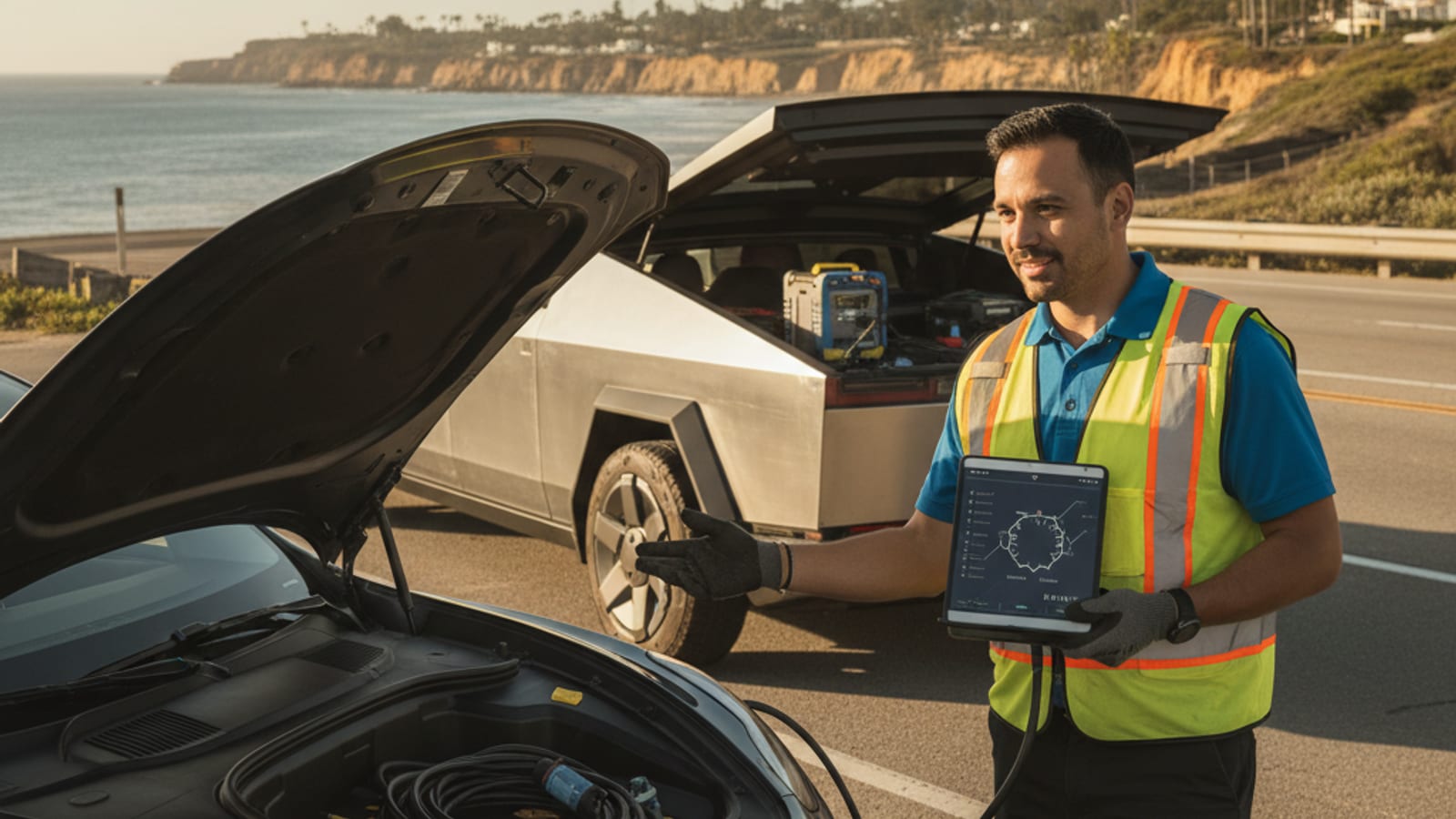
  • Roadside readiness: Despite less maintenance, EVs can still run out of charge or experience other issues. Knowing what to do if you’re out of charge on the freeway is important. Consider mobile EV charging vs. a tow for convenience. Charge Pro SD specializes in mobile EV charging and out-of-charge recovery services throughout San Diego County, dispatching our Tesla Cybertruck equipped with a 240V / 9.6 kW bed outlet, NACS plug, and CCS adapter to get you back on the road.

Common EV maintenance items & intervals

Here’s a summary of typical EV maintenance tasks and their recommended intervals. Remember, these are general guidelines, and your owner’s manual is the definitive source.

| Maintenance Item | Typical Interval (Miles/Years) | Notes