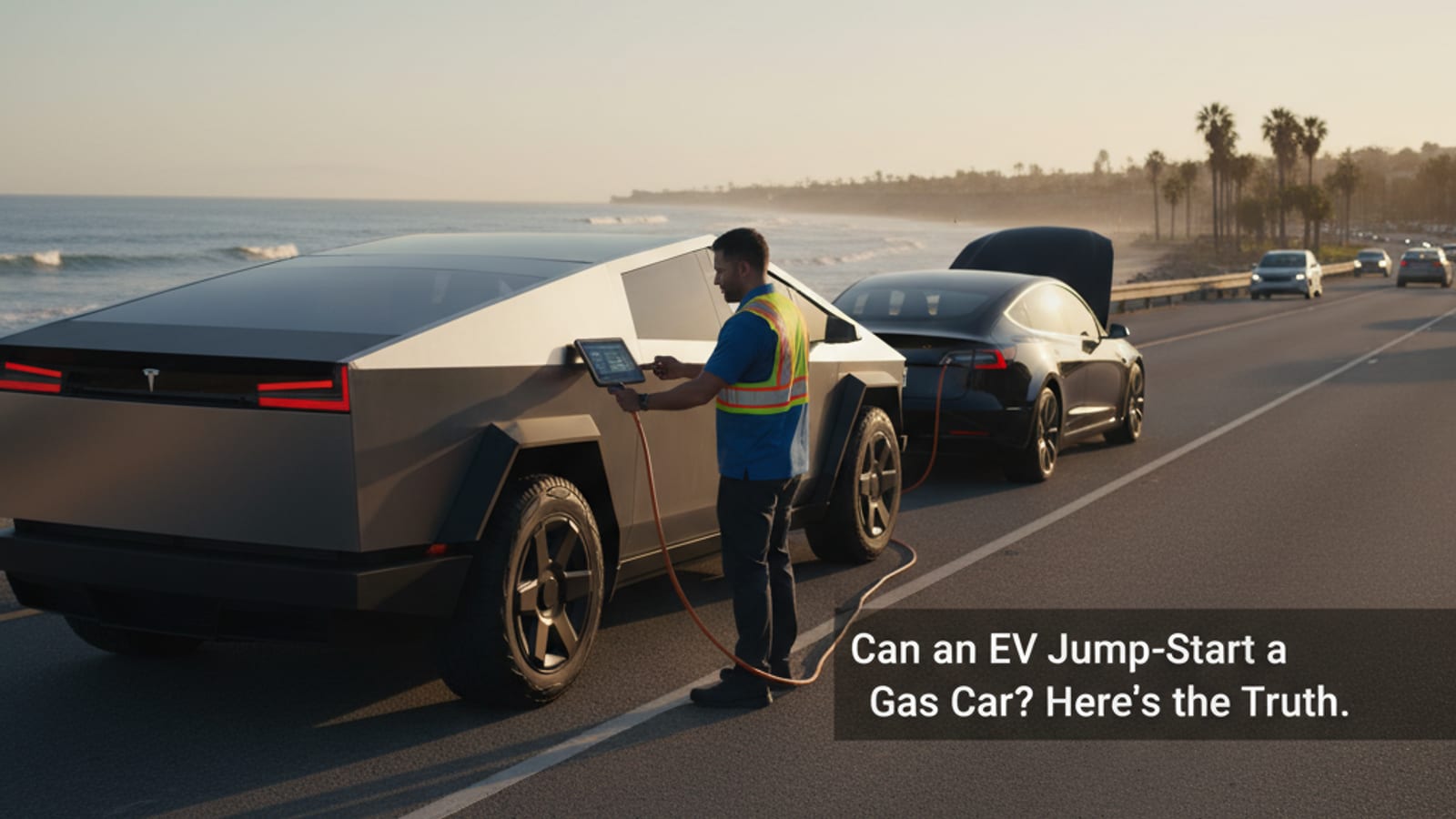
A common roadside scenario: a friend’s gas car won’t start, battery dead, and you’re there in your electric vehicle. The immediate thought might be, “Can my EV lend a hand?” It’s a question we hear often at Charge Pro SD, especially with San Diego County’s rapidly growing EV population. Many drivers assume an electric car, with its massive battery pack, must be a powerhouse for jump-starting. The reality is more nuanced than a simple yes or no. While an EV can technically jump-start a gas car, it’s not always a straightforward process, and it carries specific risks that every EV owner should understand before attempting it.

Understanding the EV’s 12V Battery System

At the heart of this question lies a common misunderstanding about how electric vehicles operate. Unlike the large, high-voltage battery that powers an EV’s motor, every electric vehicle also has a 12V auxiliary battery. This smaller battery is functionally very similar to the lead-acid battery found in a traditional gas car. Its primary role isn’t to move the car, but rather to power all the low-voltage systems: the headlights, wipers, infotainment system, power windows, central locking, and most critically, the car’s computers and relays that “boot up” the vehicle.

In a gas car, the 12V battery provides the initial surge of power to crank the engine, and then the alternator recharges it. In an EV, the 12V battery doesn’t crank an engine. Instead, it powers the control systems that prepare the high-voltage battery to send power to the motor. The EV’s main high-voltage battery pack, through a DC-DC converter, then recharges the 12V battery while the car is “on” or charging.

Here in San Diego, where Tesla density is high in coastal cities like La Jolla, Del Mar, and Carlsbad, many EV owners are familiar with their vehicle’s unique quirks. However, the 12V battery’s importance is often overlooked until it fails. A dead 12V battery in an EV can render the vehicle completely immobile, often displaying “vehicle won’t start” messages even if the main traction battery is full. This is a common service call for our team at Charge Pro SD, particularly for Tesla 12V battery jump-start requests.

The Mechanics of a Jump Start

When you jump-start a gas car, you’re not directly powering its engine. You’re providing enough temporary voltage and current to its dead 12V battery so that its starter motor can crank the engine over. Once the engine starts, the gas car’s alternator takes over, recharging its own 12V battery and powering the electrical system. The key here is the starter motor’s initial power draw. This can be significant, often requiring several hundred amps for a brief moment.

A donor vehicle’s 12V battery provides this surge. It needs to be robust enough to handle the sudden drain without suffering damage. The jumper cables create a direct electrical connection, allowing current to flow from the charged 12V battery to the discharged one. Proper connection is important: positive to positive, negative to a ground point on the dead car’s engine block, away from the battery. Incorrect connections can cause sparks, damage electronics, or even battery explosions. The National Highway Traffic Safety Administration (NHTSA) offers detailed safety guidelines for jump-starting any vehicle, emphasizing caution and correct procedure. Refer to NHTSA for safety information.

Can an EV Jump-Start a Gas Car? The Direct Answer

Yes, an EV can technically jump-start a gas car, but it comes with significant caveats and potential risks. The jump-starting capability relies solely on the EV’s 12V auxiliary battery, not its massive high-voltage traction battery.

Most EVs use a standard 12V lead-acid battery, similar in size and capacity to those found in compact gas cars. Some newer EVs, including many Teslas, have transitioned to lighter, more efficient lithium-ion 12V batteries. While these lithium 12V batteries offer advantages in lifespan and weight, their characteristics for jump-starting are different. They might not handle the sustained high current draw of a gas car’s starter motor as gracefully as a traditional lead-acid battery without internal protection circuits tripping.

The primary concerns are:

  • Undersized 12V battery: An EV’s 12V battery is typically designed for less strenuous demands than a gas car’s starting battery. It powers accessories and control systems, not a large starter motor. Attempting to jump-start a gas car can put an excessive load on the EV’s 12V battery, potentially draining it completely or causing internal damage.
  • Damage to sensitive electronics: EVs are packed with complex electronics and battery management systems (BMS). A sudden, high current draw or voltage spike from an improper jump-start attempt could damage the EV’s delicate low-voltage circuitry or even its DC-DC converter, which is responsible for charging the 12V battery from the main pack. This can lead to costly repairs.
  • Stranding your own EV: If your EV’s 12V battery is depleted or damaged during the jump, you might find yourself with two immobile vehicles instead of one. Imagine being stranded on I-15 near Escondido after helping a friend, with both cars unable to move. This is a situation best avoided.

While the physical connection might seem simple, the underlying electrical systems are not always compatible for this kind of power transfer. Tesla, for instance, generally advises against using their vehicles to jump-start other cars. Check Tesla’s support pages for specific recommendations.

Risks and Precautions When Considering an EV Jump

The decision to use your EV to jump-start a gas car should not be taken lightly. The risks often outweigh the benefits, especially when safer alternatives exist.

Potential Risks:

  1. **Over-