A Level 3 EV charger is DC fast charging. The U.S. Department of Energy’s Alternative Fuels Data Center says so in those words. It is not a 120-volt household cord, and it is not the Level 2 unit in a garage. Confirm the car’s DC connector before you drive across San Diego County to a stall that cannot accept this VIN.
Say what Level 3 charging means in plain words
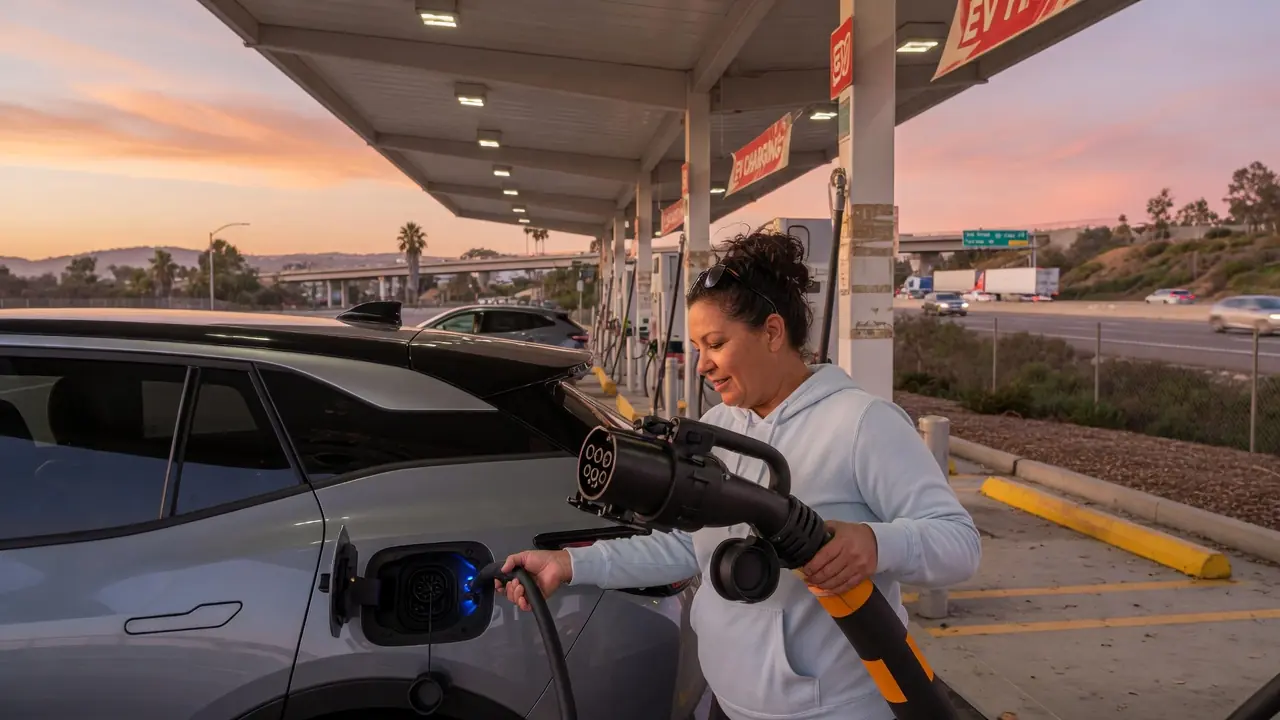
DOE describes DC fast charging equipment as enabling rapid charging along heavy traffic corridors at power outputs up to 500 kW. “This is also referred to as Level 3 charging.” DOE’s planning figure is about 100 to 200+ miles of range per 30 minutes of charging, and it says charging power varies by vehicle and battery state of charge. As of 2023, more than 20% of public EV charging ports in the United States were DC fast chargers.
Charging time still depends on state of charge, battery capacity and type, the vehicle’s onboard charging capacity, equipment output, and electrical service. A stall labeled 350 kW will not push 350 kW into a car that will not accept it.
The Level 1 sibling is what a Level 1 EV charger does. Level 1 is 120 V AC at about 1.9 kW, roughly 5 miles of range per hour. Level 2 is 240 V residential or 208 V commercial, equipment from 2.9 to 19.2 kW, about 25 miles of range per hour. Keep those pages for home and destination AC. Stay here for the DC stall on a trip.
The generic EV charging levels for stranded drivers page is a short pointer. This article is the Level 3 definition.
Separate home charging from a DC fast stop
Home charging in the United States is typically Level 1 or Level 2 AC. DOE says residential installations are typically Level 2 only; DC fast charging is commercial and public infrastructure. Do not expect a Level 3 unit on a house panel in Clairemont, and do not treat a garage outlet as a 30-minute fill.
A driver leaving Encinitas for East County, or leaving San Ysidro toward I-8, is planning public DC. A driver plugging in overnight in a Mission Hills driveway is planning AC. Mixing those plans is how people arrive at a Supercharger with a car that needed a 12V jump instead.
DC fast connectors in DOE’s current page are CCS (SAE J1772 combo), CHAdeMO, and J3400 (NACS). Tesla vehicles do not have a CCS or CHAdeMO charge port. They come with a limited CCS or CHAdeMO adapter that supports charging up to 19.2 kW, and Tesla sells full power adapters for both. All Tesla vehicles come with a J1772 adapter for non-Tesla Level 2. If you are holding the limited adapter at a high-power CCS stall, you do not have full-power DC. See CCS to NACS adapter when you are stranded.
Check the vehicle connector before you drive
Read the inlet on this car, not a blog photo. The regular 2026 U.S. IONIQ 5 has a built-in NACS port and an included CCS adapter. Earlier Ioniq years can differ. Rivian’s approved J1772 AC adapter is AC only on listed 2026+ NACS Rivians. Connector compatibility still requires the exact vehicle and equipment.
A listed station on a map is not a working stall. Public availability is not guaranteed. If the only DC site on your remaining range is offline in Carlsbad or occupied in Chula Vista, you need a backup, not another screenshot.
Emergency EV charging in San Diego is the county backup article. Out-of-charge recovery is the matching path when the pack is already empty.
If the car is in a traffic lane, California Highway Patrol says to call 911. In metropolitan areas, other roadside requests can go through 511 by saying “Roadside Assistance.” A DC stall a mile away is not a reason to stay in a live lane.
Know when a listed station may not finish the trip
The stall can be the wrong connector, the wrong power class, busy, or broken. The car can be too hot, too cold, or too empty to accept the advertised rate. DOE’s 100 to 200+ miles in 30 minutes is a class description, not your session.
A mobile charge is not automatically Level 3. Independent operators confirm what they actually carry. Do not assume a roadside truck is a public DC stall. Mobile EV charging is the on-site energy path when the public unit will not finish the trip.
Charge Pro SD is a referral service for San Diego County. We match you with licensed, independent EV charging professionals. We do not operate stations. We do not install chargers as Charge Pro. We do not send our own truck. You contract and pay the professional directly. Ask the operator to confirm make, model, year, port, adapter, location, proposed service, price, and timing.
The service area is all 67 cities in our directory. Coastal North County and inland North County are not the same charger map.
When to call us
Call when a Level 3 stall in San Diego County will not take this car, the pack is too low to hunt another site, and you need a local operator for a mobile charge or a recovery conversation. Call us at (858) 400-4465 and we’ll connect you with a local EV rescue operator.