A CCS to NACS adapter search at a dead stall is a stranded-driver question: will this plug go into this car. It is not a shopping roundup. Charge Pro SD does not sell adapters. Confirm the port on this VIN, then decide whether a different stall, an approved adapter, or a mobile charge fits.
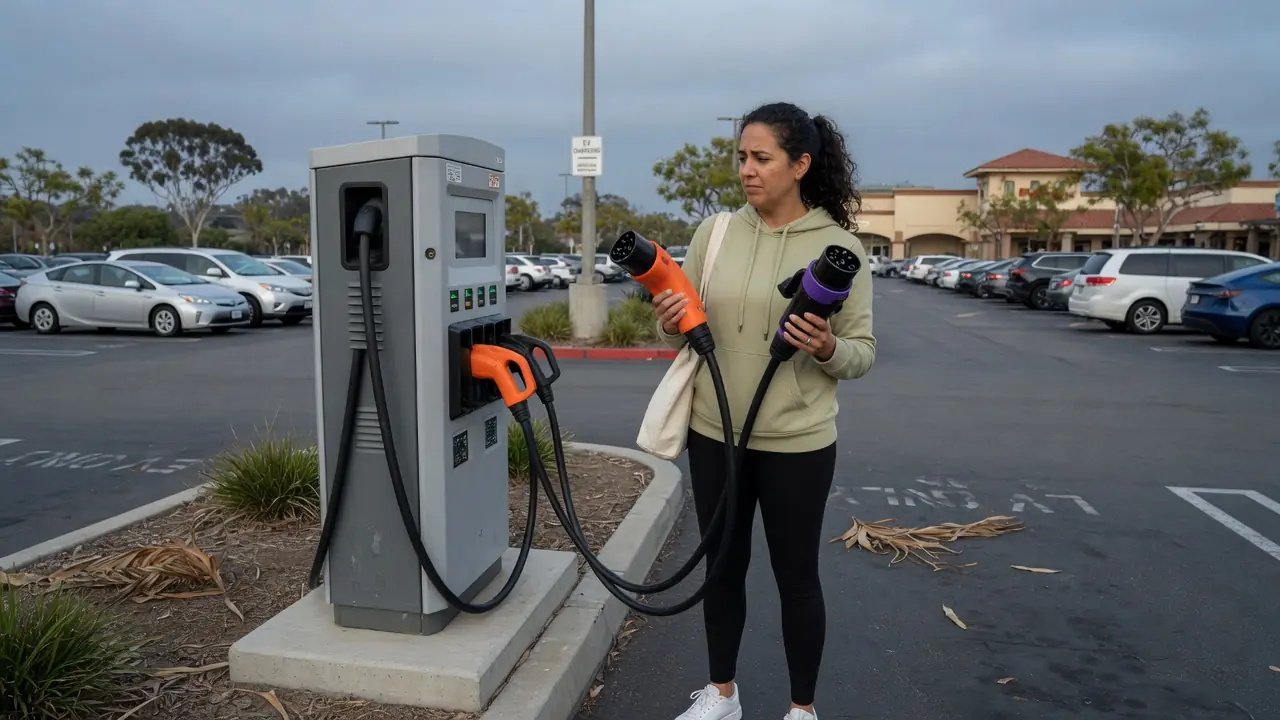
Name the port on this car, not the brand on the stall
The U.S. Department of Energy’s Alternative Fuels Data Center describes three DC fast connector families: CCS (SAE J1772 combo), CHAdeMO, and J3400, which SAE is standardizing from Tesla’s NACS design. A CCS vehicle inlet uses the J1772 portion for AC charging and adds two lower pins for DC fast charging. J1772 and J3400 are shown for AC Level 2. Connector shape still does not prove voltage or power. The stall and the car both have to agree.
Tesla vehicles do not have a CCS or CHAdeMO charge port. DOE says they come with a limited CCS or CHAdeMO adapter that supports charging up to 19.2 kW, and that Tesla sells full power adapters for both connector types. All Tesla vehicles come with a J1772 adapter for non-Tesla Level 2 equipment. Do not mix the limited adapter with a full-power DC adapter. Ask Tesla which one you are holding.
The regular U.S. 2026 IONIQ 5 has a built-in NACS port and an included CCS adapter for CCS DC fast charging. Those 2026 figures do not cover IONIQ 5 N or earlier years. If your Ioniq is an older CCS car, do not assume it now has NACS.
Rivian lists an approved J1772 AC adapter for compatible 2026 and newer Rivian vehicles with NACS ports. It is for AC chargers only and must not be used with a DC charger. A CCS-to-NACS DC adapter is a different part. Do not put Rivian’s AC adapter on a DC stall.
A driver in a Mission Valley garage, a Chula Vista shopping-center DC stall, and an Oceanside Supercharger are not holding the same problem. Say the make, model, year, and which plug is in your hand.
Separate AC adapters from DC adapters
Level 1 and Level 2 are AC. DC fast charging, which DOE also calls Level 3, is a different class, with power outputs up to 500 kW and on the order of 100 to 200+ miles of range per 30 minutes, varying by vehicle and state of charge. An adapter that is legal on AC can be the wrong object on DC.
If you only needed a household or destination AC plug, read what a Level 1 EV charger does and what a Level 3 EV charger is. Stay here when the stall in front of you is DC and the noses do not match.
Magic Dock and other stall-side adapters are station equipment. They are not in your trunk. If the stall says it can reconfigure, read the stall screen. Charge Pro SD could not confirm a San Diego station-by-station Magic Dock list. Do not assume every Tesla stall will accept a non-Tesla, and do not assume every CCS stall will accept NACS.
Charging time still depends on state of charge, battery capacity and type, the vehicle’s onboard charging capacity, equipment output, and electrical service. An adapter does not rewrite those limits.
Do not buy a random Amazon adapter on the shoulder of I-5. Unapproved adapters are how ports get damaged. Use the vehicle maker’s current approved list for this VIN.
Know when the adapter is not the job
If the traction pack is empty and no compatible stall is reachable, the job is energy at the car or a tow to a compatible stall. Mobile EV charging and out-of-charge recovery are those paths. An adapter in a shopping bag does not help if the stall is offline.
If the 12V is dead, the charge port may not open. That is a jump or a wake-up, not an adapter. Tesla, Hyundai, Rivian, and Ford each have their own 12V pages on this site.
If the car is in a traffic lane, California Highway Patrol says to call 911. In metropolitan San Diego County, other roadside requests can go through 511 by saying “Roadside Assistance.” Do not stand in a DC aisle testing plugs.
Charge Pro SD does not publish adapter prices, Tesla shop SKUs, or a “best adapter” table. Those change. The maker’s current shop and this VIN’s manual control.
What to tell a matched operator
Tell the operator the make, model, year, the port on the car, the plug on the stall, whether you have the maker’s adapter, and how much range the last screen showed. Ask them to confirm they can charge this connector in this location, or that they cannot.
Charge Pro SD is a referral service for San Diego County. We match you with licensed, independent EV charging professionals. We do not send our own truck. We do not sell adapters. We do not hold a trade license for the work. You contract and pay the professional directly. The service area is all 67 cities in our directory. A downtown garage with a height bar and a desert-edge lot in Borrego Springs are not the same pin.
What charger a Rivian uses is the Rivian connector page. Ioniq 5 charging time is the 2026 Hyundai session table. Use them as VIN checks, not as a promise that a public stall in San Marcos is working tonight.
When to call us
Call when the car is in San Diego County, the stall plug does not match the port, and you need a local operator to talk through an adapter, a different stall, or a mobile charge. Call us at (858) 400-4465 and we’ll connect you with a local EV rescue operator.