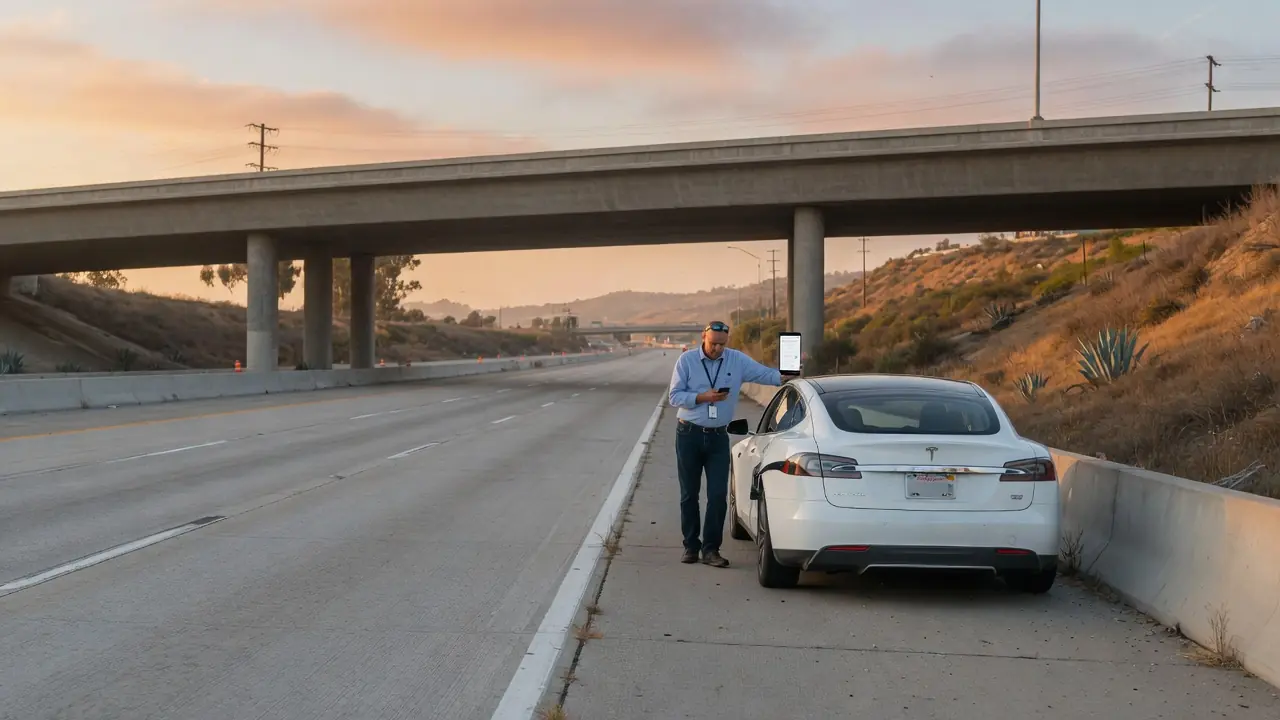
A Tesla sitting quiet on I-5 through National City can need a charger or a ride. Those are different jobs. A Tesla tow truck is the transport ask: the car has to leave the pin on a bed, not take energy where it sits. Charge Pro SD does not tow, own a truck, or dispatch a fleet.
Confirm the Tesla still needs transport
Start with what the car will not do. If the traction pack is at zero and the car is in a safe lot, on-site charging can be the first question. If the car cannot roll, cannot steer, has a tire off the rim, sat through a collision, or sits in a stall a charger truck cannot enter, transport is the honest request.
Tesla directs owners to request roadside assistance through the Tesla app. Tesla says out-of-range assistance may be available, but it is not financially covered, and availability can be restricted case by case for safety or regulatory reasons. Open that app request while you name the place. If the car is in a traffic lane or another dangerous spot, California Highway Patrol says to call 911. In metropolitan San Diego County, other roadside requests can go through 511 by saying “Roadside Assistance.” CHP Freeway Service Patrol, where it runs, may use an approved drop location if the car will not restart. That drop is not your house, a chosen shop, or a Supercharger you picked.
This page is not how to tow a Tesla with no power. That article is the loading caution. It is not how to choose a Tesla towing service in San Diego. That article is the operator-selection checklist. Stay here when the decision is still “does this Tesla even need a truck.”
A Mission Valley garage with a height bar, an Oceanside Supercharger stall, and a shoulder on SR-67 toward Ramona are not the same access problem. Say the city, the mile marker, and whether a bed can physically reach the car.
Tell empty charge from lost low-voltage power
An empty traction pack and a dead low-voltage system can look the same from the curb. One needs energy into the pack. The other needs the small battery that wakes screens, latches, and contactors.
Current Tesla Model Y owner’s information describes a lithium-ion low-voltage battery, with jump posts after the hood is open. Tesla also says a Model Y cannot be used to jump-start another vehicle. Other models and years can use different hardware. Do not copy Model Y onto a Model 3, Model S, Model X, or Cybertruck. Open that VIN’s book.
Tesla’s Model Y manual warns that the wires behind the tow-eye cover only release the hood latches. Tesla says those leads cannot charge the low-voltage battery and must be disconnected as soon as the hood unlatches. That is a hood-access note, not a tow procedure.
If the last remembered range still looked fine and the cabin will not wake, say so. If the car drove to zero on I-15 through Escondido, say that. A matched operator cannot choose charging versus transport until those two stories are separate. Out-of-charge recovery is the energy job. A tow truck is the move job.
Charge Pro SD could not confirm a public Tesla tow fee, mileage cap, or wait time. Do not treat a forum number as the quote.
Share model, year, and access details
Give the model, the model year, and the VIN if you have it. Tesla’s transporter instructions sit in that year’s owner’s manual, not in a county-wide script. A Model 3 on I-8 in El Cajon, a Model Y in a downtown garage, and a Model X in a Chula Vista driveway do not share one loading map.
Say whether you have the key card, the phone key, and a working Tesla app. Say whether the car will roll, whether Park will release, and whether the charge port will open. If the screen is dark, say that too.
Name the obstacle. A speed bump. A parking boot. A gate arm. A low garage beam. A muddy shoulder after rain in East County. The independent operator has to confirm they can enter before anyone promises a bed.
If you still need Tesla’s current transport setting, read how to put a Tesla in tow mode. Charge Pro SD could not confirm one universal menu path. Follow Tesla’s current transporter instructions for this VIN.
Ask what the tow request includes
Ask the dispatcher to name the job in one sentence. “We’ll get you to a charger” is a destination. “We’ll charge the pack here” is a different product. “We’ll load the Tesla” is transport. If they cannot say which one, pause.
Ask where the car will go. Tesla, when it is covering a warranty tow, sets Tesla’s destination rules. A club tow uses the club’s mileage and drop rules. An independent operator quotes their own destination. Charge Pro SD does not set miles, shops, or prices.
Ask whether the operator has read Tesla’s transporter instructions for this model year. Many makers specify a flatbed. This site is not authorized to freeze jacking, winching, or wheel-lift rules from memory. Those stay in Tesla’s book.
If mobile charging still might fit, compare mobile EV charging versus a tow. Keep this page for the moment charging is off the table.
Keep the Tesla app case number. Duplicate trucks help no one.
When a matched local operator may fit
A matched operator fits when you need a local EV rescue conversation in San Diego County and Tesla, CHP, or a club has not finished the job. That can mean a pack charge in a safe lot after the car is moved, or a jump of the low-voltage system so the car can roll onto a bed.
Charge Pro SD is a referral service. We match you with licensed, independent EV charging professionals. We do not send our own truck, because we do not own one. We do not employ crews. We do not hold a trade license for the work. You contract and pay the professional directly. The service area is San Diego County, all 67 cities in our directory. The operator still has to confirm they can enter the pin.
Before a referral is accepted, the operator should confirm make, model, model year, symptoms, location, proposed service, price, and timing. Charge Pro SD does not publish arrival windows.
If you already know the car must ride, Tesla roadside rescue is the matching path. If the pack is empty and the car is in a safe stall, start with charging, not a bed.
When to call us
Call when the Tesla cannot take a charge where it sits, the location is in San Diego County, and you need a local operator to talk through charging versus transport. Call us at (858) 400-4465 and we’ll connect you with a local EV rescue operator.