A Volkswagen ID.4 that will not wake can be a low-voltage problem, a high-voltage problem, or a stored fault the cluster has not explained yet. This is not a “known early failure” scorecard. Photograph the exact warning. Then open the owner’s manual for that model year before anyone clamps a cable.
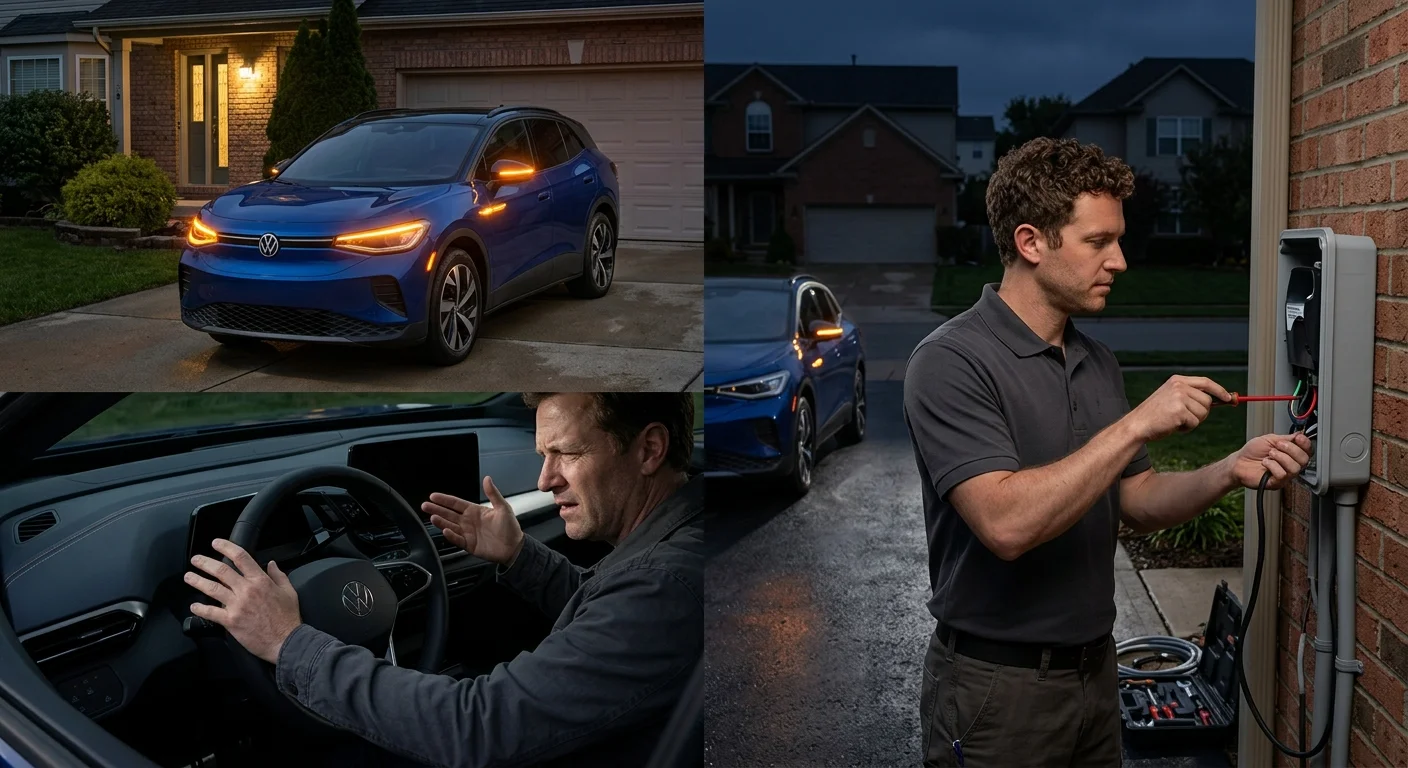
What the ID.4 is doing when it goes silent
Like other EVs, the ID.4 uses a high-voltage pack to drive and a separate low-voltage system for locks, screens, and the circuitry that lets the pack connect. Low-voltage chemistry is not a universal lead-acid rule. Confirm what that year’s VW manual names for your car.
When the low-voltage side cannot boot the computers, the car can sit unresponsive even if the traction pack still holds charge. That is a useful split. It is not proof that “a significant number” of ID.4s fail early, and it is not a software-update history. Those frequency claims are not in the approved facts ledger, so they stay off this page.
Read what happens when an EV’s 12V battery dies for the two-system idea. Do not treat it as a Volkswagen procedure.
Use the real alert, not sample copy
Do not hunt for a phrase this article invented. Photograph whatever is on the cluster or infotainment. Note whether doors unlock, whether the fob works, and whether the car still reports range.
Sluggish windows or a slow screen can have more than one cause. They are observations to hand an operator or dealer, not a DIY diagnosis.
If the ID.4 is in a traffic lane or another dangerous place, call 911. CHP uses 911 for a disabled vehicle in a dangerous location or traffic lane. In metropolitan areas, other roadside requests can go through 511 by saying “Roadside Assistance.”
Jump posts belong to that year’s U.S. ID.4 manual
This site does not have a captured U.S. ID.4 jump-start page in the approved facts file. There is no diagram here that locates jump terminals.
Open the emergency or jump-start section for your year. Follow only those terminals, polarity, and donor warnings. Do not use a 5-10 minute donor idle as a VW spec. Do not assume a gas-car clamp order. Do not treat Tesla Model Y hood-release wires as ID.4 jump points. On a current Model Y, those tow-eye leads only unlatch the hood and cannot charge the low-voltage battery.
If the manual tells you to use remote posts instead of the battery case, believe that. If it forbids using the ID.4 as a donor, believe that too.
A jump that wakes the car is still temporary if the battery is worn. Replacement, coding, and parts are shop or operator questions. They are not a Charge Pro procedure.
Getting help in San Diego without a specialist promise
Charge Pro SD is a referral service. We match ID.4 drivers with independent local operators. We do not own a countywide specialist fleet, and we do not guarantee on-site diagnosis.
The operator confirms whether they can attempt a jump, a charge, or a tow for that VIN, connector, and location. They quote you before work starts. You contract with them.
If the traction pack is empty rather than the low-voltage system, charging is a different job. The U.S. DOE Alternative Fuels Data Center shows AC Level 2 with J1772 and J3400 (NACS). A CCS inlet uses the J1772 portion for AC and adds lower pins for DC fast charging. Compatibility still requires the exact vehicle and equipment. This page does not put DC-fast gear on a mobile truck.
Tesla owners request Tesla roadside through the Tesla app. Tesla says out-of-range assistance may be available but is not financially covered. That Tesla path does not set Volkswagen policy. ID.4 owners use VW’s current channels plus, if they want a local referral, Charge Pro SD.
See non-Tesla EV rescue. Tesla-specific jump pages, including Tesla 12V battery jump, are for Teslas.
When to call for a referral
Call if you cannot follow the manual safely, you have no donor equipment, or the car is already in a tow-away or traffic-lane bind. Call (858) 400-4465. We connect you with a local operator. They confirm the work and the price.
Frequently asked questions
Are Volkswagen ID.4 12V battery failures common?
This page will not grade frequency. Owners do search for ID.4 12V problems, and a silent car with remaining range is a real task. How often it happens on your build is a Volkswagen or shop question, not a statistic we can invent.
Why does the Volkswagen ID.4 12V battery drain?
Parked electronics can draw from the low-voltage battery. Heat and age can matter on some chemistries. None of that is a license to call the battery undersized or to blame a software-update story that is not in the facts ledger. Check the manual’s storage and charging notes for that year.
What warning should I look for?
The one on your screen. Photograph it. Do not match it to sample strings from a blog.
Does Charge Pro SD jump a dead Volkswagen ID.4 in San Diego?
We refer you. An independent operator confirms whether a jump is the right job for that car. Availability and equipment are theirs to state, not ours to promise. Call (858) 400-4465.