A dead Tesla that will not wake is often the smaller low-voltage battery, not the traction pack. Tesla’s long Battery and Drive Unit warranty is a different contract. Confirm which system failed, then get Tesla’s written coverage decision before anyone replaces a part.
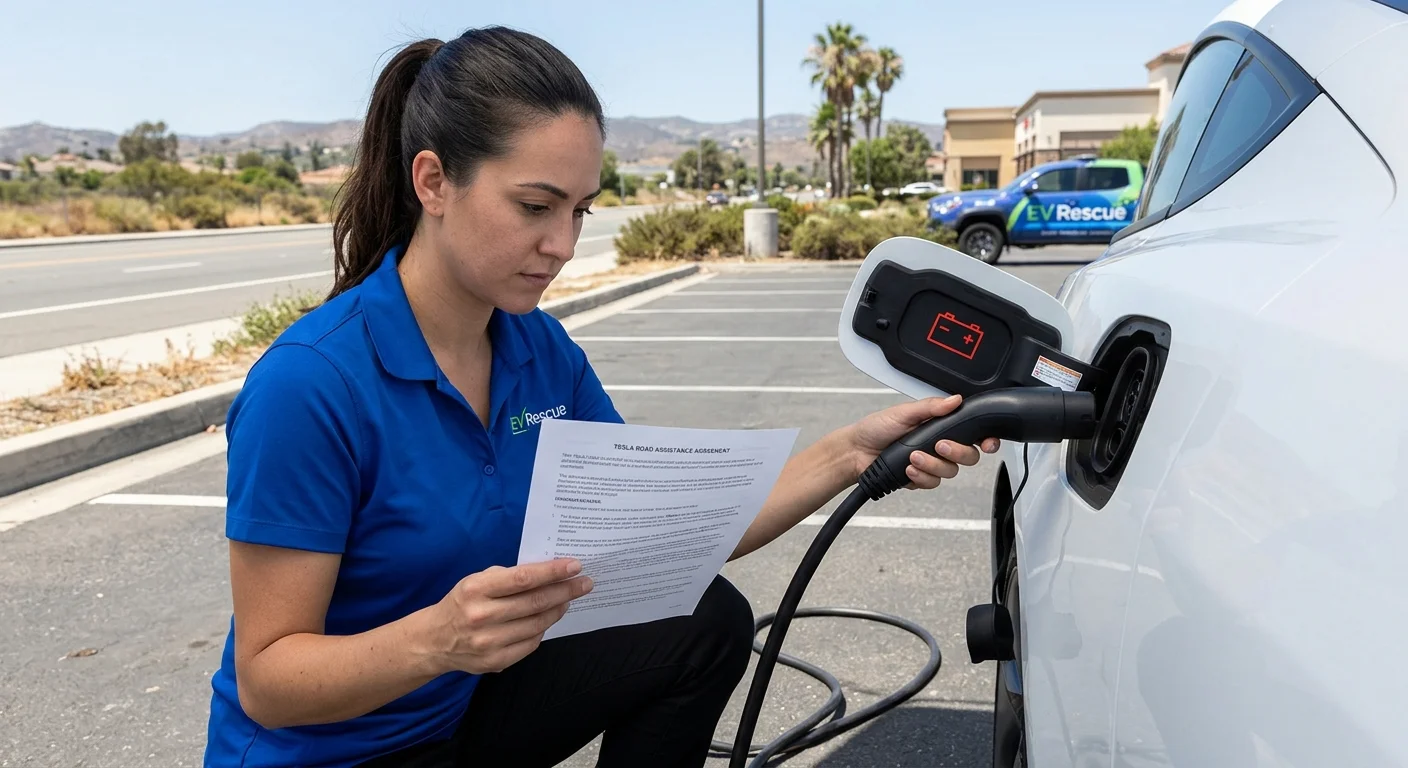
Confirm which Tesla battery the question covers
Tesla puts two electrical systems in the car, and they fail in different ways. The high-voltage pack stores the energy that moves the vehicle. The smaller low-voltage battery, which many owners still call a 12V, powers computers, screens, latches, and the wake-up path. A Tesla low voltage battery warranty question is about that smaller system. It is not a question about range, Supercharging speed, or a pack that has fallen below a capacity floor.
Search results mix the two because the word “battery” is doing too much work. What Tesla’s battery warranty covers is the traction-pack article. Keep that page for pack defects and capacity claims. Stay here when the car will not wake, the display stays dark, the doors will not release as they should, or a low-voltage warning is on the screen while the indicated driving range still looks fine.
The current Model Y owner’s manual describes a lithium-ion low-voltage battery, with jump posts under the hood after the hood is open. Tesla also says a Model Y cannot be used to jump-start another vehicle. Other models and older production dates can use different low-voltage hardware. Do not copy a Model Y label onto a Model S, a Model 3, a Model X, or a Cybertruck. Open the owner’s manual for that VIN, or ask Tesla service to name the failed part in writing.
San Diego makes the mix-up easy. A car that sat in a Mission Valley garage, an East County driveway in El Cajon heat, or an overnight curb in Pacific Beach can look “dead” in the same way. The driver still sees miles on the last remembered display and assumes the traction pack failed. Often the pack is fine and the low-voltage system will not bring the car up. A blank cabin on I-5 through the South Bay or I-15 through Escondido is a reason to identify the system, not a reason to quote pack replacement.
Ask Tesla, or a matched independent operator, three plain questions before anyone talks coverage. Which battery is at fault. What test showed that. What repair is proposed. Until those answers exist, you are comparing the wrong warranty to the wrong part.
Charge Pro SD does not sell batteries, replace batteries, or warrant Tesla parts. It connects San Diego County drivers with licensed, independent local operators. The operator you hire names the work. Tesla names the coverage. For a Model 3 invoice checklist, use Tesla Model 3 12V battery replacement cost.
Check Tesla’s current low-voltage warranty path
Open the Tesla app, go to Specs and Warranty, and read the Warranty tab for that VIN. That screen, plus the booklet issued with the car, still controls. A blog chart does not rewrite an older contract. A used Tesla in Chula Vista or Oceanside may carry different paper than a car sold new last year.
Tesla’s New Vehicle Limited Warranty for North America, in the version verified against Tesla’s PDF effective June 5, 2025, covers the high-voltage battery and drive unit on Model S, Model 3, Model X, and Model Y sold by Tesla. For Model S and Model X, that HV coverage is 8 years or 150,000 miles, whichever comes first, with a minimum 70% battery capacity retention. For Model 3 and Model Y Standard or Standard Range Plus, it is 8 years or 100,000 miles, whichever comes first. For Model 3 and Model Y Long Range or Performance, it is 8 years or 120,000 miles, whichever comes first. Those figures describe the traction pack and drive unit. They are not a 12V schedule. That PDF does not cover Cybertruck. Cybertruck owners should rely on the app and the documents issued with that vehicle.
A matching year-and-mile term for the low-voltage battery could not be confirmed from that same verified PDF. Do not assume the eight-year pack warranty follows the 12V. Do not assume a “basic” bumper-to-bumper number either. Charge Pro SD could not verify a low-voltage coverage table. The honest next step is Tesla’s VIN record, not a guessed number from a forum.
If you bought the car used, pull the original warranty packet if you still have it. Older Tesla documents used names such as Standard Range, Standard Range Plus, or Long Range. A current summary does not change those contracts. If the packet is gone, Tesla service can still print what the VIN carries. Ask for that printout or an in-app screenshot dated the day you asked.
The U.S. Department of Energy’s electric vehicle overview is useful background on how EV systems are split. It will not tell you what Tesla will pay on your car. Only Tesla’s documents do that.
People also ask how long “the Tesla battery warranty” lasts. For the traction pack, use the HV terms above and then confirm them on your VIN. For the low-voltage battery, say you could not confirm a public term and check the app. People also ask what happens after 10 years. The verified HV terms end at 8 years or the mileage cap, whichever comes first. After that, pack coverage from that PDF is over unless Tesla’s VIN record says otherwise. The low-voltage path still has to be read on that same VIN. Do not treat year 10 as a special Tesla rule. It is simply past the published HV clock.
Separate roadside help from a warranty repair
A jump, a tow, or a mobile visit is not a warranty decision. Roadside help gets the car out of a lane, into a stall, or awake enough to drive to service. Warranty repair is Tesla agreeing, in writing, that a named part failed under a named contract and that Tesla will repair or replace it on Tesla’s terms.
Tesla tells owners to request roadside assistance in the Tesla app. Tesla also says out-of-range assistance may be available but is not financially covered, and that roadside availability can be restricted case by case for safety or regulatory reasons. That is Tesla’s program, not Charge Pro SD’s. If the car is in a traffic lane or another dangerous spot on I-8, SR-78, or I-805, California Highway Patrol says to call 911. In metropolitan areas, other roadside requests can go through 511 by saying “Roadside Assistance.”
A low-voltage failure on a San Diego street often looks like a no-start, a dark screen, or a car that will not unlock as expected. That can strand you in a downtown garage, at a Supercharger stall, or on a residential street in Encinitas. Getting the 12V system awake is a roadside problem. Paying for a new low-voltage battery, or having Tesla install one under warranty, is a service problem. Keep the two tickets separate so you do not wait on coverage language while the car is still blocking a lane.
If you need the car moved or woken before Tesla service is scheduled, a matched local operator can discuss a Tesla 12V battery jump or Tesla roadside rescue. Ask that operator to confirm the exact model, model year, symptoms, and what they can do on site. Charge Pro SD does not send a truck, does not jump the battery, and does not promise an arrival window. The independent operator sets the work, the price, and the timing after they accept the job.
Tesla mobile service is a different path again. If Tesla will come to the driveway for a low-voltage battery, that is still Tesla’s appointment and Tesla’s coverage call. Read Tesla mobile service for a 12V battery for how that request is usually framed, then confirm the live options in the app. Do not treat a mobile visit as proof that the part is covered. Coverage is the written decision, not the fact that a technician showed up.
Tesla’s Model Y manual also warns that the wires behind the tow-eye cover only release the hood latches. Tesla says those leads cannot charge the low-voltage battery and must be disconnected as soon as the hood unlatches. That is a safety note from Tesla, not a DIY repair guide. If you are not comfortable opening the hood with no power, wait for Tesla or a matched operator who knows that model year.
Ask for the written coverage decision
Ask Tesla to put four things in writing before you approve a replacement. Which component failed. Whether Tesla calls that failure a covered defect on this VIN. Whether Tesla proposes repair or replacement. Who pays. A verbal “it should be covered” is not enough when the invoice is large.
Tesla decides whether a covered HV failure is repaired or replaced. The same discipline belongs on the low-voltage side. Asking only for a new 12V can skip the diagnosis. A software fault, a charging-system alert, or a high-voltage isolation issue can mimic a dead 12V. You want the failed part named.
People also ask what it costs to replace a Tesla battery. That question still splits. A traction-pack replacement is not a 12V replacement. Charge Pro SD does not publish a Tesla parts price, a shop rate, or a “typical” invoice. For the smaller battery, read Tesla 12V battery replacement cost as a planning page, then use Tesla’s written quote or the independent operator’s written quote for the car in front of you. If Tesla denies coverage, the denial should say why. Expired time, expired miles, a finding of “within specification,” collision or flood damage, and modifications are the kinds of reasons owners hear. Charge Pro SD cannot confirm a universal denial list from Tesla’s verified PDF, so treat Tesla’s letter as the source.
Independent repair does not get a blanket statement here either. We could not verify that a non-Tesla shop automatically voids every Tesla warranty line. We also could not verify the opposite. If you already had work done in Kearny Mesa or National City, tell Tesla what was done and keep the invoices. Then read Tesla’s written position for that VIN.
If Tesla says the low-voltage battery is not covered, you still have a car that may not start. That is the moment to separate payment from movement. Pay Tesla or an independent shop for the part if you choose to. Or ask a matched operator only to wake the system so you can drive to the appointment you already booked. Do not sign a pack-level repair because the 12V failed.
Keep screenshots of the Warranty tab, the service request, and any chat or email that names coverage. Dates matter when a time limit and a mileage limit both exist on the HV side. They may matter on the low-voltage side too, once Tesla shows you the term for your VIN.
When a matched operator may still fit
A matched operator is not Tesla warranty. Charge Pro SD is a referral service for San Diego County. It holds no trade license, owns no fleet, sets no prices, and gives no warranty on Tesla parts. The customer contracts with the independent operator directly.
That still helps when the car is stuck and Tesla’s roadside path is delayed, out of range, or not financially covered. A low-voltage no-start in a Rancho Bernardo driveway, a dark Model 3 on SR-52, or a Model Y that will not wake after a day at the beach is a mobility problem first. An operator who knows Tesla 12V jump points can discuss waking the car so you can reach a Tesla service appointment. Ask them to confirm the model year, the low-voltage chemistry they expect, and whether they will only jump, or whether they will not touch the car and will recommend Tesla instead.
Do not ask a roadside operator to decide Tesla’s warranty. They can describe what they see. Tesla still has to write the coverage call. Do not ask them to replace a pack on a no-start that has not been diagnosed. Do not use a Tesla to jump another vehicle. Tesla’s Model Y manual forbids that, and other models may have the same limit in their own books.
If the vehicle is already in a dangerous location, safety comes first: 911, then 511, then Tesla’s app, then a referral call. If the car is safely parked and you only need a coverage answer, start with Tesla service and the Warranty tab. A matched operator is the wrong ticket for a paperwork question.
When the diagnosis is clearly the smaller battery, you still choose who replaces it. Tesla may cover it, or Tesla may not. An independent operator may quote a replacement after they inspect. Charge Pro SD will not pick that quote for you and will not mark the part as covered. Your job is to keep the systems straight, keep the written decision, and only then decide who touches the car.
When to call us
Call when the Tesla will not wake, you are stranded in San Diego County, and you need a local EV rescue operator to discuss a 12V jump or a roadside recovery while Tesla’s coverage decision is still pending. Call us at (858) 400-4465 and we’ll connect you with a local EV rescue operator.