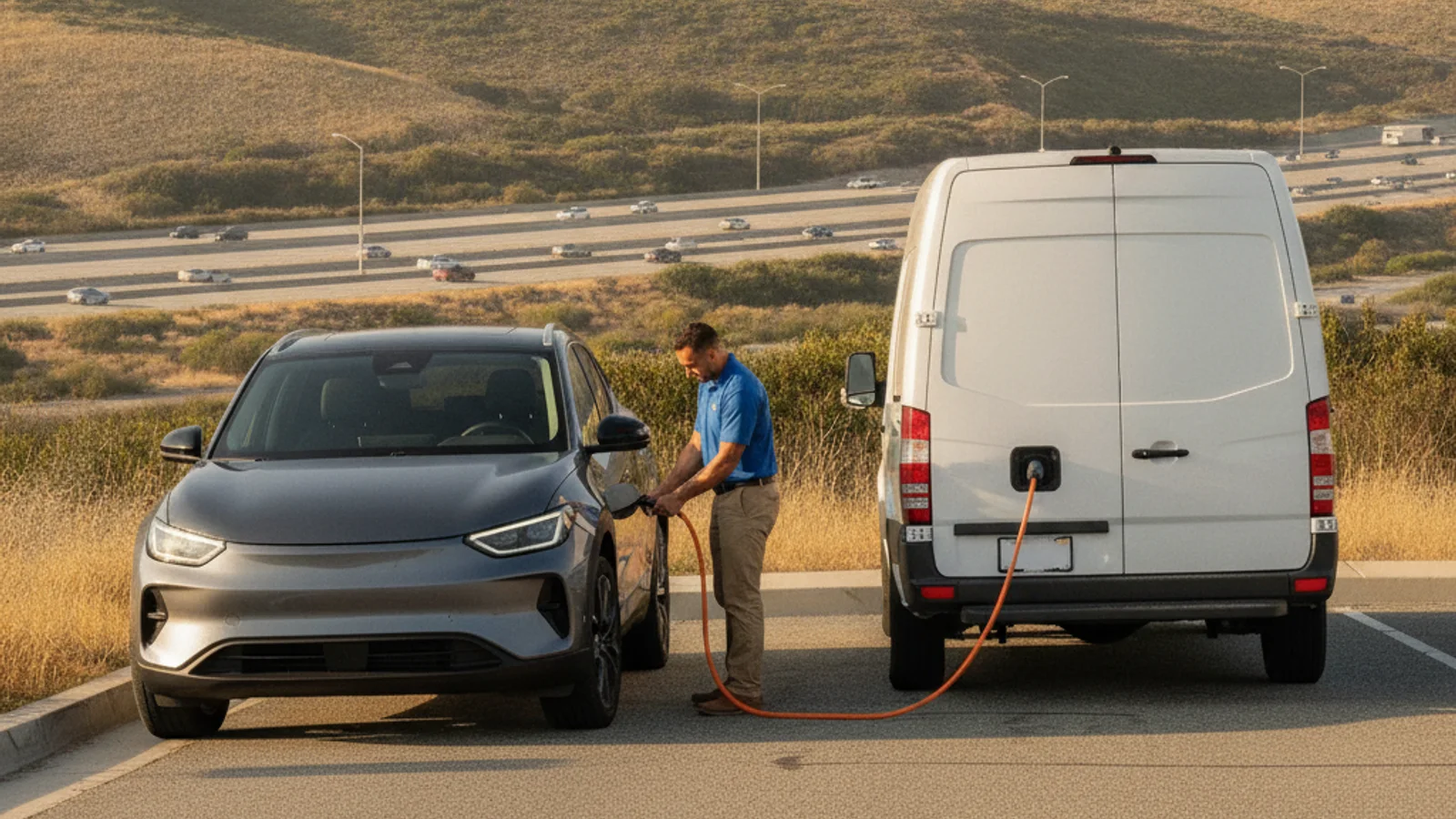
An EV that stops responding on SR-78 near Vista raises one question before any other: does it need energy, or does it need transport. The answer isn’t obvious from the dashboard alone, and getting it wrong wastes time you don’t have.
Identify your position along SR-78
Vista sits on SR-78 between Oceanside to the west and San Marcos to the east, a stretch that climbs and rolls rather than running flat. That matters because your exact position on the corridor changes what an operator can reasonably plan for. A stop near the western Vista interchanges is a different scene than one closer to the San Marcos line, even though both sit on the same route.
Give the operator your direction of travel and the nearest cross street or off-ramp, not a general description like “somewhere in Vista.” “Eastbound SR-78 approaching the Vista city limit” tells an operator something a vague location doesn’t. If you passed a specific exit before losing power, name it.
Vista’s terrain is transitional. It isn’t coastal-flat like the Oceanside end of the corridor, and it isn’t a single long grade either. The rolling street pattern means a car that displayed a workable range estimate at the coast can arrive in Vista having used more energy than expected, particularly on the climbs east of downtown. That’s a planning detail, not a diagnosis, but it’s useful context to share. Our Vista EV charging guide covers the wider local picture if you’re planning ahead rather than stopped right now.
If you’re still on the SR-78 travel lanes or the shoulder is narrow, treat that as a safety decision first. Move as far right as the roadway allows, use your hazard lights, and if the stop puts you in an unsafe position relative to traffic, contact 911 or CHP before anything else. A charging decision only makes sense once the vehicle and driver are in a safe, reachable spot. Our emergency EV roadside assistance service exists for that first step, before charging specifics enter the conversation.
Account for parking access near East Vista Way
East Vista Way runs north out of the SR-78 corridor toward Bonsall and Fallbrook, and it’s a common route for drivers who came off the freeway looking for a place to stop rather than staying on the shoulder. That instinct is often right. A residential street or a business lot gives an operator room to work that a freeway shoulder never will.
But East Vista Way and the surrounding Vista street grid are hilly, and that changes what “pulled over” actually looks like. A car stopped on a graded section of a side street, or angled against a curb on a slope, may not sit where charging equipment can be positioned safely. Tell the operator whether the vehicle is on flat ground or a grade, whether it’s in a marked space or against a curb, and whether there’s room for another vehicle alongside.
Gated communities, apartment complexes, and business lots with restricted access are common in this part of Vista, and each one adds a step. If you’re in a gated area, say so, and note whether you have a code or can meet someone at the gate. A locked lot the operator can’t enter is the same as no access, no matter how close it is to the freeway. Parking structures are less common in Vista, but where they exist, height and clearance matter, so mention them specifically.
Tell empty charge from low-voltage failure
“My EV died near SR-78” describes two very different problems. A vehicle that shows a depleted traction battery, typically a clear low-range or zero-range warning before it stopped, is a different situation than one that goes dark with no dashboard response at all.
Read the exact message on the display, if there is one, and report it word for word rather than paraphrasing. “Battery empty, pull over safely” is a different report than a screen that shows nothing and controls that don’t respond. The second pattern points toward a 12V or low-voltage issue rather than a depleted main battery, but only your vehicle’s manufacturer documentation can confirm what a given symptom means for that specific model.
Don’t diagnose the cause yourself or guess at a battery-access procedure from general EV knowledge. Battery layouts, service panels, and approved low-voltage procedures vary by manufacturer and sometimes by model year. If you have the owner’s manual, in the glovebox or the manufacturer’s app, its roadside or low-voltage section is the correct reference, not a general article.
Share what still works: interior lights, door locks, the mobile app connection, the charge port release. A car that unlocks and shows some display activity but won’t drive tells a different story than one that’s completely unresponsive. That detail helps the operator ask the right follow-up questions, though the final determination belongs to the operator and the vehicle’s own documentation, not a roadside guess.
What an operator needs before accepting the call
An operator can’t commit to a Vista call without knowing whether the situation matches what mobile charging equipment can address. That starts with the vehicle itself: make, model, model year, and the charge connector it uses. EV charging levels and connector types, J1772 for most non-Tesla vehicles and J3400 (NACS) for Tesla, aren’t interchangeable, and the operator has to confirm compatibility before committing to the trip.
Location detail matters just as much. A precise cross street, direction of travel, and description of the surface, freeway shoulder, residential street, business lot, tells the operator whether the site is workable. Vague locations cost time twice: once while the operator tries to find you, and again if the site turns out to be unworkable on arrival.
The operator also needs an honest read on the symptom, not a confident diagnosis from the driver. If you’re not sure whether the problem is an empty battery or something electrical, say that directly. “I don’t know, here’s exactly what I’m seeing” is more useful than a guess stated as fact.
Charge Pro SD connects Vista drivers with independent local operators, and the operator you’re matched with decides what equipment fits your vehicle and setting after hearing these details. Our mobile EV charging service is where that conversation starts, but the operator sets the terms, confirms compatibility, and quotes the work directly with you.
When transport may be the safer option
Some situations aren’t a good match for mobile charging, no matter how convenient it would be. A vehicle that won’t begin charging when a compatible connection is offered may have an issue mobile equipment can’t resolve on the roadside. So can a car in a spot the operator genuinely can’t reach: a blocked garage level, an active traffic lane with no safe shoulder, or a locked lot with no way in.
In those cases, the independent operator you’re connected with may recommend transport instead. That’s not a downgrade, it’s a different tool for a problem mobile equipment isn’t built to solve. Our out-of-charge EV recovery service covers that path when charging on-site isn’t the right fit.
Don’t try to force a mobile-charging outcome onto a vehicle that isn’t accepting a charge, and don’t guess at why. A vehicle’s charging system, battery management, and any fault codes are things only the manufacturer’s documentation, or the operator working the case, can properly interpret.
For a broader look at the charging picture along this stretch of SR-78, our post on the SR-78 North County corridor covers the charging landscape between Oceanside and Escondido, and our Vista roadside assistance guide covers the wider set of situations beyond charging alone. The DOE Alternative Fuels Data Center also maintains general charging infrastructure data if you want to plan ahead for future trips through this corridor.
When to call us
Call when you’re stopped near SR-78 or East Vista Way with a depleted battery, an unclear dashboard message, or a vehicle that won’t respond, and you need help sorting out whether charging or transport fits. Call us at (858) 400-4465 and we’ll connect you with a local EV rescue operator.