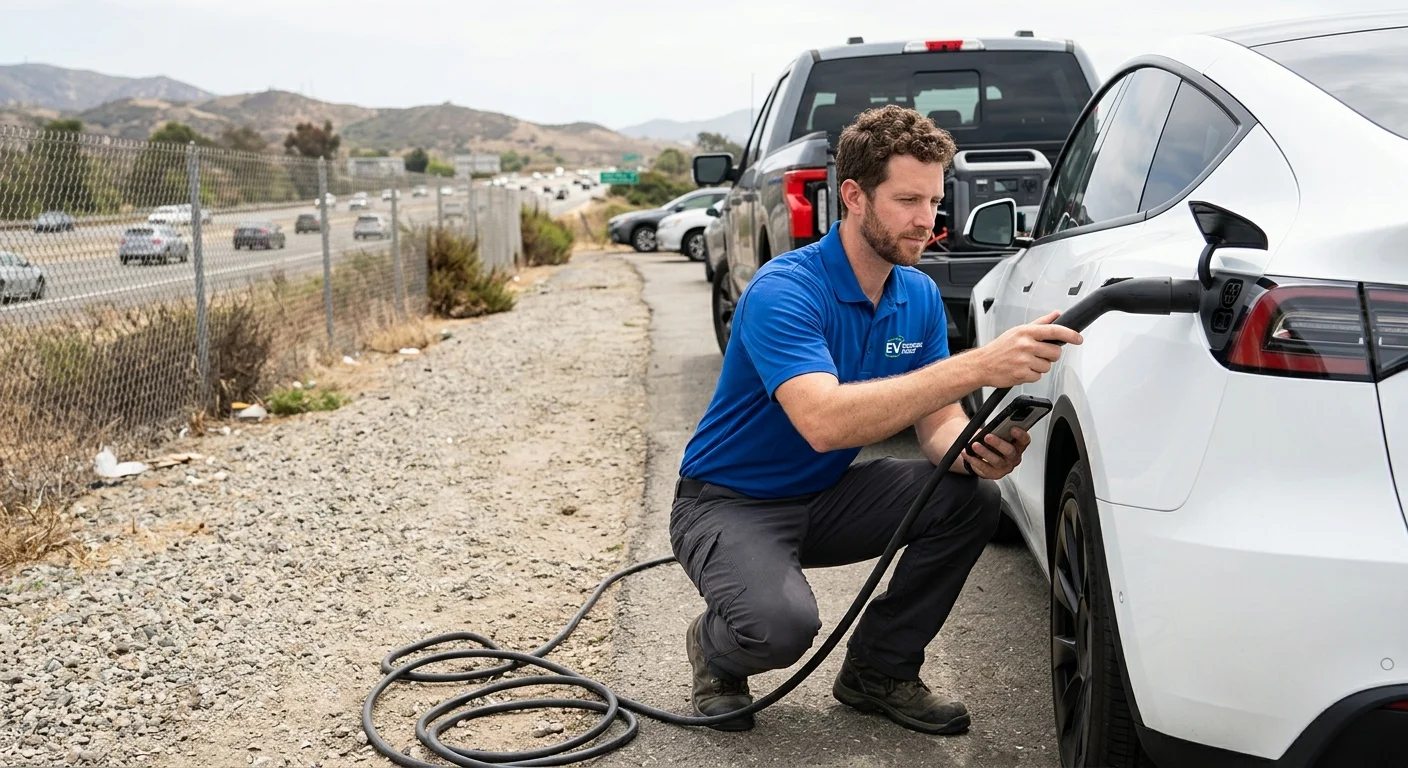
A stalled EV near SR-78 creates two immediate decisions: where are you, and does mobile charging fit the problem? In San Marcos, your direction, nearest exit, dashboard message, and safe access point give a local operator the clearest starting point. Charge Pro SD connects you with a licensed, independent operator who reviews those details before recommending charging or transport.

An electric vehicle parked safely near the SR-78 corridor in San Marcos while it

Share your SR-78 direction and nearest exit

Start with the road name, direction, and nearest signed exit. “SR-78 in San Marcos” leaves too much open. Say eastbound or westbound, then name the exit you just passed or the one ahead. If you’re near Twin Oaks Valley Road, say whether you’re on the freeway, a ramp, or the surface street. Use San Marcos Boulevard as a cross-street reference when that’s what you can see.

A dropped map pin helps, especially when an exit sign isn’t visible. Send the pin with a plain-language note. For example: “Westbound SR-78, past Twin Oaks Valley Road, stopped off the travel lane.” If you reached a parking area, name the entrance you used and the row or level where the vehicle sits. Don’t rely only on the name of a large property.

Location details also tell the operator what access needs review. A shoulder, curb, gated lot, and parking structure present different questions. Mention barriers, locked gates, height limits, narrow turns, or a vehicle blocking the charging side. If traffic exposure makes the location unsafe, contact emergency services and follow their directions.

For more corridor-specific preparation, read our SR-78 out-of-charge guide. It helps you organize the same location details before requesting mobile EV charging.

Tell empty charge from low-voltage failure

The car’s exact message matters more than a quick diagnosis. Report what happened in sequence. Note the last displayed battery percentage or range, whether it reached zero, and every warning still visible. Quote messages word for word. A screenshot can prevent a vague description from steering the request the wrong way.

For an empty-charge report, state whether the main display showed no remaining driving range before the vehicle stopped. For a possible low-voltage issue, report any message that names the low-voltage or 12-volt system. Also say whether the screens, locks, charge port, and gear controls respond. These observations don’t require you to decide what failed.

Don’t erase alerts, repeatedly retry controls, or describe the vehicle as “dead” without more detail. Open the manufacturer’s app or owner manual only if you can do so safely. Use the model-specific wording you see there. If the display changed after the stall, tell the operator what changed and when.

The independent operator reviews the vehicle, reported battery state, and access details before choosing a service path. Our out-of-charge recovery page explains how we route this kind of request. Charging shouldn’t be assumed from the word “stall” alone. Clear symptoms let the operator decide whether to evaluate a mobile charge, another roadside service, or transport.

Account for Twin Oaks Valley Road access

On Twin Oaks Valley Road, give more than the nearest address. Say whether the EV is beside a curb, inside a lot, on a ramp, or behind a gate. If you’re closer to San Marcos Boulevard, name that cross street and your direction of travel. A pin placed on the vehicle is better than one placed at a property’s mailing address.

Tell the operator how the vehicle can be approached. Include the gate entrance, call box, parking level, and any posted clearance. State which side contains the charge port, but don’t promise that a service vehicle can reach it. If the EV is boxed in, share what blocks each side. Photos of the approach and parking position can answer those questions faster than a long text.

Keep safety separate from convenience. Don’t stand in a traffic lane to guide someone toward you. If you can’t remain with the vehicle safely, tell the operator where you are and follow instructions from emergency personnel. Never move the EV into traffic just to make access easier.

Our San Marcos EV roadside guide covers the broader choices around a disabled electric vehicle. This mobile-charging article narrows the decision to vehicle symptoms and site access. The more exact your Twin Oaks Valley Road details are, the less an operator must infer before discussing a suitable response.

Prepare the details an operator needs

Put the facts in one message before you call. Start with the vehicle’s year, make, model, and current location. Add the direction of travel, nearest exit or cross street, and a map pin. Then copy the dashboard message exactly. Include the battery percentage or displayed range only as shown by the vehicle.

Describe what still responds. Can the doors open? Does the screen turn on? Will the car shift, and is the charge port reachable? These are observations, not instructions to keep testing a disabled car. If the car shows a warning, photograph it before the display changes.

Add the physical access notes from Twin Oaks Valley Road or San Marcos Boulevard. Mention gates, garage levels, height signs, tight turns, traffic exposure, and the side of the vehicle facing open space. Say whether passengers need a safer waiting place. Don’t send account passwords, app login codes, or payment details in an initial location message.

If you know the connector type, share it. If you don’t, send a clear photo instead of guessing. The U.S. Department of Energy’s electric vehicle overview provides general EV background, but it can’t identify the right response for your stalled vehicle. The matched operator must review your vehicle, reported battery state, and site access. That compact fact set gives the operator what they need to discuss the next step without relying on assumptions.

Choose mobile charging or transport

Mobile charging and transport are different service paths. Don’t choose one from the word “battery” alone. Ask the operator to evaluate three things: the vehicle, the reported battery state, and the place where it stopped. Those are the details named throughout this guide.

A mobile charging discussion may fit when the operator confirms the request matches their service and the vehicle’s location can be handled. That isn’t a promise of availability, equipment, delivered charge, or outcome. The operator decides what they can offer after reviewing your information. Ask what service they’re proposing and what the planned next step is.

Transport may be the path the operator recommends when charging doesn’t match the symptoms, vehicle, or access conditions. Confirm the destination and how the disabled EV will be handled before you authorize anything. Don’t assume that reaching a charger solves every stall. The vehicle’s own warnings and ability to accept a charge still need review.

Charge Pro SD doesn’t perform the roadside work, set its price, or give its warranty. We connect you with a licensed, independent local operator. Ask that operator directly about current price, payment terms, the proposed service, and any warranty before agreeing. Don’t rely on a general quote from another incident. Keep the decision with the operator who has your facts, not with a generic roadside label.

When to call us

Call when an EV stalls around SR-78, Twin Oaks Valley Road, or San Marcos Boulevard and you need an operator to assess charging versus transport. Have the location, vehicle, dashboard message, battery display, and access details ready. Call us at (858) 400-4465 and we’ll connect you with a local EV rescue operator.