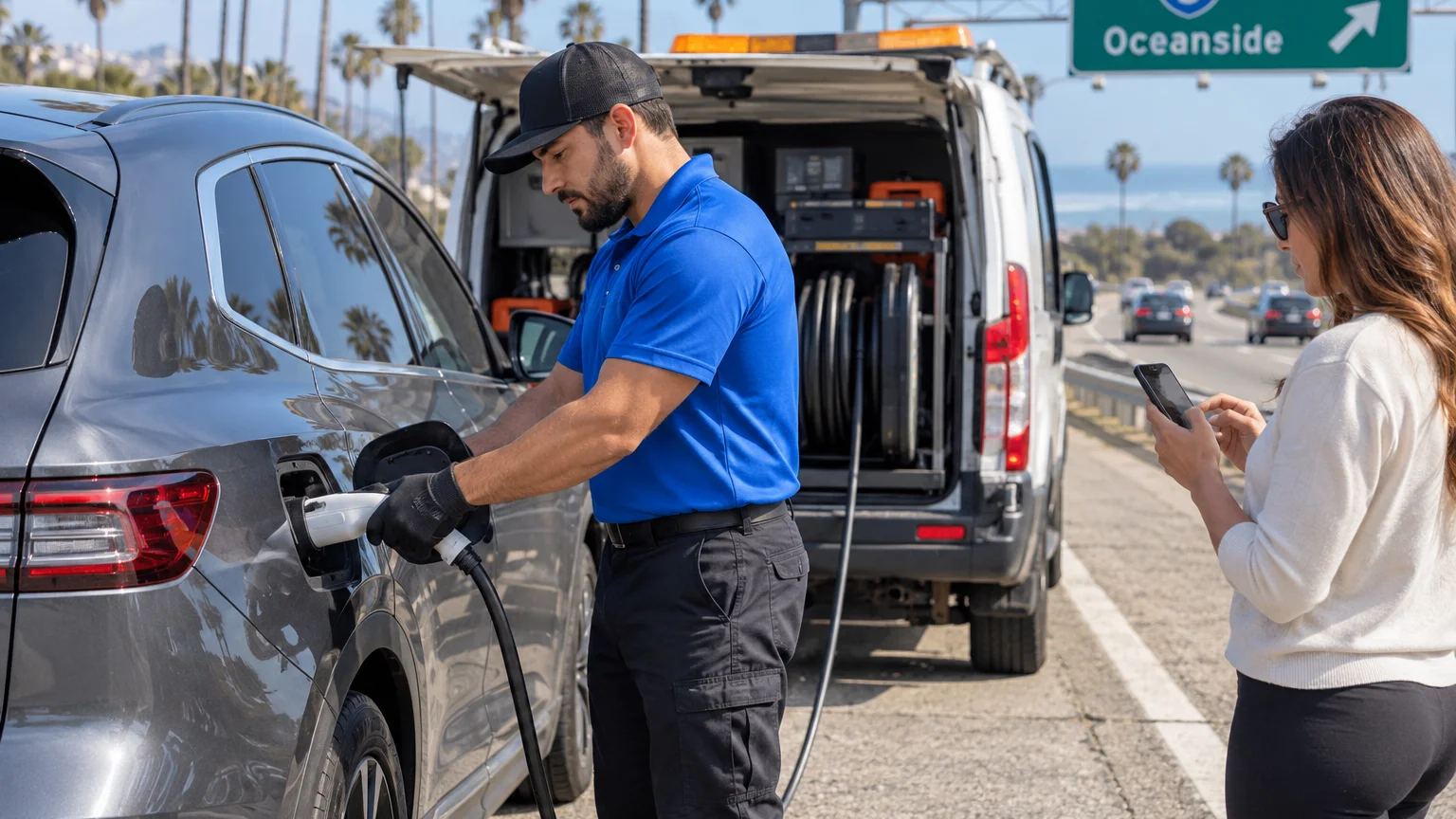
An EV stall in Oceanside creates one immediate decision: charge where the car stopped or arrange transport. Your location, vehicle condition, connector, and remaining battery display help an independent operator evaluate those options.
Share your I-5 direction and nearest exit
“I’m on I-5 in Oceanside” doesn’t give an operator enough detail. Start with your direction of travel and the nearest exit. Then say whether you’re still on the freeway, on an exit ramp, or parked beyond the interchange.
Share your phone’s location pin when possible. Street names and nearby businesses can help, but a pin reduces confusion when similar entrances appear on both sides of I-5. Mention which side of the road you’re on and whether the car occupies a marked parking space.
If you’re northbound toward the Camp Pendleton corridor, say so clearly. Don’t describe yourself as simply “near the base.” Tell the operator whether you’re south of the corridor, approaching an entrance, or already inside controlled property. The operator must decide whether access is possible.
A stalled car in a traffic lane or another dangerous location needs emergency attention. California Highway Patrol guidance says to call 911 when a disabled vehicle is in a traffic lane or dangerous location. Charging can wait until the immediate hazard is addressed.
Don’t move into traffic to inspect the charge port or read a road sign. Share what you can observe from a safe position. If conditions change while you’re arranging help, update the operator.
Our Oceanside EV roadside assistance guide covers the broader choices after a breakdown. For incidents farther north, the Oceanside and Camp Pendleton corridor guide adds corridor-specific planning.
Tell empty charge from low-voltage failure
A motionless EV isn’t automatically out of driving charge. The operator needs to separate a depleted traction battery from a possible low-voltage problem, charging fault, tire issue, or other failure.
Don’t diagnose it from one warning or battery percentage. Instead, describe exactly what happened. Report the displayed charge level, warning messages, sounds, and which controls still respond. Say whether the vehicle powers on, unlocks normally, shifts, or shows a blank display.
If the car lost power while moving, share that detail. If it parked normally and later wouldn’t wake, say that instead. Tell the operator whether you recently connected to a charger and whether the vehicle accepted any energy.
Avoid attempting improvised electrical work. Don’t open panels, handle wiring, or use an unapproved adapter. Vehicle-specific low-voltage procedures differ. The correct instructions come from the owner’s manual for the exact model year.
A truly depleted driving battery may be considered for out-of-charge EV recovery. A different failure may require another roadside service or transport. The independent operator makes that call after reviewing the vehicle and symptoms.
The displayed state of charge also doesn’t establish how much energy a mobile session could deliver. Charging time depends on battery state, battery capacity, vehicle charging limits, equipment output, and available electrical service, according to the U.S. Department of Energy. Ask the operator what equipment is proposed and whether it matches your vehicle.
Account for Coast Highway and harbor access
Coast Highway and Oceanside Harbor require more precise directions than a neighborhood name. Tell the operator which road or entrance you used, where the vehicle stopped, and whether a gate or parking control affects access.
Near Coast Highway, identify the nearest cross street or driveway. State whether the EV is curbside, in a business lot, inside a garage, or on private property. Don’t assume a charging vehicle can occupy the space beside you. The operator needs room and permission to position any proposed equipment.
At Oceanside Harbor, share the specific lot, marina entrance, or nearby landmark visible from the car. Mention height limits, gates, ticketed entry, and narrow access if you can see them. If staff control the property, ask what roadside vehicles may enter before arranging service.
An access problem can change the recovery choice. Mobile charging might be considered when the operator confirms compatible equipment and a workable position. Transport may fit better when the vehicle can’t be reached safely or the underlying problem isn’t an empty traction battery.
Never promise a property manager that an operator will arrive with particular equipment. Charge Pro SD is a referral service, not the roadside provider. We connect drivers with independent local operators. The selected operator confirms access, service scope, equipment, timing, and price directly with you.
Keep your phone available after sharing the location. If you move to another lot, entrance, or safer position, send a new pin. A small location change around Coast Highway or the harbor can affect how the operator approaches the vehicle.
Prepare the details an operator needs
Gather the core facts before requesting mobile EV charging. Begin with the vehicle’s make, model, model year, and displayed battery percentage. The model year matters because connector compatibility depends on the exact vehicle and equipment.
Next, identify the charge port and any adapter you have. Don’t describe a connector only by its shape if you’re unsure. A photo of the charge port, adapter label, and dashboard message may give the operator better information.
Share these details:
- Your exact location pin and direction of travel
- The nearest exit, cross street, gate, or lot entrance
- Whether the vehicle is in traffic or safely parked
- Make, model, model year, and displayed charge level
- Charge-port type and approved adapters on hand
- Dashboard messages and controls that still respond
- Parking restrictions, clearance limits, or access controls
- The destination you’re trying to reach
Ask the independent operator to confirm the proposed service before accepting it. That confirmation should cover vehicle compatibility, equipment, access, price, timing, and the expected next step. Don’t assume a charging connection guarantees enough energy to reach your destination.
Charge Pro SD doesn’t own charging equipment, set prices, or guarantee a charging result. The operator decides whether the requested service fits after reviewing the facts. You’ll contract with and pay that operator directly.
Remove valuables only if doing so is safe and permitted. Keep your keys, phone, and vehicle information with you. If another person owns the car, be ready to explain your authority to request service.
Choose mobile charging or transport
Mobile charging and transport solve different problems. The right choice depends on the diagnosis, vehicle compatibility, access, and where the car needs to go.
Mobile charging may be considered when the driving battery is depleted, the vehicle can accept the operator’s proposed connection, and the location allows the equipment to be positioned. The operator still needs to confirm what service is available and what outcome is realistic.
Transport may make more sense when the vehicle won’t accept a charge, the charge port is damaged, or the symptoms suggest something other than an empty traction battery. It may also be the workable choice when the operator can’t safely or lawfully reach the parked vehicle.
Compare the complete plan, not just the first step. Ask where transport would take the EV. If charging is proposed, ask what happens if the car doesn’t accept energy. Confirm the price and payment terms directly with the operator before authorizing work.
Don’t choose based on an unsupported arrival estimate. Conditions can change along I-5, Coast Highway, Oceanside Harbor, and the Camp Pendleton corridor. Access may also depend on the property or exact stopping point.
A mobile session is a roadside recovery option, not a repair. Even if the vehicle begins operating, warning messages or repeated charging trouble may still need evaluation by the manufacturer, an authorized service center, or another qualified professional.
The goal is a suitable recovery decision based on the actual vehicle and location. Clear details let the independent operator explain whether charging, another roadside service, or transport fits.
When to call us
Call when a stranded EV in Oceanside needs a mobile charging assessment and you can share the vehicle, connector, symptoms, and exact location. Call us at (858) 400-4465 and we’ll look for an independent local EV rescue operator who can take the request.