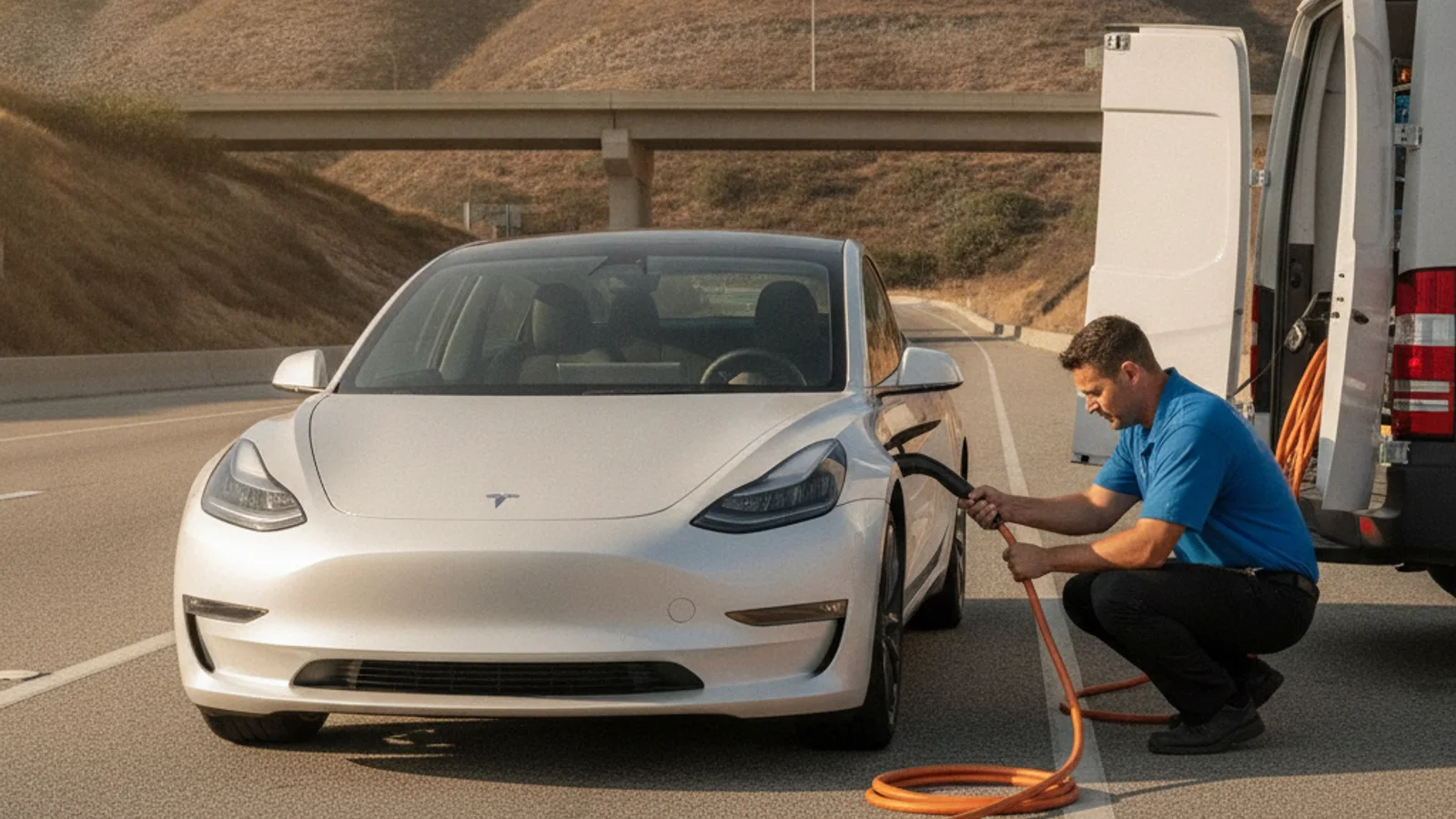
Escondido sits where I-15 and SR-78 meet, and that interchange sends traffic in four different directions at once. A stall here isn’t the same problem as a stall on a flat coastal street, and the right next step depends on what stopped working and exactly where the vehicle sits.
Start with a safe location on I-15 or SR-78
Escondido is inland north county, set in a valley below the hills that separate it from the coast. That geography means both freeways through town carry grade changes, and a car that loses power on an upslope often can’t coast to the widest part of the shoulder. Get as far right as the road allows before doing anything else.
I-15 runs north and south through the middle of Escondido, with SR-78 crossing it and continuing west toward San Marcos and Vista or east toward Ramona. If the vehicle can still move under its own power, even a short distance, use that to reach a paved shoulder past the interchange rather than stopping inside it. The merge points near the I-15/SR-78 junction carry more lane changes than a typical stretch of freeway, and a stopped vehicle there is harder for other drivers to see coming.
If the car can’t move at all, turn on hazard lights and stay inside with a seatbelt on if you’re anywhere close to a traffic lane. Don’t get out to inspect the charge port on an active shoulder. That can wait until everyone in the vehicle is somewhere safer.
If it’s an immediate hazard, a vehicle blocking a lane, smoke, a collision, or anything that puts people at risk, call 911 first and follow the responding officers’ instructions. Those take priority over anything in this post.
Tell an empty battery from a low-voltage failure
“My EV died” describes two different problems, and the vehicle usually gives clues. A depleted traction battery typically shows a specific low-charge or zero-range warning on the dashboard before the car stops responding to the accelerator. A low-voltage failure often looks different: the car may go dark, refuse to shift out of park, or leave the door handles, locks, or infotainment system unresponsive even though the display last showed a usable range.
Note exactly what you saw before the car stopped, and write down the wording of any warning message rather than paraphrasing it. Check whether the interior lights, locks, and mobile app still respond. A car that still unlocks and shows lights but won’t drive points toward one kind of problem. A completely dark cabin points toward another. Neither observation is a diagnosis on its own, but both are useful for whoever you reach next.
Don’t attempt to access the traction battery or attempt a jump procedure yourself. Vehicle designs vary enough that a step correct for one model can damage another. If you have the owner’s manual for your make, model, and model year, its low-voltage and towing sections are the only source that applies to your car. When the manual isn’t available, say that plainly rather than guessing.
Share exit, direction, and access details
Once you’re in a safer position, the location details you give matter as much as the symptom. “Somewhere on I-15 in Escondido” covers a wide stretch of road. “Northbound I-15 just past the SR-78 interchange, before the Valley Parkway exit” tells a matched operator which direction to approach from and roughly how far along the corridor you are.
Name the nearest exit and your direction of travel first. On I-15 through Escondido, that might be Valley Parkway, Felicita Road, or Centre City Parkway. On SR-78, name whether you’re closer to the I-15 junction or further out toward San Marcos to the west or Ramona to the east. If you can see a mile marker, an overpass name, or a business sign, include it.
Access conditions change what’s practical for anyone responding. A vehicle on an open shoulder is a different situation than one in a gated apartment complex, a parking structure with a height limit, or a residential cul-de-sac in the Escondido hills. Mention whether the location has a locked gate, a keypad, limited turnaround space, or restricted hours. If you’re not the only person present, say whether someone authorized to approve service is with the vehicle.
When mobile charging may fit
Mobile charging is worth raising with a matched operator when the symptoms point to a depleted traction battery rather than a low-voltage fault, and when the vehicle sits somewhere a service vehicle can safely reach and work. A paved shoulder past the interchange, a parking lot, or a driveway are the kinds of locations where on-site charging is more likely to make sense than a live traffic lane.
The independent operator you’re connected with decides whether mobile charging is the right fit after reviewing your vehicle’s make and model, the displayed symptoms, and the exact location. That review also covers connector compatibility. According to the DOE Alternative Fuels Data Center, Level 2 charging in the field uses the J1772 standard or J3400 (NACS) for Tesla vehicles, and DC fast charging uses CCS, CHAdeMO, or J3400. Which of those applies to your car depends on the vehicle itself.
There’s no fixed figure for how much charge a roadside session adds, since that depends on the equipment, the vehicle’s acceptance rate, and how depleted the battery is. The realistic goal on the road is often enough usable charge to reach a fixed charging location rather than a full battery. If you’re planning ahead of a longer trip through Escondido, our Escondido EV charging guide covers local charging options worth knowing before the gauge gets low.
Ask about mobile EV charging when you contact us, and share the vehicle and location details above so the matched operator can confirm whether it fits your situation.
When transport may fit instead
Transport becomes the more likely path when the vehicle shows a low-voltage fault rather than a depleted battery, when the charge port won’t accept a connection, or when the location genuinely isn’t safe or accessible for on-site charging equipment. A live traffic lane on the SR-78/I-15 interchange, a blocked charge port, or an unclear fault code are all reasons an operator may recommend moving the vehicle instead of charging it where it sits.
Our out-of-charge recovery service connects Escondido drivers with independent local operators who make that call after reviewing the actual vehicle and setting, not from a general description over the phone. If the cause of the stall hasn’t been confirmed, say so directly. “Unknown problem” is a more honest starting point than guessing at a cause that turns out to be wrong.
Don’t attempt to direct how the vehicle should be loaded, put into a tow mode, or have its parking brake released. Those steps vary by manufacturer, and using instructions written for a different model can cause damage. If you have the manual, hand its towing section to whoever arrives. If you don’t, say that clearly so the response accounts for it.
For a broader comparison of what happens along the wider I-15 corridor beyond Escondido, our post on getting stranded on I-15 covers the corridor between Escondido and the rest of the county. For general roadside help in Escondido beyond this specific charging decision, see our Escondido EV roadside assistance guide.
When to call us
Call when your EV has stopped near Escondido, whether that’s on I-15, SR-78, or a local street, and you’re not sure whether it needs a charge or a ride. Share the symptoms and the exact location described above so the matched operator can make that call. Call us at (858) 400-4465 and we’ll connect you with a local EV rescue operator.