How long it takes to charge a Ford F-150 Lightning depends heavily on which battery pack you have and where you’re plugging in. On a DC fast charger, Ford’s published specs put a 15 to 80 percent charge at around 41 minutes for the Extended Range battery under ideal conditions. Plug into a home Level 2 charger instead, and a full charge commonly takes 8 to 10 hours. That gap is wide enough to change how you plan a workday or a road trip, and the reason comes down to which of the truck’s two battery packs you’re driving.

A Ford F-150 Lightning connected to a DC fast charging station in San Diego

Why Ford F-150 Lightning charging time depends on the battery pack

The Lightning ships with two different battery options, and they don’t charge at the same rate. The Standard Range pack holds roughly 98 kWh total, with about 89.5 kWh usable. The Extended Range pack is bigger, at roughly 131 kWh total with about 120 kWh usable. A bigger pack takes longer to fill from empty, but it also tends to accept a faster peak charging rate at a DC fast charger, which is why the two packs don’t scale in charging time the way you might expect from their size difference alone.

That split matters because the question “how long does it take to charge a Ford Lightning” doesn’t have one answer. The honest answer is that it depends on your battery, your charger, and your starting point, and the rest of this guide breaks down each of those pieces so you can plan around your actual truck instead of a generic number.

Home charging: Level 1 vs Level 2

A standard household outlet, called Level 1 charging, technically works with the Lightning, but it’s not a realistic daily plan for a battery this size. Adding meaningful range overnight on a regular 120-volt outlet takes many hours, and a full charge from empty could take several days. Most owners treat Level 1 as an emergency backup, not a routine.

Level 2 home charging is what most San Diego County Lightning owners rely on. Ford’s own Charge Station Pro, which delivers up to 80 amps on a dedicated circuit, charges the Extended Range battery from empty to full in roughly 8 to 10 hours, and the Standard Range battery in roughly 6 to 8 hours. Drop down to a lower-amperage 48-amp home charger and those times stretch to somewhere around 12 to 14 hours for a full charge. Either way, plugging in overnight covers a full charge for nearly any daily driving pattern without any planning required.

If your home doesn’t have a 240-volt circuit installed yet, that’s a separate project from the truck itself, and one worth pricing out with a licensed electrician who can confirm your panel has the capacity before you commit to a specific charger.

DC fast charging: what the numbers actually mean

This is where Ford F-150 Lightning charging time gets fast enough to matter on a road trip. On a charger capable of feeding the truck its full rated power, Ford’s published specs list a 15 to 80 percent charge at around 41 minutes for the Extended Range battery, and around 44 minutes for the Standard Range battery, both under ideal conditions: a mild starting battery temperature and a charging station actually delivering its rated output.

In the real world, especially on an older or busier public charger, those numbers commonly run longer. Charging speed also isn’t constant across that 15 to 80 percent window. Like nearly every EV, the Lightning accepts power fastest in the middle of a charging session and slows down as the battery approaches full, which is why most fast-charging stops target 80 percent instead of 100. Topping off the last 20 percent can take nearly as long as the rest of the session combined, so planning a stop around 80 percent is the more time-efficient habit for a trip through San Diego County.

What actually slows a charge down

A few real-world factors explain why your session might not match the spec sheet. Battery temperature matters: a colder pack accepts power more slowly, though San Diego’s mild coastal climate means this is a smaller factor here than it would be somewhere with real winters. A charging station running below its rated output, which happens more often at busy public locations, caps your session below what the truck could otherwise accept. And starting a fast-charge session with a higher existing charge level means less total range added even though the percentage climbs quickly at first.

Towing or hauling a heavy load before you plug in can also leave the battery warmer or cooler than ideal depending on conditions, which shifts the charging curve slightly. None of these factors are unique to the Lightning, but a truck this size and this heavy makes the differences a little more noticeable than they’d be in a smaller EV.

When it’s not about charging time at all

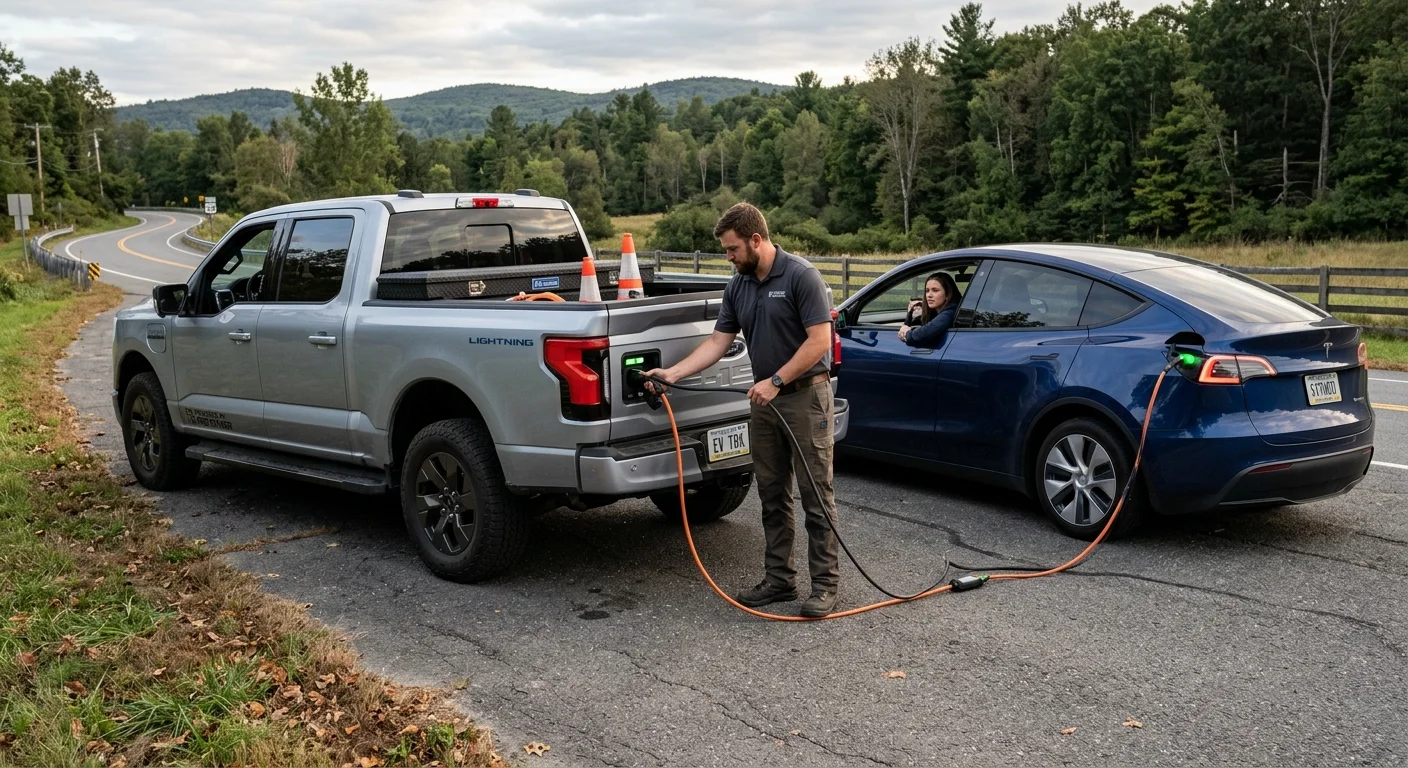
If your Lightning’s charging session isn’t progressing at all, rather than just taking longer than expected, that’s a different problem than the one this guide covers. A truck that won’t accept a charge or won’t start afterward is usually a 12V battery issue rather than a main battery problem; our guide to a Ford F-150 Lightning that won’t start walks through the more likely causes and how to find the jump terminals. If you’re weighing whether the Lightning itself can charge another stranded EV using Pro Power Onboard, we cover that separately in our guide to using an F-150 Lightning to charge another EV.

Stranded with a Lightning in San Diego

If you’re out of range rather than just planning a charge, Charge Pro SD is a referral service that connects stranded drivers with independent local operators through our non-Tesla EV rescue referral line, covering San Diego County from Carlsbad to Escondido and the inland valleys. We also connect drivers through our mobile EV charging referral line when a truck this size can’t make it to a station on its own. We don’t perform the charging ourselves. We connect you with a local operator who can assess the vehicle and bring a charge to its location.

Frequently asked questions

How long does it take to fully charge a Ford F-150 Lightning at home?

On a Level 2 home charger like Ford’s Charge Station Pro, a full charge typically takes roughly 6 to 8 hours for the Standard Range battery and roughly 8 to 10 hours for the Extended Range battery, depending on your starting charge level and your home charger’s output.

How fast does a Ford Lightning charge at a DC fast charger?

Ford’s published specs list a 15 to 80 percent charge at around 41 minutes for the Extended Range battery and around 44 minutes for the Standard Range battery, on a charger capable of matching the truck’s peak charging rate. Real-world times often run longer depending on the station’s actual output and the battery’s starting temperature.

Does the Extended Range battery charge faster than the Standard Range battery?

The Extended Range battery holds more energy, roughly 120 kWh usable versus about 89.5 kWh usable for Standard Range, but it also accepts a higher peak charging rate at a DC fast charger. The two packs end up close in fast-charging time despite the size difference, though home charging a full Extended Range battery still takes longer in total hours.

Can I charge my Ford Lightning from a regular wall outlet?

Yes, through Level 1 charging, but it’s slow enough that most owners only use it as a backup. A full charge from empty on a standard 120-volt outlet could take several days given the size of the Lightning’s battery.

Does cold weather slow down Ford Lightning charging?

Yes, a colder battery generally accepts power more slowly at a fast charger. San Diego’s mild coastal climate keeps this from being a major factor for most local drivers compared to colder regions.

What if my Lightning won’t charge at all?

That’s usually a different issue than charging speed, often a 12V battery problem or a charging system fault rather than the main battery itself. Call us at (858) 400-4465 and we’ll connect you with a local independent EV operator.