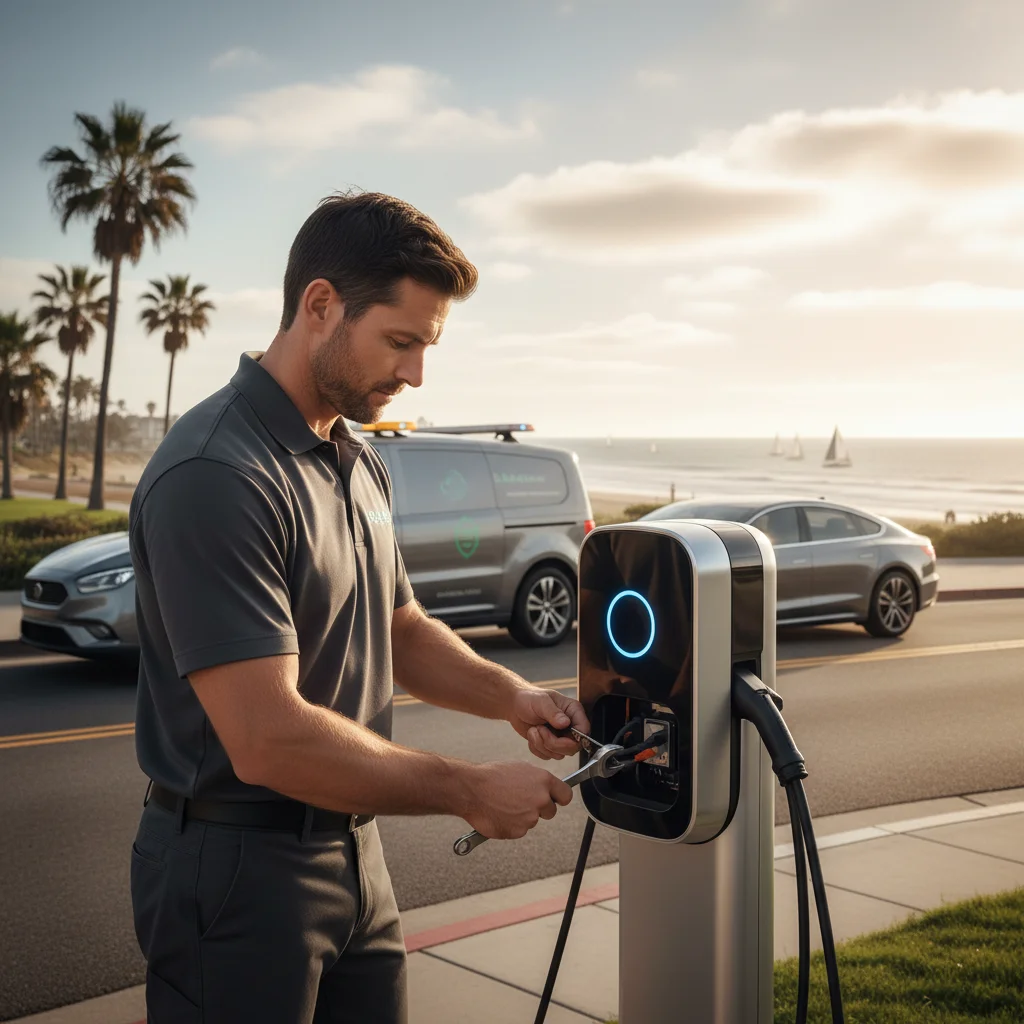
EV roadside assistance in Ramona and Valley Center means real response times of 35 to 60 minutes, because these two inland communities sit 25 to 40 miles from the nearest fast charger. If your battery dies on SR-67 north of Lakeside or on Valley Center Road between Rincon and the casino, a tow runs $200 to $400 before you’ve moved an inch toward a plug. Charge Pro SD drives to you in our Tesla Cybertruck, delivers 30 to 60 miles of range through a 240V / 9.6 kW bed outlet, and gets you moving without a hook.

A Tesla Model 3 stopped on the shoulder of SR-67 near Ramona in inland North County San Diego, mobile EV charging truck approaching

Why Ramona and Valley Center strand EV drivers more than most

Both towns sit in a charger desert. The nearest Tesla Supercharger is in Escondido on Auto Park Way, roughly 20 miles from downtown Ramona via SR-78, and closer to 25 miles from Valley Center’s town core. Level 2 options are sparse: a handful of ChargePoint units at the Ramona Municipal Airport and a couple of slower plugs at casino properties are the main public options. There is no DC fast charger within either community as of mid-2026.

The terrain compounds the problem. SR-67 climbs more than 1,500 feet from El Cajon to Ramona, and grades above 5% accelerate battery draw noticeably. Summer heat in the inland valleys adds to regen losses: battery management systems in most EVs reduce charging efficiency and boost cooling loads when ambient temps push past 95F, which is routine in Ramona July through September. Drivers who left home with 80 miles of range and assumed that was plenty can easily find themselves with 15 miles showing on a road with no shoulder, no nearby charger, and spotty cell coverage on the canyon stretches of SR-67 below Mussey Grade Road.

Valley Center sits at a similar disadvantage. Valley Center Road runs about 12 miles from the 78 junction to the town center, with elevation change throughout. There is no Supercharger or public DC fast charger on the route. Residents making a run to Escondido or San Marcos and returning uphill can arrive home with considerably less range than they planned.

The charger map and what it means for range planning

LocationNearest public DC fast chargerMiles from RamonaMiles from Valley Center town center
Escondido (Auto Park Way Supercharger, 16 stalls)Tesla Supercharger~20 via SR-78~18 via Valley Center Rd
San Marcos (Palomar College area)EVgo / ChargePoint~24 via SR-78~22
Lakeside (Walmart area)Electrify America~22 via SR-67~35
Ramona AirportChargePoint Level 2 (not DC)0~12
Valley Center Casino areaLevel 2 only~150

For non-Tesla EVs without NACS adapters, the Escondido Supercharger is not usable without an adapter. The practical gap widens further. Charge Pro SD carries both NACS and CCS connections and can serve any EV on the market.

SR-67, SR-78, and the routes where batteries go to zero

SR-67 is the primary artery connecting Ramona to the greater San Diego metro. The descent from Ramona into Santee and El Cajon recovers some regen, but the climb back up is where the math turns against you. Drivers heading home from work in El Cajon or Santee who didn’t top off before the ascent often run into trouble between Mussey Grade Road and the Main Street off-ramp in Ramona, a stretch with no shoulder on much of its length and limited cell service through the canyon.

SR-78 connects Ramona westward toward Escondido and San Marcos. The western half is flat enough, but the segment east of Escondido includes rolling terrain that catches drivers off guard. Heading east from Escondido with 30 miles of range and 25 miles to go sounds fine until the hills trim that buffer.

Valley Center Road has fewer safety issues but similar range dynamics. The road is largely two-lane with limited pullouts. If you run out near the Rincon Band reservation or on the rural stretch between Lilac and Cole Grade Road, you’re waiting in a low-traffic area with spotty Verizon and AT&T coverage.

Our out-of-charge EV recovery service is built for exactly this scenario: we confirm your GPS pin, stage from North County, and typically reach you in 35 to 55 minutes. Read more about what to do when your EV is running low before you’re fully stranded.

Summer heat and what it does to inland EV range

Coastal San Diego averages 70F in August. Ramona averages 93F. Valley Center runs similarly hot from June through October. That inland temperature difference matters for EV range in two ways.

First, the battery cooling system runs constantly at high ambient temps, drawing power that would otherwise go to the drivetrain. In a Tesla Model 3 Long Range, Consumer Reports testing suggests roughly 10 to 17 percent range reduction above 95F compared to 70F. In a Hyundai Ioniq 5 or Kia EV6 with their larger thermal management loads, the reduction can be similar.

Second, air conditioning load is heavier in 95F heat than at the coast. Running A/C at full blast on a 10-mile climb up SR-67 uses meaningfully more energy than the navigation estimate calculated at 70F.

Practical advice for Ramona and Valley Center drivers: charge to 90 to 100 percent before any trip that involves the SR-67 descent and return climb. Add a 15-mile buffer on top of what navigation says you’ll need during June through September. If your battery falls below 20 percent and the nearest charger is more than 15 miles away, call for help before you’re completely stopped. A mobile EV charging call from 15 percent costs the same as one from zero, but you’ll have safer options for where to pull over.

For more on how the I-15 corridor further inland handles EV rescue, see EV roadside assistance on the I-15 corridor. For the broader North County picture, the mobile EV charging North County guide covers the full zone.

Frequently asked questions

Does Charge Pro SD serve Ramona and Valley Center?

Yes. We cover both communities as part of our San Diego County service area. Ramona and Valley Center are among our longer dispatches from North County staging, so expect 35 to 55 minutes for most calls. We recommend calling as soon as your battery falls below 20 percent on a rural road rather than waiting until you’re stopped. Visit our Ramona city page for local details.

How far is the nearest EV charger from downtown Ramona?

The closest public DC fast charger is the Tesla Supercharger on Auto Park Way in Escondido, roughly 20 miles west via SR-78. There are no DC fast chargers within Ramona or Valley Center as of mid-2026. Level 2 chargers at the Ramona Airport and casino properties in Valley Center are available but add hours to a charge session, which is not practical if you’re stranded.

What does mobile EV rescue cost compared to a tow in Ramona?

A tow from Ramona to the Escondido Supercharger typically runs $180 to $380 depending on time of day and tow company, and you still need to charge at the destination. Charge Pro SD’s mobile rescue delivers 30 to 60 miles of range on site. For current pricing details, see our mobile EV charging cost guide. In most scenarios, mobile rescue is faster and costs less than a tow plus the subsequent charging stop.

Can you charge non-Tesla EVs in Valley Center?

Yes. Our Cybertruck carries both NACS and CCS adapters, so we can deliver emergency charge to any EV currently sold in the United States, including Hyundai Ioniq 5 and 6, Kia EV6, Ford Mustang Mach-E, Rivian R1S and R1T, Chevrolet Equinox EV, and others. See non-Tesla EV rescue in North County for more detail on what we carry.

What should I do if I lose cell service on SR-67 before calling?

Get off the highway at the safest available pullout and try calling from there. Signal on SR-67 improves at higher elevation toward the Ramona plateau compared to the canyon stretches near Mussey Grade. If you can’t get through on the first attempt, move forward slowly if you have residual power and try again from the next pull-off. Turn off A/C and set speed to 25 mph to extend your range while searching for signal. Our emergency EV roadside assistance team can work with partial GPS coordinates if the signal drops mid-call.


Running out of charge in Ramona or Valley Center doesn’t have to mean a long wait and a costly tow. Call Charge Pro SD at (858) 400-4465 and we’ll bring the charge to you.