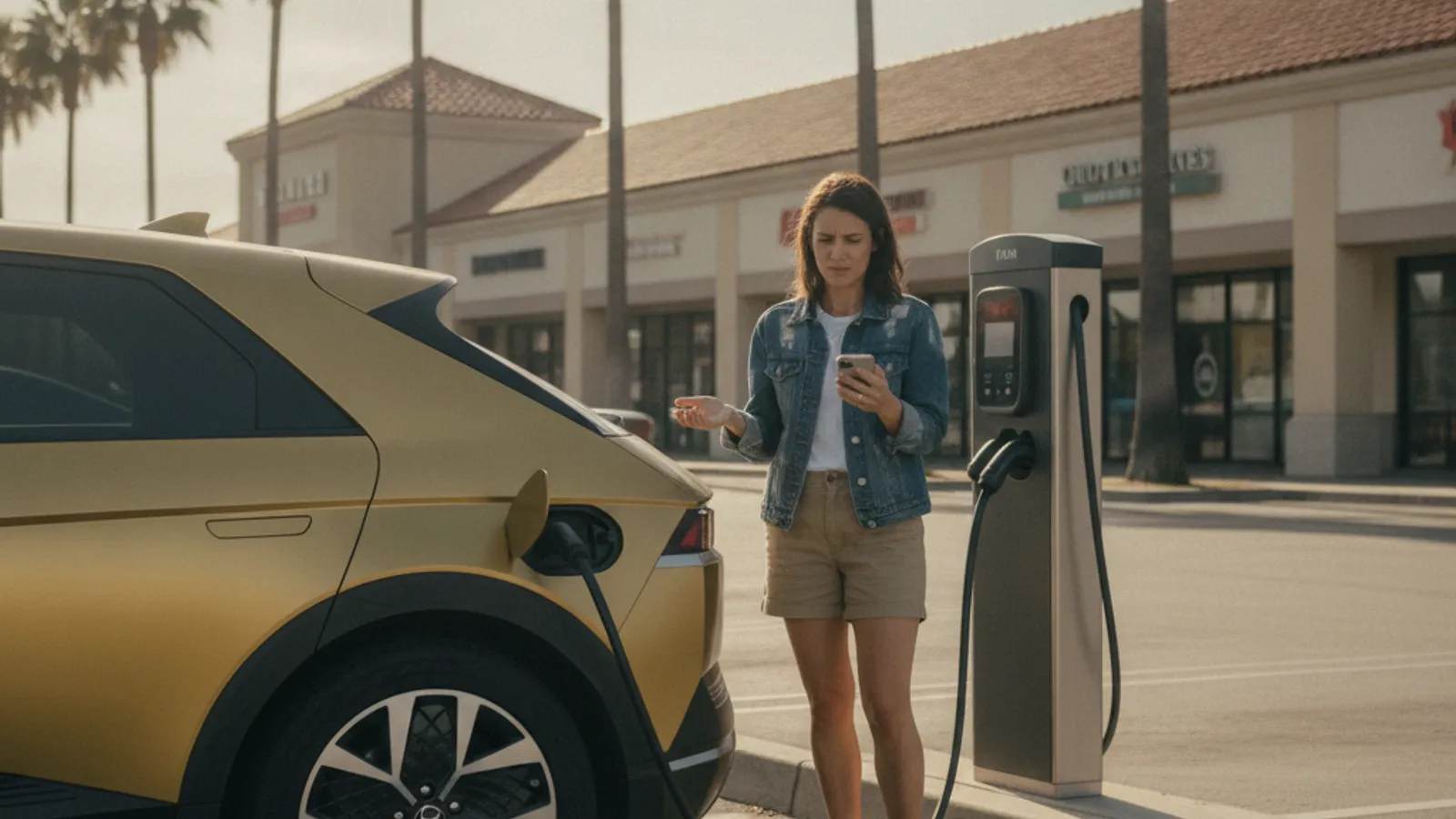
A breaker that trips every time you plug in your EV almost always means the circuit is undersized, sharing load with something else, or has a genuine ground fault, not a random glitch. A breaker that flips once in a while can be a coincidence. One that trips every session, or trips within a few minutes of starting, is telling you something specific about the circuit. Here’s how to read the pattern, what’s safe to check yourself, and where the line is between a DIY fix and a call to a licensed electrician.
Read this first: Charge Pro SD doesn’t do electrical work
We’re a mobile rescue and mobile charging service, not an electrical contractor. We don’t wire panels, pull permits, or install circuits. If your home charging circuit has a real electrical fault, that job belongs to a licensed electrician, and this guide will help you describe the problem to one clearly. What we can do is get your car charged right now with a mobile visit while the circuit gets sorted out on its own timeline.
The four real causes, in order of how often we see them
1. The circuit is undersized or shared
Level 2 home charging pulls a steady, heavy load for hours at a time, unlike most household appliances that cycle on and off. If the circuit is shared with anything else, a shop dryer outlet, a sub-panel feeding a garage full of tools, it can trip under the combined draw even though the charger alone would be fine. A dedicated circuit sized correctly for the charger’s amperage is the standard fix, and that’s electrician work.
2. GFCI nuisance tripping
Most Level 2 EVSE units already have built-in ground fault protection. If your outlet is also on a GFCI-protected circuit, which code requires for a NEMA 14-50 receptacle used for EV charging, you can end up with two ground fault systems watching the same circuit. EVSEs push a small test current to ground to verify a proper earth connection, and that tiny current can be enough to trip an external GFCI even though nothing is actually wrong. This is a known, documented issue, not something you’re imagining, and it’s a common reason electricians end up hardwiring a charging station instead of using a plug-in GFCI receptacle.
3. Moisture in the outlet or connector
San Diego’s coastal air and irrigation overspray both get into outdoor outlets more than people expect. Moisture inside a NEMA 14-50 receptacle or at the charging cable’s plug end can trip a GFCI as a genuine safety response, not a false alarm. If the outlet is outside, uncovered, or near a sprinkler zone, this is worth ruling out before assuming the circuit itself is undersized.
4. A faulty EVSE or charging cable
Less common, but it happens. The charger unit itself, or the portable cable that came with your car, can develop an internal fault that trips the breaker every time it’s asked to deliver full power. If a different charger or a different outlet doesn’t trip the same breaker, the charging equipment is the likely culprit, not your home’s wiring.
Quick reference: what the pattern tells you
| Pattern | Likely cause | Whose job is it |
|---|---|---|
| Trips immediately at plug-in, every time | Ground fault, moisture, or a faulty EVSE | Electrician, or try a different EVSE first |
| Trips after 10-30 minutes of charging | Undersized or overloaded circuit | Electrician |
| Trips only when something else is running on the same circuit | Shared circuit, combined load too high | Electrician |
| Trips only outdoors or after rain or sprinklers | Moisture in the outlet or connector | Dry it out, then electrician if it recurs |
| Trips with your car’s cable but not with a different EVSE | Faulty charging equipment | Charger manufacturer or replacement |
What’s safe to check yourself
Reset the breaker once and see if the pattern repeats. Check whether the outlet or connector is wet or corroded and let it dry before trying again. Note whether anything else was running on the same circuit when it tripped. Don’t keep resetting the same breaker hoping it holds, and don’t open the panel to investigate wiring yourself. A breaker that keeps tripping is protecting you from a real fault, and repeated resets can mask a problem that gets worse.
What to do while the circuit gets fixed
An electrical fix can mean scheduling an electrician, sometimes a panel upgrade if you’re on an older 60-amp or borderline 100-amp panel, and that’s not a same-day job. If you need the car charged in the meantime, that’s where mobile charging fits. Our mobile EV charging service brings a Cybertruck rescue truck to your home and delivers real range without touching your home’s electrical system. If the car ends up too low to wait on a permanent fix, our guide on running low on battery covers how to manage what’s left safely.
Frequently asked questions
Is it dangerous to keep resetting a breaker that trips on my EV charger?
Repeatedly resetting a tripping breaker isn’t safe practice. The breaker is tripping to protect the circuit from a real condition, whether that’s overload, moisture, or a ground fault. If it trips more than once or twice, stop resetting it and have an electrician look at the circuit.
Can a bad EV charging cable cause a breaker to trip?
Yes. If the cable or EVSE itself has an internal fault, it can trip the breaker every time it tries to deliver power, even on a correctly sized and wired circuit. Testing with a different charger or a different outlet helps narrow down whether it’s the equipment or the wiring.
Does Charge Pro SD install or repair home EV chargers?
No. We’re a mobile rescue and mobile charging service. We don’t wire circuits, install chargers, or pull permits. For a wiring or breaker problem, you’ll need a licensed electrician. We can get your car charged in the meantime with a mobile visit.
Why does my GFCI trip only with the EV charger and nothing else?
Level 2 EVSEs run a small ground-verification current that some external GFCI breakers read as a fault, even when the circuit is otherwise fine. This is a known interaction between two ground fault systems on the same circuit, and it’s often resolved by hardwiring the unit instead of using a GFCI-protected outlet.
How much does it cost to fix a circuit that keeps tripping?
It depends on the cause. A straightforward dedicated circuit fix can run a few hundred dollars, while a panel upgrade for an older 60-amp or borderline 100-amp panel can run well into four figures. An electrician can give you a real number once they’ve seen the panel and the run to the outlet.
Call Charge Pro SD at (858) 400-4465 and we’ll be on our way.